A disposable vape that lights up but no smoke comes out is one of the most frustrating failure modes in cannabis oil devices. The LED indicator confirms that at least part of the battery and activation circuit is responding, yet the atomizer fails to generate visible vapor.
For users, this often feels like the disposable vape is not hitting even though the light is on. For cannabis brands and oil processors, however, the symptom can point to a specific set of problems involving oil viscosity, airflow, ceramic coil performance, battery output, or hardware-oil compatibility.
In many cases, these problems can be diagnosed-and sometimes prevented-during the hardware-matching and product-development stage.

How a Disposable Vape Pen Works
A disposable vape pen is a self-contained, single-use vaporizing device that integrates a battery, an atomizer, and a pre-filled oil reservoir into one sealed unit. Unlike a 510-thread cartridge paired with a separate battery, a disposable has no user-serviceable connections. Everything is factory-assembled and intended to operate until the oil is depleted or the battery reaches its cycle limit.
The core workflow has three links in a chain.
First, the battery delivers current when activated. Second, the atomizer-the heating element, typically a ceramic coil-converts that electrical energy into heat. Third, cannabis oil wicks into the heating zone and vaporizes into inhalable aerosol.
Strictly speaking, what a vape produces is an aerosol rather than smoke. Break any one of these links and you can get the signature symptom: the vape lights up but no vapor comes out.
The activation mechanism matters here. Most cannabis disposables use auto-draw activation, meaning an airflow sensor inside the body detects the negative pressure created during inhalation and closes the circuit automatically.
Button-activated pens also exist, but auto-draw activation is widely used in the disposable format. When the sensor fires, the LED lights up. If the atomizer does not respond correctly, the user may see the light without getting vapor.
For a more detailed comparison of the two activation methods, see our guide to button vs inhale activation in cannabis vape hardware.
Understanding this three-link chain is the foundation for every diagnosis that follows.
Why a Disposable Vape Lights Up but Produces No Vapor
When the LED illuminates but no aerosol is produced, the failure usually sits somewhere between the battery's electrical output and the oil's physical arrival at the heating surface.
The causes generally fall into four categories.
|
Failure Category |
What the LED Tells You |
Likely Root Cause |
Typical Fix |
|
Oil delivery failure |
Solid light, no vapor |
Oil too viscous; clogged airway; wick not saturated |
Warm the device; use preheat if available |
|
Atomizer coil failure |
Solid or blinking light |
Coil open circuit; ceramic core cracked; dry-burn damage |
Device may be end-of-life |
|
Battery contact issue |
Intermittent or dim light |
Electrode contact gap; oxidation on contacts |
Check device condition; internal repair is generally impractical |
|
Sensor / protection trigger |
Blinking pattern |
Short circuit, timeout, or low-voltage protection |
Wait, reset, or recharge if supported |
In cannabis disposables, oil-related problems are often among the first things to investigate when a disposable vape is not producing vapor, followed by atomizer degradation and electrical connection issues.
If the device still produces some vapor but performance has dropped significantly, our guide to why cannabis vape hardware produces weak vapor explains the most common hardware-side causes in more detail.
Blinking LEDs can also indicate a protection circuit rather than a completely dead device.
How Oil Viscosity Causes Wicking Failure
This is where cannabis hardware differs significantly from conventional nicotine vaping.
Cannabis oils-including distillate, live resin, live rosin, CBD formulations, and other cannabis concentrates and THC extracts-can be considerably more viscous than standard nicotine e-liquid.
A high-potency THC distillate may move very slowly at room temperature, while some live resin or live rosin formulations may behave differently depending on terpene content, formulation, storage temperature, and other characteristics.
Viscosity refers to a fluid's resistance to flow. The physical concept of viscosity and fluid properties helps explain why thicker oils move more slowly through narrow oil-delivery channels.
The higher the viscosity, the more slowly the oil migrates through the atomizer's wicking channels.
In a ceramic coil atomizer, oil travels through the porous ceramic structure via capillary action. The ceramic's micro-pores draw liquid toward the heating surface.
This process works effectively when the ceramic structure and cannabis oil are properly matched. It becomes less reliable when the cannabis oil is too thick for the vape hardware and cannot penetrate the ceramic fast enough to keep pace with vaporization.
When oil cannot wick fast enough, the ceramic coil may heat without receiving enough fresh oil.
In mild cases, the result is weak or wispy vapor.
In more severe cases, the ceramic coil produces little or no vapor, and repeated activation without sufficient oil supply can contribute to dry-burn damage.
Temperature is one of the most important variables.
Cannabis oil viscosity can decrease as temperature rises. A disposable left in a cold car overnight or stored in a cool environment may temporarily experience poor oil flow.
Gently warming the device between your palms may help restore oil mobility. This is also why some cannabis disposables include a preheat function-a lower-power heating cycle designed to warm viscous oil before the user takes a draw.
For applications involving especially thick formulations, brands may also want to evaluate a disposable vape designed for thick cannabis oil.
The hardware-oil match is therefore not a minor detail. It is one of the most important variables affecting whether a disposable performs consistently from the first puff to the last.
Matching Cannabis Oil Type to Vape Hardware
Different cannabis extract formats can have different viscosity and vaporization characteristics, which may require different ceramic structures, wicking designs, airflow configurations, voltage settings, and power-delivery profiles.
|
Oil Type |
Typical Viscosity Profile |
Hardware Considerations |
|
Distillate |
High viscosity; thins with heat |
Standard ceramic configurations may work depending on formulation |
|
Live Resin |
Variable; terpene-rich formulations can behave differently |
Oil-compatible ceramic structure and preheat may improve performance |
|
Live Rosin |
Often highly viscous; formulation characteristics vary |
Wider oil delivery paths and properly matched ceramic hardware may be beneficial |
|
CBD Formulation |
Medium to high; formulation-dependent |
Coil and hardware selection depend on the exact formulation |
An oil that performs well in one cannabis disposable may clog, wick slowly, or produce weak vapor in another.
The difference is not necessarily that one oil is inherently unsuitable. In many cases, the problem is the cannabis oil vape hardware compatibility.
For example, live resin and live rosin often require more deliberate oil-hardware matching than standard distillate formulations. Brands developing extract-specific products can compare hardware designed for live resin or hardware designed for live rosin when evaluating their options.
Brands that select hardware independently from their oil formulation are more likely to encounter problems such as weak vapor, slow wicking, clogging, burnt taste, or inconsistent performance.
For this reason, the oil formulation and vape hardware should be evaluated as one system rather than as two separate purchasing decisions.
How Airway Clogging Stops Vapor From Reaching the User
Even when oil reaches the coil and vaporizes correctly, the aerosol still has to travel through the device's airway before reaching the user's mouth.
In cannabis disposables, this airway is relatively narrow.
Over time, vapor can condense on the inner walls of the airway. Each puff may leave a small amount of residue, and repeated use can gradually narrow the airflow path.
Eventually, airflow can become significantly restricted.
In that situation, the ceramic coil may still fire and the LED may still illuminate, but the user feels little airflow and sees very little vapor because the vapor pathway is partially or completely blocked.
This can be especially noticeable with sticky or terpene-rich cannabis formulations.
Another related failure mode is oil migration.
During storage, oil can slowly move through the internal airway, particularly depending on storage position, temperature, hardware geometry, and oil viscosity.
If oil accumulates near the mouthpiece, the first few draws may produce very little vapor until the airflow path begins to clear.
For end users, gently warming the device and taking slow priming draws may help with a mild clog.
For cannabis brands, however, the larger lesson is that airflow design, condensation management, intake geometry, and oil characteristics all need to be considered during hardware selection and testing.
Our article on poor airflow in cannabis vape hardware provides a deeper look at how airflow geometry can influence draw resistance, vapor output, and clogging risk.
If the same clogging problem repeatedly appears across a large number of finished products, the issue should be investigated at the oil-hardware and device-design level rather than treated only as an end-user problem.
How Battery and Contact Problems Cause a Vape to Light Up but Not Hit
A lit LED tells you that the battery has at least some charge and that the activation circuit has responded.
It does not necessarily guarantee that sufficient power is reaching the ceramic coil.
Between the battery and atomizer are electrical contacts and electrodes that complete the heating circuit.
In a disposable, the battery and atomizer are permanently assembled at the factory. There is no user threading or unthreading, but manufacturing tolerances still matter.
If an electrode connection is marginal, the sensor may activate and the LED may illuminate while insufficient current reaches the heating element.
The result is a vape battery that appears to work but the coil does not heat properly.
Contact contamination or oxidation can also increase electrical resistance.
If the coil receives insufficient power, it may fail to reach an effective vaporization temperature, producing weak vapor or no vapor even though the LED is illuminated.
Because a disposable device is sealed, there is generally little an end user should do internally.
For manufacturers and brands, this is primarily a production and quality-control issue. Consistent assembly tolerances, electrical testing, component quality, and clean manufacturing conditions help reduce these failures before products reach consumers.
Users should also avoid puncturing, opening, crushing, or overheating sealed devices containing lithium batteries. The FDA provides additional vape battery safety guidance.
How Battery Voltage and Protection Circuits Affect Vapor Production
Cannabis vape hardware is commonly designed to operate at relatively controlled voltage levels, although the correct voltage depends on coil resistance, ceramic structure, heating area, airflow, and oil formulation.
Thicker oils may require a different heating profile to achieve efficient vaporization, while excessive voltage can overheat oil, accelerate residue formation, affect flavor, or reduce coil life.
Modern disposable batteries also include protection circuits that interrupt power under abnormal conditions.
Common protection behaviors include:
- Low-voltage protection: The battery charge has fallen below its working threshold. The device may blink several times. Recharge the device if it is designed to be rechargeable.
- Short-circuit protection: The system detects abnormal atomizer resistance and interrupts current to protect the battery and circuit.
- Timeout protection: A draw exceeds the device's maximum activation time, so the circuit temporarily cuts power to prevent overheating.
A blinking LED is therefore useful diagnostic information.
However, blink patterns are not universal. The exact meaning of three, eight, ten, or another number of flashes depends on the specific device and its control board.
For a cannabis brand, the protection logic should be documented and tested as part of the overall product specification.
Because voltage and resistance work together, brands evaluating power settings should also understand how resistance affects cannabis vape hardware.
For product programs that require multiple heating profiles, an adjustable voltage AIO disposable vape can provide more flexibility during formulation and performance matching.
How Ceramic Coil Failure Causes No Vapor
The atomizer coil is the component that actually performs vaporization.
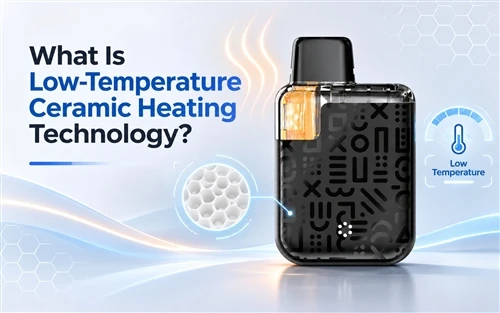
In cannabis disposables, ceramic atomization is widely used because the ceramic structure can support oil delivery and distribute heat across the vaporization surface.
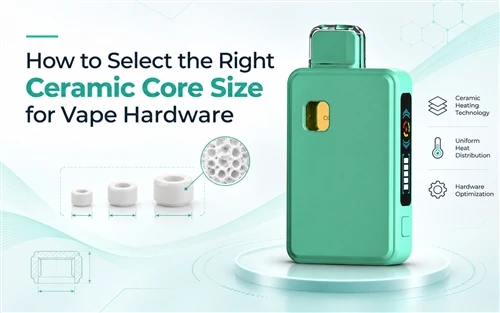
The ceramic substrate serves two primary functions.
First, it allows cannabis oil to move through its porous structure toward the heating zone.
Second, it helps distribute heat around the atomization surface.
A heating element is integrated with the ceramic structure. When electrical current flows through the heating element, the ceramic transfers heat to the oil and vaporization occurs.
Ceramic atomizers can handle many cannabis oil formulations effectively, but they are not indestructible.
Common failure modes include:
- Dry-burn damage: The heating element is activated without adequate oil saturation. Excessive heating can damage the heating structure and eventually create an open circuit.
- Ceramic cracking: Physical impact or thermal stress can damage the ceramic substrate and potentially interrupt the heating path.
- Residue buildup: Thermally degraded oil residue can gradually accumulate on the heating surface, reducing heat-transfer efficiency and vapor production.
The first two are generally permanent failures.
The third tends to develop gradually. Vapor production may decline over time until the atomizer can no longer efficiently vaporize oil.
Because a disposable vape is sealed, cleaning a heavily degraded ceramic coil is usually impractical.
In a manufacturing or quality-control environment, atomizer resistance can be measured to determine whether the coil is open, shorted, or still within its intended specification.
An open or shorted coil generally indicates an electrical failure. If resistance remains within specification but the device produces no vapor, attention should return to oil delivery, airflow, power delivery, or other system-level factors.
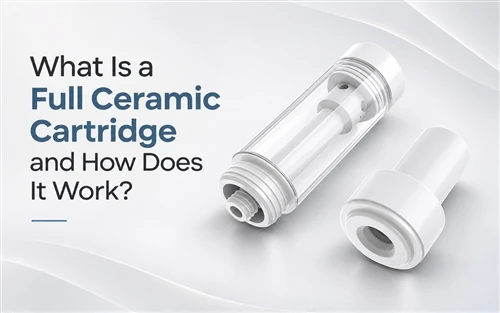
Brands evaluating alternative ceramic structures can also review a full ceramic disposable vape as one possible hardware configuration.
How to Troubleshoot a Disposable Vape That Lights Up but Does Not Hit
For brands developing customer-support resources-or for a user holding a disposable vape that lights up but is not hitting-the fastest approach is to check reversible problems before assuming that the atomizer has permanently failed.
|
Step |
Check |
What to Do |
|
1 |
Device temperature |
Warm the device gently between your palms to improve cold oil flow |
|
2 |
Preheat function |
If equipped, run the manufacturer's recommended preheat cycle |
|
3 |
LED blink pattern |
Check whether the device is indicating low voltage, timeout, or another protection condition |
|
4 |
Airflow |
Determine whether the draw feels unusually restricted |
|
5 |
Priming draw |
Take slow, gentle draws rather than excessively hard inhalations |
|
6 |
Battery charge |
Recharge the device if it is rechargeable and the battery may be low |
|
7 |
Airway condition |
Look for visible oil accumulation or blockage near the mouthpiece |
Avoid opening, puncturing, disassembling, or aggressively heating a sealed lithium-battery disposable.
If normal troubleshooting does not restore vapor, the device may have suffered a permanent atomizer failure, internal disconnection, or another hardware defect.
For a broader troubleshooting checklist covering additional disposable-vape faults, see how to fix a disposable weed vape pen.
The important point is that a vape that lights up but produces no vapor is not necessarily experiencing a battery failure.
The LED confirms activation, but effective vaporization still depends on oil delivery, airflow, heating performance, electrical output, and the compatibility between the oil and the hardware.
How Cannabis Brands Can Prevent Weak or No Vapor Problems
The most effective way to address repeated disposable vape not hitting complaints is to prevent the underlying failure before the finished device reaches consumers.
For cannabis brands and oil processors, that means focusing on hardware selection, oil-hardware matching, engineering validation, and quality control.
Test the Actual Oil and Hardware Together
Test the exact oil formulation that will be used in production with the exact ceramic coil, airflow structure, intake design, voltage, resistance, and tank configuration being considered.
Oil viscosity, terpene profile, formulation, and storage temperature can all affect performance.
Testing only a generic reference oil may not accurately predict how the finished product will behave.
Temperature testing is also important because a hardware-oil combination that performs well at room temperature may behave differently during cold-weather storage or transportation.
Consider Preheat for High-Viscosity Cannabis Oils
Live resin, live rosin, high-viscosity distillate, and other thick cannabis oil formulations may benefit from a properly designed preheat function.
The goal is not simply to increase heat.
It is to temporarily improve oil mobility so that the ceramic heating zone can become adequately supplied before vaporization begins.
Match Voltage and Resistance to the Oil
Voltage should not be selected independently from resistance, ceramic coil structure, heating area, airflow, and oil formulation.
Insufficient power may contribute to weak vapor.
Excessive power can overheat oil, accelerate residue buildup, affect flavor, and shorten atomizer life.
The correct configuration should therefore be established through oil-specific testing rather than by using the highest available voltage.
Validate Airflow and Oil Delivery
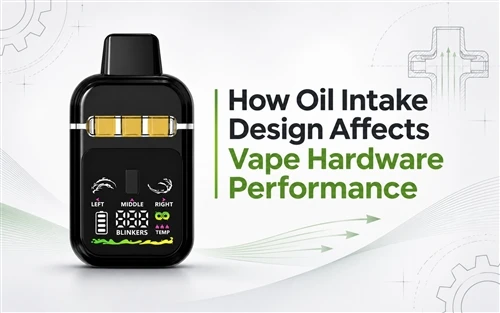
High-viscosity and terpene-rich formulations can place different demands on intake channels, ceramic porosity, airflow, and condensation-management structures.
If the oil delivery path is too restrictive, the coil may not remain adequately supplied.
If the airway design is poorly matched to the oil and vapor characteristics, condensation and clogging can become more noticeable.
Test Atomizer Resistance and Finished Device Performance
Resistance testing can identify out-of-spec atomizers before assembly or shipment.
Finished devices should also be evaluated for activation consistency, airflow, vapor production, oil leakage, clogging, battery performance, and other relevant reliability factors.
The same principle applies across all of these checks:
Cannabis oil and vape hardware function as one system.
Selecting them independently and hoping that they perform well together increases the risk of weak vapor, clogging, burnt taste, inconsistent output, and other field failures.
Testing them as a matched system provides a much stronger foundation for consistent product performance.
For brands sourcing or developing cannabis vape hardware, oil compatibility should therefore be treated as a primary engineering requirement rather than a secondary purchasing consideration.
FAQ
Why does my disposable vape light up but no smoke comes out?
If a disposable vape lights up but no smoke comes out, the activation circuit is responding, but effective vaporization is not occurring. Common causes include cannabis oil that is too viscous to reach the ceramic coil efficiently, a clogged airflow path, insufficient battery output, a damaged atomizer, or an internal electrical connection problem.
In cannabis devices, the visible output is technically vapor or aerosol rather than smoke.
Why is my disposable vape not hitting even though it has oil?
Having oil in the tank does not guarantee that the oil is reaching the heating surface.
Thick THC oil can remain on the tank wall, flow slowly in cold conditions, or fail to wick through the ceramic structure fast enough. Airway blockage and coil failure can create the same symptom.
If brands repeatedly encounter this problem, the oil viscosity, ceramic coil, intake structure, voltage, resistance, and airflow should be evaluated together.
Can thick THC oil cause a disposable vape to stop producing vapor?
Yes. High-viscosity THC oil can move too slowly through the oil delivery and ceramic wicking structure.
Cold temperatures can make this problem more noticeable.
A properly matched ceramic core, intake design, heating profile, and-in some applications-preheat function can help improve vaporization performance with thicker cannabis formulations.
Why does my THC vape light up but not hit after sitting for a long time?
After extended storage, cannabis oil may become less mobile, migrate within the tank, or contribute to airway blockage depending on the formulation, temperature, storage orientation, and hardware design.
Gently warming the device and following the manufacturer's recommended activation or preheat procedure may help with temporary oil-flow issues.
If the device continues to light up without producing vapor, the atomizer or internal electrical connection may have failed.
How can cannabis brands reduce disposable vape no-vapor complaints?
The most effective approach is to test the actual oil and vape hardware as a complete system before mass production.
Brands should evaluate oil viscosity, ceramic coil design, intake structure, airflow, voltage, resistance, activation method, temperature performance, and finished-device reliability.
Oil-specific hardware matching can help reduce weak vapor, clogging, burnt taste, inconsistent output, and unnecessary product returns.
Final Thoughts
When a disposable vape lights up but no smoke comes out, the LED only confirms that the device has detected activation-it does not confirm that oil is reaching the ceramic coil or that the heating system is working correctly.
In most cases, the root cause can be traced to oil delivery, airflow, atomizer performance, electrical power delivery, or a mismatch between the cannabis oil and vape hardware.
For cannabis brands, repeated disposable vape not hitting complaints are therefore best addressed upstream through oil-specific hardware selection, engineering validation, and quality control rather than only through consumer troubleshooting.
ASM VAPE is a B2B cannabis vape hardware manufacturer and OEM/ODM supplier focused on oil-matched hardware, ceramic atomization, customized product development, testing, and scalable production for THC/CBD brands. If your project is dealing with weak vapor, clogging, oil-hardware compatibility, or disposable performance issues, contact ASM VAPE to discuss your oil formulation and hardware requirements.
- Chinese technical reference on electronic cigarette cartridge structures
- Technical article on precision dicing technology for ceramic atomizer cores
- Technical teardown reference covering ceramic coils, cotton coils, and leak-prevention structures
- Chinese technical reference on atomizer coil operating principles
- Technical comparison of resistance heating, piezoelectric atomization, and ceramic atomization technologies
- Patent-analysis reference concerning ceramic atomizer technology in a U.S. Section 337 investigation