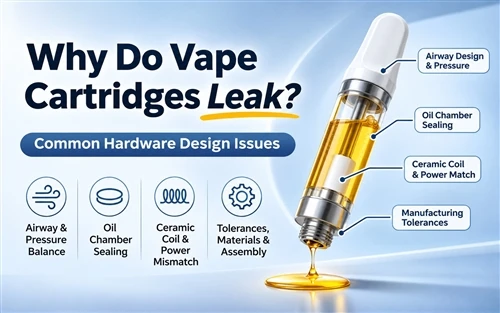
Ceramic cores have become the default atomizer solution for cannabis vape hardware, and for good reason-they deliver consistent flavor, resist high temperatures, and avoid the burnt-taste failures that plague cotton wicks. But selecting the right ceramic core size is where most brands and oil processors get it wrong. A core that's too small starves thick distillate of oil flow; one that's too large floods thin CO2 extracts and produces weak, airy vapor. The size of the ceramic heating element-its diameter, height, pore structure, and resistance-must match the oil viscosity, cartridge capacity, and target wattage of your specific product. This guide breaks down the key variables so you can make that match on purpose instead of by trial and error.
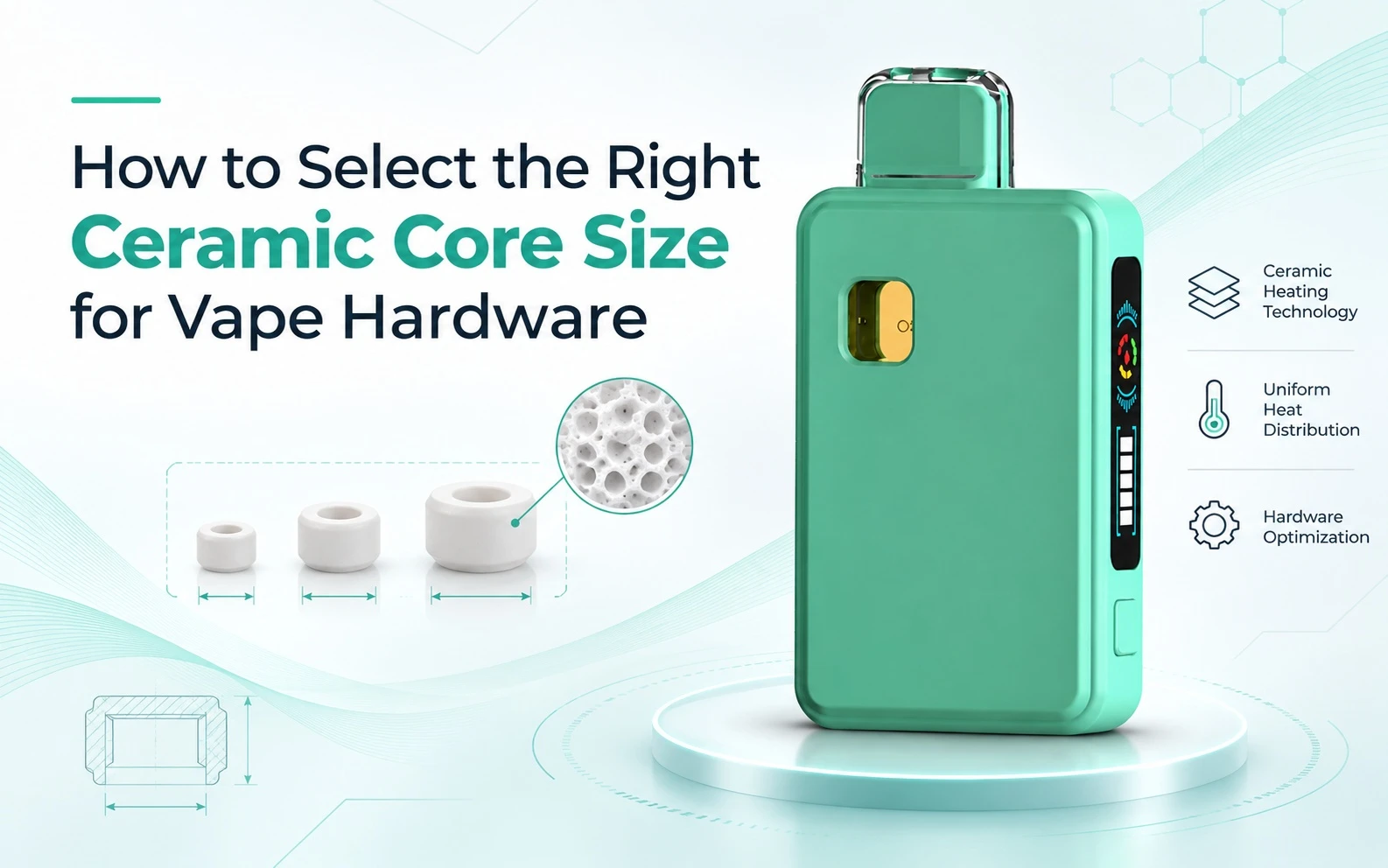
What Is a Ceramic Core in Cannabis Vape Hardware?
A ceramic core (also called a ceramic heating element or ceramic atomizer core) is a porous ceramic component embedded with a heating trace-typically a metallic film or resistance wire-that vaporizes oil through capillary action. Unlike cotton wicks, which absorb oil into fibers, porous ceramic draws oil through a network of micro-pores formed during high-temperature sintering. The oil reaches the heating surface evenly, vaporizes on contact, and the ceramic itself acts as a thermal buffer that prevents localized overheating.
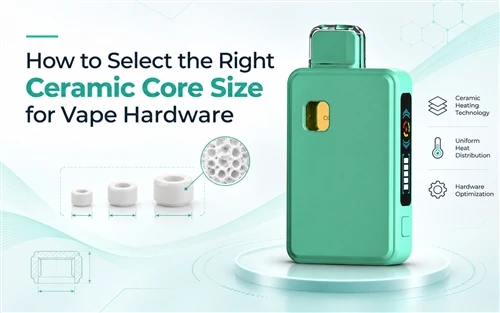
The term "ceramic core size" in this context refers to more than just physical dimensions. It encompasses the ceramic body's diameter and height, the porosity (typically in the range of 50%–60% for mainstream ceramic cores), average pore diameter, the number and diameter of oil intake holes on the cartridge base, and the electrical resistance of the embedded heating element (commonly 0.8Ω–1.4Ω for cannabis applications). Each of these parameters independently affects how oil flows, how heat distributes, and how much vapor the device produces per puff.
Getting all of them aligned with your cannabis oil profile is the difference between a cart that hits clean from first puff to last and one that clogs, leaks, or burns halfway through.
How Ceramic Core Size Affects Oil Flow and Vapor Production
How Oil Viscosity Affects Ceramic Core Selection
Cannabis oils span a wide viscosity range. Distillate-a highly refined THC or CBD concentrate-is thin and flows readily at room temperature. Live resin and live rosin, which retain more plant waxes and terpenes, are noticeably thicker. CO2-extracted oils fall somewhere in between, and some high-terpene full-spectrum extracts can approach the consistency of honey.
A ceramic core's pore structure and intake hole configuration determine how fast oil reaches the heating surface. A core designed for thin distillate may have fewer, smaller intake holes (commonly 2×1.2mm or 2×1.5mm) to restrict flow and prevent flooding. That same core paired with thick live resin will choke-oil can't wick through fast enough to keep the heating surface saturated, and the user gets dry, burnt hits within the first few dozen puffs.
Conversely, a core with large intake holes (4×2.0mm is a common configuration for thick oils) paired with thin distillate will over-deliver oil, producing gurgling, leakage from the mouthpiece, and diluted vapor that lacks potency.
The table below maps common cannabis oil types to their typical viscosity behavior and the intake configurations that generally work:
Table 1. Cannabis Oil Types and Recommended Intake Configurations
|
Oil Type |
Viscosity at Room Temp |
Typical Intake Holes |
Risk if Mismatched |
|
Distillate (THC/CBD) |
Low–medium |
2×1.2mm – 2×1.5mm |
Flooding, leaking if holes too large |
|
CO2 Extract |
Medium |
2×1.5mm – 4×1.5mm |
Slow wicking if holes too small |
|
Live Resin |
High |
4×1.5mm – 4×2.0mm |
Burnt taste, clogging if holes too small |
|
Live Rosin / Full-Spectrum |
Very high |
4×2.0mm + preheat |
Dry hits, core starvation |
For brands working with high-viscosity extracts, evaluating vape hardware designed for live resin or a postless live rosin vape pen can provide useful starting points when comparing different ceramic heating structures.
Cartridge Capacity and Core Volume Must Scale Together
The ceramic core's physical volume needs to match the cartridge's oil capacity. A 0.5ml cartridge typically uses a smaller-diameter core (around 6mm–8mm), while a 1.0ml or 2.0ml cartridge requires a larger core (10mm–12mm or more) with a greater heating surface area. If the core is undersized relative to the oil volume, the heating element works harder to vaporize the same amount of oil, accelerating degradation of both the ceramic and the heating trace. The cart may taste fine for the first third of the oil and then degrade sharply as the core fatigues.
Oversized cores in small cartridges create a different problem: the heating surface extends beyond the oil's contact zone, wasting energy and producing inconsistent vapor density. You'll also burn through battery faster, which matters in disposable vape pens where battery capacity is tightly budgeted.
Most 510-thread cartridges on the market come in 0.5ml, 1.0ml, and 2.0ml capacities, and reputable cannabis vape hardware manufacturers pair each capacity with a core sized for that volume. The mistake brands make is swapping oils into a cartridge without verifying that the pre-installed core matches the new oil's viscosity-same hardware, different oil, different performance.
Key Parameters for Choosing the Right Ceramic Core Size
Resistance and Wattage Compatibility
The heating element's resistance (measured in ohms) determines how much power the core draws at a given voltage. Lower resistance (around 0.8Ω–1.0Ω) draws more current and produces more heat, which suits thicker oils that need higher temperatures to vaporize efficiently. Higher resistance (1.2Ω–1.4Ω) runs cooler and works well with thinner oils that vaporize at lower temperatures.
Most cannabis vape batteries output 3.2V–4.0V, and the effective wattage is calculated as voltage squared divided by resistance (P = V²/R). At 3.7V, a 1.2Ω core draws roughly 11.4W; a 1.4Ω core draws about 9.8W. That difference of ~1.5W is enough to change the vaporization profile significantly-thicker oils may need the extra wattage, while terpene-heavy extracts can degrade and taste harsh at higher power.
Variable-voltage batteries give users some room to adjust, but the core's resistance still sets the baseline. If your oil requires a specific temperature window to preserve terpene integrity, choose a core resistance that lands in that window at the battery's default voltage-not one that forces users to dial settings up or down to compensate. Understanding how resistance affects cannabis vape hardware can help brands evaluate these settings more effectively.
Pore Size and Porosity
Porosity-the percentage of the ceramic body's volume occupied by pores-typically ranges from 50% to 60% in mainstream vape ceramic cores. Higher porosity means more oil storage capacity and faster wicking, which benefits thick oils. But it also reduces the ceramic's mechanical strength, making the core more prone to cracking during manufacturing, filling, or shipping.
Pore diameter matters independently of overall porosity. Smaller pores (in the low-micron range) produce finer capillary action and work well with thin oils that wick easily. Larger pores accommodate thicker oils but may allow faster drainage that can contribute to leakage if the oil is too thin.
Some newer ceramic technologies use aligned or straight-through pore structures rather than the tortuous, worm-like channels produced by traditional sintering methods. These designs can achieve porosity upward of 70%–80% while maintaining structural integrity, improving oil flow for high-viscosity extracts without sacrificing durability. From available product documentation, this approach is still emerging and not yet standard across the industry.
Physical Dimensions: Diameter and Height
The core's diameter determines the heating surface area in contact with oil, which directly affects vapor production per puff. Height determines the oil pathway length-taller cores provide a longer wicking distance, which can help regulate flow for thinner oils but may impede delivery for thick ones.
For standard 510 cartridges, core diameters typically range from 6mm (for 0.5ml carts) up to 12mm or more (for 2.0ml carts). The relationship isn't strictly linear with capacity-a 2.0ml cart doesn't need double the core diameter of a 1.0ml cart, because the oil column height also increases. But the heating surface must scale enough to vaporize oil at a rate that keeps pace with user puff duration and frequency.
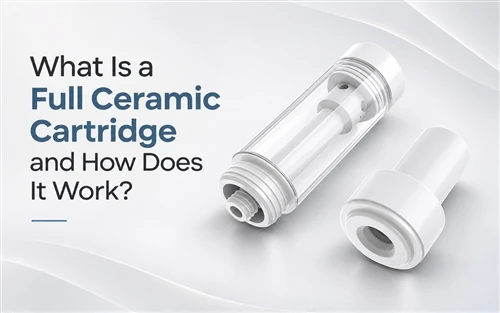
For example, a 1mL full ceramic vape cartridge provides a practical product format for evaluating ceramic heating structures within a standard cartridge capacity.
The table below summarizes typical ceramic core specifications across common cartridge sizes:
Table 2. Typical Ceramic Core Specifications by Cartridge Capacity
|
Cartridge Capacity |
Core Diameter (approx.) |
Common Resistance |
Intake Holes |
Typical Battery Voltage |
|
0.5ml |
6–8mm |
1.2Ω–1.4Ω |
2×1.2mm |
3.2–3.7V |
|
1.0ml |
8–10mm |
1.2Ω–1.4Ω |
2×1.5mm – 4×1.5mm |
3.4–3.7V |
|
2.0ml |
10–12mm |
0.8Ω–1.2Ω |
4×1.5mm – 4×2.0mm |
3.7–4.0V |
These are general ranges compiled from publicly available product specifications across multiple hardware manufacturers. Actual values vary by brand and core generation-always validate with your supplier's spec sheet and your own oil testing.
How to Match Ceramic Core Size to Your Cannabis Oil and Vape Device
Step 1: Characterize Your Oil
Before selecting hardware, measure your oil's viscosity at the temperature users will actually experience-typically room temperature (around 20°C–25°C) for cartridge storage, and slightly elevated during use as the battery heats the core. If your oil viscosity changes significantly with small temperature shifts, you need a core with intake holes sized for the worst-case (thickest) condition, and possibly a preheat function to warm the oil before the first puff.
Step 2: Define Your Device Parameters
Know your battery's output voltage (fixed or variable), the cartridge capacity you're targeting, and whether the device is a disposable or refillable 510 cart. Disposables have fixed voltage and no user adjustment, so the core resistance must be precisely matched-there's no margin for error. Refillable carts paired with variable-voltage batteries offer some flexibility, but the core should still be optimized for the default voltage setting, since most users never change it.
For brands evaluating integrated device designs, a full ceramic disposable vape with 1mL and 2mL capacity options provides another hardware format to consider when matching ceramic heating systems with device specifications.
Step 3: Test Before Scaling
Order samples of 2–3 core configurations that bracket your estimated needs. Fill them with your actual oil-not a substitute-and run a structured puff test covering the full oil volume. Track these failure modes:
- Burnt taste early in the cycle → core is too small or intake holes are too restrictive for your oil viscosity
- Leaking from the mouthpiece or base → intake holes are too large, or core porosity is too high for thin oil
- Clogging after storage → oil is thickening in the intake channels; consider a core with larger intake holes or add a preheat function
- Weak or airy vapor → core diameter is too small for the cartridge capacity, or resistance is too high for the battery voltage
- Inconsistent vapor across puffs → pore structure may be uneven, or the heating trace has poor distribution; switch to a higher-quality core manufacturer
The checklist below condenses the ceramic core selection logic:
- Thin oil (distillate) → smaller intake holes (2×1.2mm), higher resistance (1.2Ω+), standard porosity
- Thick oil (live resin/rosin) → larger intake holes (4×2.0mm), lower resistance (0.8Ω–1.0Ω), higher porosity, preheat recommended
- Small cart (0.5ml) → small-diameter core (6–8mm), avoid oversized heating surface
- Large cart (2.0ml) → larger core (10mm+), ensure heating surface scales with oil volume
- Disposable device → fixed-voltage match is critical, no room for user adjustment
- Variable-voltage battery → core optimized for default voltage, with some tolerance range
Common Vape Hardware Problems Related to Ceramic Core Size
Burnt Taste
The single most common consumer complaint, and it usually traces back to a core that can't wick oil fast enough. The heating surface runs dry, the ceramic overheats, and the residual oil on the surface carbonizes. This is almost always a viscosity-to-intake mismatch: thick oil, small intake holes, no preheat. It can also result from a core that's physically too small for the cartridge capacity-the element works overtime and degrades prematurely.
For additional troubleshooting, see what causes burnt taste in cannabis vape hardware.
Leaking
Leakage occurs when oil flows through the core faster than the heating element can vaporize it. Excess oil pools in the airway or seeps through the base seal. The root cause is typically intake holes that are too large for the oil's viscosity, or a core with porosity above what the oil requires. It can also stem from manufacturing tolerances-if resistance varies by more than about ±5% between batches, some cores will run hotter and vaporize faster while others run cooler and leave excess oil unvaporized. Reputable manufacturers typically control resistance tolerance to within ±2%.
Clogging
Clogging happens when oil thickens or crystallizes in the intake channels or airway after the device sits unused. It's most common with high-viscosity, high-terpene oils that partially solidify at lower temperatures. A core with larger intake holes reduces the severity-there's more channel volume for oil to flow through even when partially thickened. Preheat functions, which run a low-voltage pulse for 10–15 seconds before normal operation, warm the oil enough to restore flow. If clogging is a persistent issue with your oil, switching to a core designed for thick oils is more effective than relying on user behavior.
Harsh or Burned Flavor
When the core runs too hot-either because resistance is too low for the battery voltage, or the heating trace is unevenly distributed-terpenes degrade before they vaporize properly. The result is a harsh, acrid hit that tastes burnt even when the ceramic itself isn't damaged. This is a resistance-to-voltage mismatch, not a size issue per se, but it's often misdiagnosed as a core quality problem. Verify the actual wattage at your battery's default voltage before blaming the ceramic.
Working With Your Cannabis Vape Hardware Supplier
The most practical advice is also the most overlooked: talk to your cannabis vape hardware supplier about your oil before finalizing a ceramic core specification. Give them the viscosity data, the target cartridge capacity, the battery voltage, and the oil type. A supplier with genuine ceramic core expertise will recommend a specific core configuration-not just sell you whatever's in stock.
Request spec sheets that document resistance tolerance, porosity range, pore size distribution, and intake hole dimensions. If the supplier can't provide these, that's a red flag. Batch-to-batch consistency is what separates a reliable hardware partner from one whose carts perform well in sample testing but fail at scale.
For brands scaling up, insist on a pilot run with your actual oil before committing to a large order. Test across multiple batches of both oil and hardware. The interaction between oil formulation and ceramic core performance is not fully predictable from spec sheets alone-empirical validation is the only reliable method.
FAQ
Does a Larger Ceramic Core Always Produce More Vapor?
Not necessarily. A larger ceramic core can provide greater heating surface area and improve vapor production when properly matched with the oil and power settings. However, an oversized core may consume more energy or cause inconsistent vapor density. Actual performance depends on the effective heating area, oil wicking efficiency, ceramic porosity, resistance, and battery voltage-not physical size alone.
What Ceramic Core Size Is Best for Thick THC Oil?
There is no single ceramic core size that works best for every thick THC oil formulation. High-viscosity oils generally require sufficient intake capacity and effective heating surface area to maintain consistent oil flow. Ceramic porosity, pore diameter, resistance, and preheat functionality also influence performance. The most reliable approach is to test several ceramic core configurations with your actual oil before selecting hardware for bulk production.
How Does Ceramic Core Size Affect Live Resin and Live Rosin Vaping?
Ceramic core size affects how efficiently live resin and live rosin reach the heating surface and vaporize. A core that is too small or has restrictive oil intake channels may struggle to supply enough oil, resulting in weak vapor or burnt hits. An appropriately matched ceramic heating core, combined with suitable voltage and resistance settings, can support consistent vapor production while helping preserve the flavor characteristics of terpene-rich extracts.
For a broader comparison of compatible device structures, see choosing the right vape hardware for live rosin.
Can the Same Ceramic Core Be Used for 0.5ml and 2.0ml Cartridges?
It depends on the ceramic core design, heating capacity, and oil formulation. Smaller cartridges typically use more compact ceramic cores, while larger cartridges may require greater heating surface area. However, cartridge capacity alone does not determine the ideal core size. Brands should verify oil compatibility, battery output, vapor performance, and full-cartridge consistency before using the same core configuration across different capacities.
What Should Cannabis Brands Test Before Ordering Ceramic Vape Hardware in Bulk?
Cannabis brands should test the selected hardware with their actual oil formulation across the full cartridge capacity. Key checks include vapor production, flavor consistency, oil wicking, clogging, leakage, resistance stability, and performance after storage. Comparing multiple ceramic core configurations and conducting pilot production tests can help identify potential compatibility issues before scaling.
Final Thoughts
Selecting the right ceramic core size for cannabis vape hardware comes down to matching oil viscosity, cartridge capacity, heating surface area, battery voltage, and core resistance. A larger core is not automatically better-the ideal configuration is one that delivers sufficient oil to the heating surface, maintains appropriate heating performance, and produces consistent vapor throughout the product's use.
At ASM VAPE, we specialize in cannabis vape hardware manufacturing and OEM/ODM solutions, helping THC/CBD brands match ceramic core configurations, heating parameters, and hardware structures to their specific oil formulations. If you're developing a new vape product or optimizing an existing one, contact ASM VAPE to discuss your oil compatibility requirements and custom hardware project.