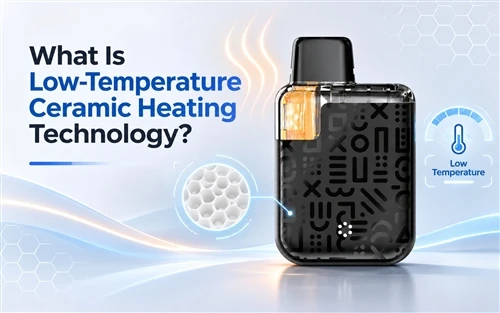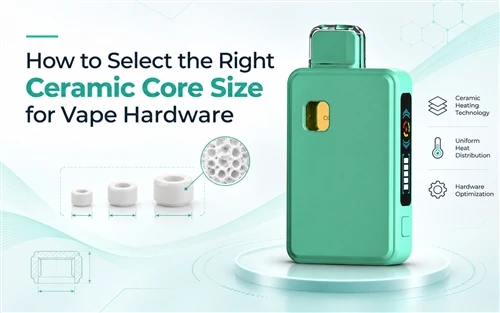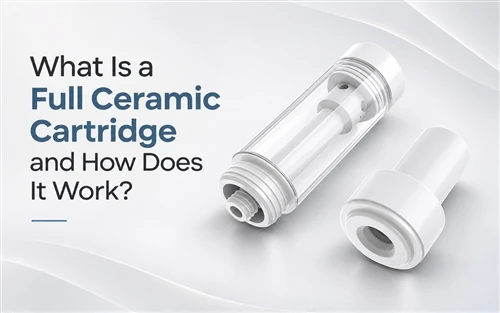

Low-Temperature Ceramic Heating Technology refers to the use of porous ceramic structures to vaporize oils at controlled, reduced temperatures rather than combusting them. In cannabis vape hardware, this means a ceramic heating element absorbs and evenly distributes heat across the oil, avoiding the hotspots and scorching typical of traditional metal coils. The result is cleaner vapor, better flavor fidelity, and significantly reduced thermal degradation of sensitive compounds.
How Porous Ceramic Coils Work in Cannabis Vape Hardware
A porous ceramic coil is the core component that makes low-temperature ceramic heating possible. Unlike metal wire wrapped around a cotton wick, it is a sintered ceramic body perforated by thousands of microscopic pores. These pores form a three-dimensional, interconnected network of internal oil pathways - oil is drawn in through capillary action, held within the ceramic matrix, and released as vapor when the element heats up.
The Mechanics of Low-Temp Atomization
The ceramic's pore structure is engineered to a precise size range. Pores that are too large flood the coil and cause leakage; pores that are too small starve it and produce dry hits. The target pore diameter balances two competing demands: fast absorption so oil reaches the heating surface quickly, and controlled retention so oil does not oversaturate and spill.
This is where the 3D interconnected internal oil pathways matter. Oil enters from one surface, travels through a labyrinth of channels, and reaches the heating zone from multiple directions simultaneously. The result is even wetting of the entire ceramic body, not just the area nearest the oil inlet.
Electrical parameters, including voltage and resistance, differ sharply by design architecture. Postless full ceramic designs - where there is no metal center post passing through the oil - typically operate at 2.2–2.8V with a resistance of 1.4–1.8Ω. This lower-power profile is sufficient because the ceramic itself distributes heat uniformly. Center post metal designs, by contrast, run at higher voltages of 2.8–3.3V and lower resistance of 1.0–1.2Ω, driving more power through a metal conductor to achieve faster heat-up. The trade-off is raw thermal output against heat uniformity and material purity.
The ceramic heating element's ability to hold and radiate heat evenly - rather than concentrating it at a single hot point - is the fundamental mechanical advantage that enables CBD oil atomization without burning.
Why Temperature Control Matters for THC and CBD Oil
Cannabis oils are not uniform liquids. They carry a complex profile of cannabinoids and terpenes - the aromatic compounds responsible for flavor, aroma, and entourage effects. Terpenes are volatile. Many begin to degrade at temperatures well below the operating range of a conventional metal coil, and once degraded, they cannot be recovered.
Traditional metal coils create localized hotspots. The wire heats unevenly, with the hottest point far exceeding the average surface temperature. Oil passing over that hotspot is effectively burned, not vaporized. The consequences are immediate: harsh taste, off-notes, and the loss of the very terpenes that define a strain's character.
A ceramic heating element addresses this at the material level. Ceramic has high thermal inertia - it heats slowly and uniformly, then holds that heat across its entire surface. There is no single point that overshoots. This even heat distribution is what makes terpene preservation possible: the oil is vaporized at a temperature low enough to keep volatile compounds intact.
Low-temperature operation also prevents the oil itself from carbonizing. Residue buildup on the heating surface is dramatically reduced, which extends the functional life of the THC cartridge and maintains vapor quality over more puffs.
Temperature control is not a feature add-on. It is the single most important variable determining whether a vape delivers the oil's intended flavor profile or a degraded approximation of it.
How Postless Full Ceramic and Center Post Metal Coils Compare
The two dominant coil architectures in cannabis vape hardware differ in how they deliver heat and how they interact with the oil. The table below compares their key parameters.
|
Feature |
Postless Full Ceramic Coil |
Center Post Metal Design |
|
Voltage Range |
2.2–2.8V |
2.8–3.3V |
|
Resistance |
1.4–1.8Ω |
1.0–1.2Ω |
|
Metal Contact with Oil |
No metal center post |
Direct |
|
Terpene Preservation |
Excellent |
Moderate |
|
Best Application |
Live resin / live rosin / Delta-9 oils |
Distillate / thicker oils needing more heat |
The postless full ceramic design eliminates the metal center post from the oil path. No center post means one less potential source of metal-oil contact, reducing the risk of metallic contamination and the off-flavors it may introduce. Its lower operating voltage reflects the ceramic heating architecture's efficiency, allowing effective vaporization at a lower power setting. This makes it a preferred choice for live resin and live rosin, where flavor fidelity is a primary performance metric.
The center post metal design trades purity for raw thermal force. The metal post conducts heat aggressively, which is useful for very thick, high-viscosity oils that a ceramic element alone may struggle to vaporize efficiently. The cost is direct metal contact with the oil and a higher operating temperature that degrades terpenes more aggressively.
For brands working with premium extracts where terpene preservation is non-negotiable, the postless full ceramic architecture is a strong choice. A postless live rosin vape pen is one practical application of this approach. Center post designs remain relevant for specific high-viscosity formulations that demand more thermal energy than low-temperature ceramic can deliver alone.
Common Ceramic Coil Problems and How to Address Them
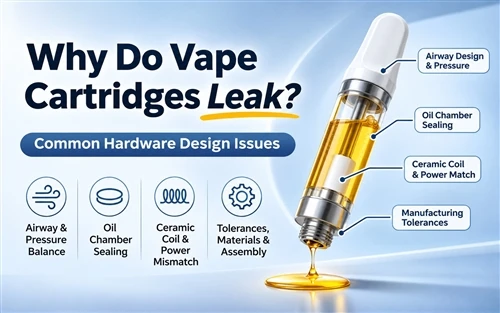
Even the best ceramic coil fails if the oil delivery system is poorly engineered. The four most common failure modes in cannabis vape hardware are clogging, dry hits, leakage, and inconsistent vapor production. Each has a distinct root cause, and each is addressed at the structural level of the ceramic core.
Clogging occurs when oil viscosity increases - often due to temperature drops or crystallization in high-purity extracts - and the pore structure cannot pull oil through fast enough. The fix is not more heat; it is a pore architecture calibrated for the oil's viscosity range.
Dry hits are the inverse problem: oil is not reaching the heating surface before it activates, so the ceramic burns its residual coating. This produces an acrid, unmistakable taste. It signals a mismatch between absorption rate and heating rate.
Leakage happens when oil floods through the ceramic faster than it can be vaporized, exiting through the airflow path. It is the most visible failure - and the most damaging to brand reputation.
Inconsistent vapor production is the cumulative effect of all three: the coil alternates between flooding and starving, delivering uneven hits across a single session.
The engineering response to all four is the same structural approach: precision laser micro oil channels combined with golden pore matrix engineering. Laser micro channels are physically cut into the ceramic body at controlled depths and widths, creating dedicated pathways that regulate how quickly oil enters the heating zone. The golden pore matrix - a precisely calibrated distribution of pore sizes throughout the ceramic - ensures that oil is absorbed fast enough to prevent dry hits but retained firmly enough to prevent flooding and leakage.
This balance between fast absorption and controlled delivery is what separates a reliable ceramic core from a generic one. High-viscosity oils like live resin and THCA are the most demanding test case: they require a pore structure aggressive enough to pull thick oil, yet disciplined enough to hold it until vaporization. Getting this balance right is the difference between a cartridge that performs consistently from the first puff to the last and one that fails unpredictably mid-session.
FAQ
What Is the Difference Between Low-Temperature Ceramic Heating and Traditional Metal Coils?
Low-temperature ceramic heating uses a porous ceramic heating element to distribute heat across the oil, while traditional metal coil designs rely on metal conductors to generate heat. Ceramic heating technology is designed to reduce localized hotspots and support more consistent cannabis oil vaporization, particularly when the heating structure and temperature settings are properly matched to the oil formulation.
Is Low-Temperature Ceramic Heating Suitable for Live Resin and Live Rosin?
Yes. Low-temperature ceramic heating technology is commonly used in vape hardware designed for live resin and live rosin because these extracts can benefit from controlled heating and consistent terpene flavor expression. However, compatibility depends on cannabis oil viscosity, ceramic coil structure, oil intake design, and electrical parameters. Highly viscous formulations may require additional optimization to maintain reliable oil flow and vapor production.
How Do Voltage and Resistance Affect Ceramic Vape Heating Performance?
Voltage and resistance influence the electrical power delivered to a ceramic heating element. Different combinations affect heating speed, vapor production, and overall atomization performance. However, lower voltage does not automatically guarantee a lower heating temperature. Ceramic coil size, heating surface area, airflow, and cannabis oil viscosity must also be considered when optimizing low-temperature vape hardware.
Can Low-Temperature Ceramic Heating Reduce Clogging and Burnt Taste?
Properly engineered low-temperature ceramic heating systems can help reduce burnt taste by supporting more controlled heat distribution. Clogging, however, also depends on oil viscosity, ceramic pore structure, intake pathways, and airflow design. A well-matched ceramic coil and oil delivery system can improve vaporization consistency and reduce these common hardware performance issues, although low-temperature heating alone cannot eliminate every potential problem.
Final Thoughts
Low-Temperature Ceramic Heating Technology uses engineered porous ceramic structures to vaporize cannabis oils at controlled, reduced temperatures, supporting terpene preservation, minimizing localized overheating, and delivering more consistent vapor quality. Its value is not incremental: it fundamentally changes what a THC cartridge can deliver in terms of flavor, purity, and reliability. However, achieving these benefits requires the right combination of ceramic heating technology, oil compatibility, and hardware design.
As a dedicated cannabis vape hardware manufacturer and OEM/ODM solutions provider, ASM VAPE specializes in oil-matched hardware solutions, ceramic atomization technology, and customized device configurations for THC/CBD brands. Contact ASM VAPE to discuss your cannabis oil formulation, hardware performance requirements, or next custom vape hardware project.