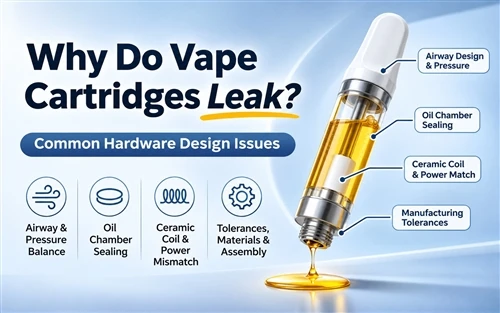
Vape cartridge leakage is rarely a single-point failure. It is almost always the visible symptom of a hardware design compromise - an airway that cannot hold pressure, a seal that cannot resist low-viscosity oil, or a coil that feeds faster than it can atomize. For THC and CBD brands, a leaking cannabis vape cartridge is not just a product defect; it is a liability that travels through the supply chain and lands on the dispensary shelf. This article explains why vape cartridges leak by breaking down the four hardware design issues behind most cartridge leaks and what to specify to prevent them.

What Causes Vape Cartridges to Leak?
A cannabis vape cartridge (also called a "cart") is a pre-filled or fillable container that houses cannabis oil and an atomizer coil; it attaches to a battery that powers the heating element. Leakage occurs when oil escapes its intended path - the oil chamber - through gaps in the airway, seal interfaces, or coil housing.
The root causes cluster into four design domains:
|
Leak Category |
Primary Failure Mode |
Typical Trigger Condition |
|
Airway & pressure balance |
Oil forced through air channel under pressure differential |
Temperature swings, altitude change, vibration |
|
Oil chamber sealing |
Low-viscosity oil penetrates interference-fit gaps |
Thin distillate, live resin/rosin at elevated temperature |
|
Oil feeding vs. atomization mismatch |
Coil floods; excess oil spits back through mouthpiece |
High-porosity ceramic with low-wattage battery |
|
Mold tolerance & material defects |
Latent seepage through micro-gaps and degraded seals |
Terpene exposure over weeks; uneven pressing |
Most field-reported leaks trace back to one of these four. The sections below examine each in design terms.
How Airway Design and Pressure Imbalance Cause Vape Cartridge Leaks
How the Airway Governs Leak Risk
The airway is the gas path from the intake port through the atomization chamber to the mouthpiece. In a well-designed cartridge, the airway and the oil chamber are separated by a sealed boundary, and internal pressure stays balanced whether the device is upright, inverted, or in transit.
Pressure imbalance is where leaks begin. When ambient temperature rises, trapped air inside the oil chamber expands and pushes oil toward the path of least resistance - typically the airway opening or the coil seat. The same happens during air freight or high-altitude transport, where external pressure drops and the internal-to-external differential forces oil outward.
Postless Designs and Side Air Channels
Postless cartridges - designs without a center metal post running through the oil chamber - rely on side air channels routed along the chamber wall. This architecture improves aesthetics and reduces metal-to-oil contact, which is why it is increasingly preferred for live resin, live rosin, and Delta-9 oil products. But the trade-off is sealing complexity.
Without a center post to anchor a primary seal, the side channels become the critical leak path. If the channel geometry does not maintain a consistent interference fit along its entire length, temperature cycling and vibration will exploit any micro-gap. Oil squeeze-out through side channels is one of the most common failure modes in postless designs.
Design mitigations that work:
- Redundant sealing at the air-channel entry and exit points, not just at the mouthpiece base
- Pressure equalization holes calibrated to release air without admitting oil - typically achieved through hydrophobic membranes or labyrinth geometries
- Vertical airpath isolation ensuring the oil feed and air path do not share an unsealed interface
Cartridges that treat the airway as a sealed pressure system rather than a simple tube leak significantly less under real-world shipping and storage conditions.
How Poor Oil Chamber Sealing Causes Vape Cartridge Leaks
The Interference Fit Problem
The oil chamber is sealed at multiple interfaces: the mouthpiece-to-glass joint, the coil seat-to-chamber base, and any fill-port closure. Each of these relies on either an interference fit (mechanical compression of mating parts), a chemical bond (adhesive or welding), or a gasket seal (O-ring or silicone plug).
Interference fit refers to a mechanical assembly where one part is deliberately sized larger than its mating hole, so that pressing them together creates a compressive seal. When the interference is insufficient - typically due to tolerance drift in molding - the seal opens under thermal expansion or oil pressure. Low-viscosity oils such as thin distillate and live resin penetrate these gaps faster than thicker oils, which is why the same cartridge design may hold a high-viscosity RSO but leak with a winterized distillate.
Anti-Leak Grooves and Sealant Strategy
Well-engineered chambers incorporate anti-leak grooves - small channels machined or molded into sealing surfaces that trap migrating oil before it reaches the exterior. These grooves act as secondary containment, buying time and reducing visible leakage even when the primary seal is imperfect.
The table below compares the four sealing strategies used in cartridge manufacturing:
|
Sealing Method |
Mechanism |
Strengths |
Limitations |
|
UV curable adhesive |
Liquid resin cured by UV light at the bond line |
Fast cycle time; bonds dissimilar materials |
Brittle if over-cured; UV shadow areas may under-cure |
|
Ultrasonic welding |
High-frequency vibration melts and fuses mating plastic surfaces |
No consumables; hermetic seal possible |
Limited to thermoplastic pairs; joint design critical |
|
Laser welding |
Focused laser melts a precise weld seam |
Minimal heat-affected zone; clean aesthetic |
Higher equipment cost; material-dependent absorption |
|
Mechanical press-fit / snap |
Interference compression or snap-fit latch |
No curing step; reworkable |
Tolerance-sensitive; may relax over time |
No single method is universally superior. The right choice depends on the oil viscosity profile, the chamber material, and whether the cartridge is disposable or refillable. What matters is that the sealing strategy is specified deliberately - not left as whatever the mold shop defaults to.
O-Ring Design Fundamentals
When O-rings are used (common in refillable cartridges and some disposable bases), their performance depends on three factors that are frequently under-specified:
- Compression ratio: For static sealing applications, O-rings typically require 15–30% compression to maintain a reliable seal. Below 15%, the seal is marginal; above 30%, the material takes a permanent set and loses resilience.
- Groove dimensions: The O-ring groove must follow standard dimensional ratios - groove width typically 1.3–1.5 times the cross-section diameter, with fill volume around 85–95% to prevent extrusion while allowing thermal expansion.
- Material compatibility: The seal material must resist the specific oil chemistry it contacts. The common options are NBR (nitrile), FKM (fluoroelastomer), EPDM, and silicone - each with different resistance profiles to terpenes and cannabinoids. Material compatibility can be evaluated using established test methods such as ASTM D471, which addresses the effects of liquids on rubber materials.
A seal that swells, hardens, or loses elasticity after terpene exposure is a latent leak waiting to happen. Material selection should be validated against the actual oil formulation, not a generic reference fluid.
How Ceramic Coil Flooding and Power Mismatch Cause Leaks
When the Coil Outpaces the Battery
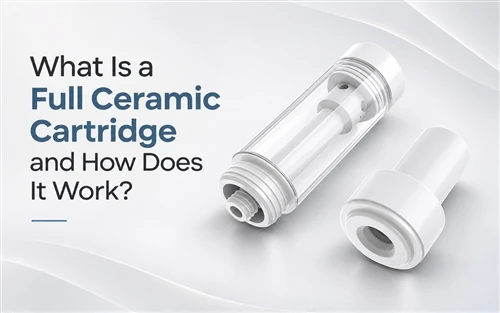
The ceramic coil is the component that draws oil from the chamber and atomizes it into vapor. Its feeding rate - governed by porosity, pore size, and capillary action - must be matched to the battery's heating power. When the coil feeds oil faster than the battery can vaporize it, the excess floods the coil housing and eventually escapes as spit-back (droplets of unatomized oil reaching the mouthpiece) or seepage through the airway.
This mismatch is common in cartridges that pair high-porosity ceramic coils with low-voltage batteries. The coil's capillary action continuously draws oil regardless of whether the heating element is active, so any period of inactivity allows oil to accumulate in the atomization chamber.
Ceramic Coil Porosity and Matching Parameters
Porosity in a ceramic coil refers to the volume fraction of open pores in the sintered ceramic body - the network of micro-channels through which oil travels by capillary action. Higher porosity means faster oil delivery but also greater flood risk if heating power is insufficient.
From industry technical literature, typical porosity targets for cannabis vaporization ceramics fall in the range of 12–15 micrometer average pore diameter, with batch-to-batch variance ideally kept below 2% to ensure consistent feeding rates across production lots.
The table below outlines the parameter matching logic for different cannabis oil types:
|
Oil Type |
Viscosity Profile |
Recommended Resistance |
Voltage Range |
Coil Consideration |
|
Distillate (winterized) |
Low to medium |
1.0–1.2 Ω |
2.8–3.3 V |
Center-post design; higher power for clean vaporization |
|
Live resin / live rosin |
Medium; terpene-rich |
1.4–1.8 Ω |
2.2–2.8 V |
Postless full-ceramic; lower power preserves terpene profile |
|
Delta-9 / full-spectrum |
Variable |
1.4–1.8 Ω |
2.2–2.8 V |
Postless; larger coil surface area compensates for lower power |
|
RSO / high-viscosity |
High |
1.0–1.2 Ω |
2.8–3.3 V |
May require pre-heat function; center-post for thermal transfer |
The key principle: resistance and voltage must be specified for the oil, not the other way around. A cartridge designed for distillate will under-perform and potentially leak when filled with live resin, because the lower power cannot keep pace with the coil's feeding rate for a thinner, terpene-heavy oil.
Spit-Back and Flooding as Leak Symptoms
Spit-back is often misdiagnosed as a mouthpiece seal failure. In reality, the oil is arriving at the mouthpiece through the airway because the coil is flooded - the atomization chamber has more oil than the heating element can convert to vapor. The fix is not a tighter mouthpiece seal; it is rebalancing the coil-to-battery power ratio or selecting a coil with lower porosity for the given oil viscosity.
Flooding also accelerates seal degradation. Oil that pools in the atomization chamber exerts continuous hydrostatic pressure on every seal interface, shortening the effective life of adhesives and O-rings that would otherwise hold indefinitely under normal operating conditions.
How Manufacturing Tolerances, Materials, and Assembly Cause Cartridge Leaks
Tolerance Stack-Up and Micro-Gaps
Even a well-designed cartridge will leak if the manufacturing tolerances are not controlled. Every injection-molded and metal-stamped component has dimensional variation. When multiple parts are assembled, these variations stack up - meaning the cumulative gap at a seal interface can be several times larger than the variation on any single part.
Loose mold tolerances create gaps that are invisible at room temperature under static conditions but open under thermal cycling, vibration, or oil pressure. These are the most insidious leaks: they do not appear in QC bench testing but surface after weeks in distribution or on the dispensary shelf.
Tightening tolerances has a cost. But the cost of a recall or a returned batch - not to mention the brand damage - is orders of magnitude higher. The relevant question is not whether to invest in tolerance control, but where to concentrate it: at the seal interfaces, the coil seat, and the airway junctions.
Material Degradation Under Terpene Exposure
Terpenes are aggressive solvents. Prolonged exposure degrades many common sealing materials:
- Low-grade silicone swells and loses dimensional stability after sustained terpene contact. The swelling may temporarily improve sealing, but as the material takes a set and eventually hardens, the seal fails.
- Standard nitrile (NBR) performs adequately with many oil formulations but can degrade with high-terpene concentrates over extended storage periods.
- FKM (fluoroelastomer) offers superior terpene resistance but at higher material cost.
- EPDM is generally not recommended for hydrocarbon-rich environments.
Material selection should be validated through accelerated aging tests with the actual oil formulation, not assumed from generic compatibility charts.
Assembly Consistency and Pressing Uniformity
Even with correct parts and materials, uneven assembly creates leaks. If the coil seat is pressed at an angle, or if the mouthpiece is crimped with non-uniform force, one side of the seal interface may be under-compressed while the other is over-compressed. The under-compressed side becomes the leak path.
Automated assembly with force monitoring and position feedback is the reliable way to achieve consistent pressing. Manual assembly or semi-automated processes without closed-loop control are the most common source of batch-level leak variation - the same design leaks from one production run but not another, because the pressing force was different.
Production Environment and Contamination Risk
Hardware contamination parallels oil solvent testing in importance. Particulate contamination in the oil chamber - whether from manufacturing residue, airborne debris, or cross-contamination from adjacent processes - can compromise seal surfaces and introduce failure points. ISO-certified cleanroom production is the industry baseline for cartridges intended for regulated cannabis markets.
Ceramic coils themselves require certification for heavy-metal-free and lead-free composition. According to a 2019 advisory from the Maryland Medical Cannabis Commission, potential lead contamination in used vape cartridges was identified as a patient safety concern, underscoring why hardware material certification is not optional in regulated markets.
How to Specify a Leak-Resistant Vape Cartridge
Translating the design issues above into actionable specification criteria gives cannabis brands and oil processors a checklist for hardware sourcing:
|
Specification Area |
What to Require from the Manufacturer |
|
Airway design |
Redundant sealing at air-channel interfaces; pressure equalization feature |
|
Chamber sealing method |
Specified deliberately (UV adhesive, ultrasonic weld, or press-fit) - not default |
|
O-ring compression |
15–30% compression ratio with standard groove geometry; material matched to oil |
|
Ceramic coil porosity |
12–15 μm average pore diameter; batch variance <2%; heavy-metal-free certified |
|
Oil-to-coil matching |
Resistance and voltage specified for the target oil viscosity and terpene profile |
|
Mold tolerance |
Seal-interface dimensions held to ±0.02 mm or tighter |
|
Assembly process |
Automated pressing with force monitoring; no manual crimping for seal-critical joints |
|
Production environment |
ISO-certified cleanroom; documented contamination control protocol |
|
Material validation |
Accelerated aging test with actual oil formulation; terpene compatibility confirmed |
|
Batch QC |
Leak testing on a statistical sample from every production lot, not first-article only |
This checklist is not exhaustive, but it covers the failure modes that cause the majority of field leaks. A cannabis vape cartridge manufacturer that cannot answer these specification questions with specific numbers - not generalities - is a risk.
FAQ
Why Is My Vape Cartridge Leaking From the Bottom?
A vape cartridge leaking from the bottom may indicate a problem with the coil seat, base seal, or connection between the oil chamber and airflow channel. Poor sealing, manufacturing tolerances, and pressure changes can allow cannabis oil to escape through these interfaces. For 510 vape cartridges, the base structure and sealing interfaces should be inspected to identify the actual leakage path.
Why Does Vape Oil Leak Through the Mouthpiece or Airflow Holes?
Oil leaking through the mouthpiece or airflow holes is often associated with coil flooding, pressure imbalance, or poor separation between the oil chamber and airway. When a ceramic coil absorbs oil faster than the heating element can vaporize it, excess oil may accumulate in the atomization chamber and escape through the airflow path.
Can Cannabis Oil Viscosity Cause Vape Cartridge Leaking?
Yes. Cannabis oil viscosity directly affects how oil moves through the cartridge's intake holes, ceramic coil, and sealing interfaces. Lower-viscosity oils may penetrate small gaps more easily, particularly at elevated temperatures. Different formulations, including distillate, live resin, and live rosin, require appropriately matched hardware parameters to reduce leakage risks.
Are Postless Vape Cartridges More Likely to Leak?
Not necessarily. Postless vape cartridges eliminate the central metal post and often use side airflow channels, which can introduce additional sealing requirements. However, leakage depends on the overall airway structure, seal quality, material compatibility, and manufacturing precision. A properly engineered postless design can provide reliable performance when matched to the intended cannabis oil.
How Can Cannabis Brands Prevent Vape Cartridge Leaks During Shipping?
Cannabis brands can reduce shipping-related leakage by selecting cartridges with reliable sealing structures and evaluating how filled devices respond to temperature changes, altitude-related pressure differences, and vibration. Testing hardware with the actual oil formulation before bulk production helps identify potential leakage problems that may not appear during initial assembly inspections.
Conclusion
Vape cartridge leaks trace back to four hardware design issues: airway pressure imbalance, oil chamber sealing defects, oil feeding and atomization mismatch, and mold tolerance or material flaws. These risks can be reduced when the cartridge is specified against the actual cannabis oil formulation and validated through controlled manufacturing - rather than sourced as a commodity component and filled as an afterthought.
ASM VAPE is a cannabis vape hardware manufacturer and OEM/ODM solutions provider specializing in oil-matched hardware, ceramic atomization technology, and customized hardware development for THC/CBD brands. If your brand is experiencing cartridge leakage or developing hardware for a new oil formulation, contact ASM VAPE to discuss your requirements, explore suitable hardware configurations, and arrange sample testing.