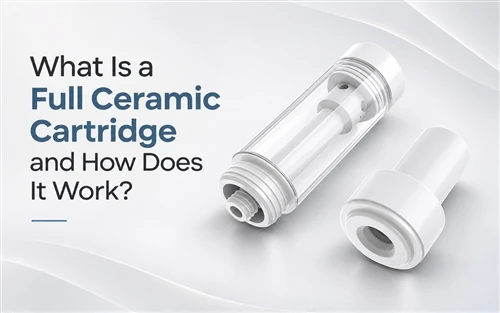
A full ceramic cartridge is a type of cannabis vape cartridge designed with ceramic components in the atomizer and, often, the center post and mouthpiece. Depending on the design, the oil reservoir may be made from ceramic or glass, while electrical contacts and heating traces may still contain metal. Unlike standard ceramic cartridges that use a ceramic heating core with a metal center post, a full ceramic cartridge typically relies on a sintered porous ceramic body with an integrated heating element to both wick and atomize cannabis oil. The result is a cleaner oil-contact design, more consistent flavor delivery, and a material structure that holds up well against repeated thermal cycling when properly matched to the oil formulation.

What Is a Full Ceramic Cartridge?
What Makes a Cartridge Full Ceramic?
The term "full ceramic" gets thrown around loosely in the industry, so it helps to define it precisely. A full ceramic vape cartridge (sometimes called an "all-ceramic" cartridge) generally uses ceramic for key components such as the center post, mouthpiece, and atomizer body. The oil reservoir may also use glass tank construction, while the ceramic heating element typically contains an integrated resistance trace.
The ceramic body is commonly made from sintered alumina or zirconia-based materials. However, "full ceramic" does not necessarily mean that every component is ceramic or that the entire cartridge is completely metal-free. The exact oil-contact surfaces and vapor-path materials depend on the cartridge's construction. For example, ASM VAPE's BULLET 1mL full ceramic vape cartridge combines a glass tank with a ceramic center post and ceramic mouthpiece.
This matters because metal components in the oil path - even medical-grade stainless steel - can interact with certain cannabis oil formulations over time, particularly acidic distillates and terpene-rich live resins. Reducing direct metal-to-oil contact simplifies both the flavor profile and the material safety assessment.
Full Ceramic vs. Standard Ceramic vs. Wick Cartridges
The differences between cartridge types come down to what touches the oil and how heat is delivered. The table below lays out the structural and functional distinctions.
|
Feature |
Full Ceramic |
Standard Ceramic |
Wick (Cotton/Fiber) |
|
Center post material |
Ceramic |
Metal (usually steel) |
Metal or plastic |
|
Heating element |
Integrated ceramic heating film or trace |
Metal wire on ceramic |
Metal wire around cotton |
|
Oil contact surface |
Ceramic and/or glass, depending on design |
Ceramic + metal |
Cotton + metal |
|
Flavor purity |
Highest |
High |
Moderate |
|
Oil compatibility |
Broad (thin to thick) |
Moderate |
Thin oils preferred |
|
Burnt taste risk |
Very low |
Low |
High |
|
Typical cost |
Premium |
Mid-range |
Budget |
A full ceramic cartridge costs more to produce - sintering a multi-part ceramic assembly with an integrated heating trace is a more complex manufacturing process than wrapping wire around cotton. But the performance gap is real, and for premium THC and CBD product lines, that gap translates directly into consumer perception and repeat purchases.
How Does a Full Ceramic Cartridge Work?
Porous Ceramic: The Wicking Engine
The heart of a ceramic vape cartridge is the porous ceramic body - a sintered material shot through with thousands of interconnected micro-pores. These pores typically range from roughly 2 to 15 microns in diameter, depending on the formulation and sintering process. When oil enters the cartridge, capillary action draws it through this pore network toward the heating element, much like a sponge pulling water upward.
Unlike cotton wicks, which degrade over time and can char at high temperatures, the ceramic pore structure is dimensionally stable. It doesn't compress, burn, or shed fibers into the oil. The pore network also distributes oil more evenly across the heating surface, which means the heating film vaporizes a consistent film of oil rather than pooling it in one spot.
The Ceramic Heating Mechanism
In a full ceramic cartridge, the heating element is typically a thick-film or thin-film resistance trace printed onto or embedded within the ceramic body during the manufacturing process. When the battery sends current through this trace, electrical resistance converts the energy into heat. The ceramic substrate then distributes that heat across its surface. The size of the ceramic core also affects the heating surface area and overall vaporization performance.
This is a fundamentally different mechanism from a wire-and-wick setup. A metal wire coil creates hot spots - areas of concentrated heat that can exceed 400°C under dry-burn conditions. The ceramic film, by contrast, spreads thermal energy across a wider surface area, keeping peak temperatures lower and more controlled. According to industry testing data, ceramic heating elements typically operate in the 200–300°C range during normal use, which is sufficient to vaporize cannabinoids and terpenes without reaching the degradation thresholds that produce off-flavors or unwanted byproducts.
The practical outcome: more even vaporization, fewer burnt hits, and a flavor profile that stays consistent from the first puff to the last.
The Vapor Path: From Oil to Aerosol
When a user draws on the cartridge, several things happen in sequence. The battery's airflow sensor or fire button activates power to the heating trace. The ceramic surface heats up, vaporizing the thin film of oil held in the pore network at the heating zone. The resulting aerosol travels up through the ceramic center post (in a full ceramic design) or a metal tube (in standard designs), through the mouthpiece, and into the user's mouth.
In a full ceramic cartridge with a ceramic center post and mouthpiece, the vapor travels through a predominantly ceramic pathway. This can reduce direct contact with exposed metal surfaces, although the exact vapor-path materials depend on the cartridge's design.
Benefits of Full Ceramic Cartridges
Flavor Integrity
Cannabis oils - particularly live resin and live rosin - carry complex terpene profiles that are easily distorted by material interactions. Metal surfaces can catalyze subtle oxidation reactions, and cotton wicks can impart a faint fibrous taste that masks delicate terpene notes. Ceramic materials are generally chemically stable under normal vaping temperatures, helping minimize unwanted interactions with terpenes, cannabinoids, and other compounds in the oil.
For brands selling terpene-forward products, this is the single most important advantage. The flavor the formulator put into the oil is the flavor the consumer tastes.
Thermal Stability and Longevity
Ceramic materials have high thermal shock resistance and dimensional stability. They don't warp, melt, or deform under the temperatures generated by a vape heating element. This means the pore structure that governs wicking performance stays consistent over the life of the cartridge.
A wick cartridge's cotton degrades with every heating cycle. A standard ceramic cartridge's metal center post can develop oxidation or carbon buildup. A full ceramic cartridge with a ceramic center post avoids both failure modes. In practice, full ceramic cartridges tend to deliver more consistent performance across a full tank of oil, with less flavor drift in the final third of the cartridge's life.
Broad Oil Compatibility
Different cannabis oil formulations have dramatically different viscosities. Thin distillate flows easily; thick live rosin barely moves at room temperature. The pore structure of a ceramic body can be tuned during manufacturing - adjusting pore size, porosity percentage, and pore connectivity - to match the viscosity range of the target oil.
The following table outlines general pore-size recommendations for different cannabis oil types. Actual compatibility depends on the specific formulation and cartridge design.
|
Oil Type |
Viscosity Range |
Recommended Pore Size |
Wicking Speed |
|
THC/CBD distillate |
Low |
Fine (2–5 μm) |
Fast |
|
Live resin |
Medium |
Medium (5–10 μm) |
Moderate |
|
Live rosin |
High |
Coarse (10–15 μm) |
Slow, steady |
|
High-terpene blends |
Variable |
Tuned to base viscosity |
Depends on formulation |
A wick cartridge can't be tuned this way - cotton is cotton. This is why full ceramic cartridges have become the preferred hardware for brands working with full-spectrum and high-terpene extracts, where oil behavior is less predictable and more demanding. For brands developing live rosin products, selecting oil-matched hardware for live rosin is especially important.
Common Full Ceramic Cartridge Problems and Fixes
Even the best hardware can underperform if paired with the wrong oil or used incorrectly. The most frequent problems with full ceramic cartridges fall into three categories.
Clogging and Hard Draws
Thick oils - especially live rosin and high-terpene distillates - can solidify in the pore network or the center post channel when the cartridge sits unused, particularly in cooler environments. The oil doesn't disappear; it thickens and blocks the vapor path.
The fix is usually simple: warm the cartridge gently. Holding it near a warm air source for 30–60 seconds, or taking a few short primer puffs without firing the battery, can soften the oil enough to restore flow. For chronic clogging in cannabis vape cartridges with a specific oil formulation, the pore size may be too fine for that viscosity - a manufacturing spec issue, not a user error.
Leaking
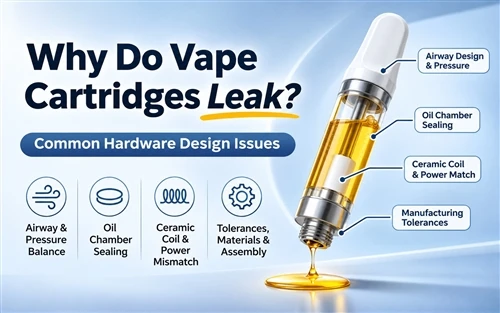
Leaking in a full ceramic cartridge is less common than in wick-based designs, but it can happen. The usual causes are overfilling beyond the reservoir's rated capacity, damaged or misaligned silicone seals at the base and mouthpiece, or thermal expansion pushing oil through the airflow path during air transport or storage in high temperatures.
Prevention comes down to fill discipline and storage. Fill to the rated volume, not to the brim. Store cartridges upright. Avoid leaving them in hot vehicles.
Burnt or Harsh Taste
A burnt taste from a ceramic cartridge almost always means the heating element ran dry - the wicking rate couldn't keep up with the vaporization rate. This happens when a user takes rapid consecutive draws without giving the ceramic pore network time to replenish oil at the heating zone, or when the oil level is too low to reach the wicking area.
The solution: pace your draws, and replace or refill the cartridge before the oil drops below the wicking line. If burnt taste appears with a full tank, the pore size may be too small for the oil's viscosity, and a cartridge with a coarser pore structure is the right fix.
How to Choose the Right Full Ceramic Cartridge
Selecting a full ceramic cartridge comes down to three variables: oil viscosity, desired flavor profile, and capacity requirements. The table below maps common use cases to spec recommendations.
|
Use Case |
Oil Type |
Capacity |
Pore Spec |
Priority |
|
Premium THC distillate |
Distillate |
0.5–1.0 ml |
Fine |
Flavor purity |
|
Live resin vape |
Live resin |
0.5–1.0 ml |
Medium |
Terpene preservation |
|
Full-spectrum rosin |
Live rosin |
0.5 ml |
Coarse |
Wicking reliability |
|
CBD wellness line |
CBD distillate |
1.0 ml |
Fine to medium |
Consistency |
|
High-terpene concentrate |
Terpene-rich blend |
0.5 ml |
Tuned to base |
Balanced delivery |
The right cartridge isn't always the most expensive one. It's the one whose pore structure, heating profile, and material composition match the oil you're putting in it. For brands evaluating different designs, products such as the ZING full ceramic cartridge provide a practical starting point for exploring full ceramic hardware options.
FAQ
Are Full Ceramic Cartridges Completely Metal-Free?
Not necessarily. A full ceramic cartridge typically uses ceramic components for key parts such as the center post, mouthpiece, and heating structure. However, some designs also include glass reservoirs, metal electrical contacts, or integrated resistance traces. For THC/CBD brands evaluating material safety, it is important to verify the actual oil-contact materials and request appropriate material testing rather than relying solely on the "full ceramic" designation.
Is a Full Ceramic Cartridge the Same as a Ceramic Coil Cartridge?
No. A ceramic coil cartridge generally refers to a cartridge that uses a ceramic heating element, while other components, including the center post, may still be metal. A full ceramic cartridge typically incorporates additional ceramic components in the oil-contact or vapor-path structure. Both designs use ceramic heating technology, but their material construction and performance characteristics can differ.
Can Full Ceramic Cartridges Be Used for Live Resin and Live Rosin?
Yes. Full ceramic cartridges can be suitable for live resin, live rosin, and other terpene-rich cannabis oils. However, compatibility depends on oil viscosity, ceramic pore structure, intake design, heating temperature, and voltage settings. High-viscosity oils may require specially optimized ceramic heating cores and oil-flow configurations to prevent clogging, weak vapor, or burnt taste.
Are Full Ceramic 510 Cartridges Compatible With All 510 Batteries?
A full ceramic 510 cartridge is generally designed to connect with compatible 510-thread batteries. However, having the same thread connection does not guarantee optimal performance. Battery voltage, cartridge resistance, power output, and heating characteristics must also be compatible with the cannabis oil formulation and the cartridge's ceramic heating element. These factors are important when choosing compatible 510 cannabis vape cartridge hardware.
Do Full Ceramic Cartridges Prevent Clogging, Leaking, and Burnt Taste?
Full ceramic construction can help improve heating consistency and reduce certain material-related problems, but it does not completely eliminate clogging, leaking, or burnt taste. These issues can still occur when the oil viscosity, ceramic pore size, intake design, voltage, or sealing structure is not properly matched. Selecting oil-matched cannabis vape hardware and conducting sample testing are important steps for improving reliability.
Conclusion
A full ceramic cartridge is a cannabis vape cartridge that uses a porous ceramic heating structure and typically incorporates ceramic components in its oil-contact and vapor-path design. It works by drawing cannabis oil through microscopic pores via capillary action, then using an integrated resistance heating element to atomize the oil. Its key advantages are flavor integrity, thermal stability, broad oil compatibility, and consistent vaporization performance when the hardware is properly matched to the oil formulation.
ASM VAPE is a professional cannabis vape hardware manufacturer and OEM/ODM solutions provider specializing in ceramic atomization technology, full ceramic cartridge options, and oil-matched hardware solutions for THC/CBD brands. If you're developing a new cannabis vape product line or evaluating cartridge hardware for your oil formulation, contact ASM VAPE to discuss your technical requirements, customization options, and project needs.