Airflow design determines how air enters a cannabis vape cartridge, passes through the heating area, carries aerosol through the center airway, and exits through the mouthpiece. It affects draw resistance, vapor density, flavor, coil temperature, condensation, and pressure inside the cartridge.
A high-quality ceramic core cannot compensate for a poorly designed airflow path. When airflow does not match the oil, heating system, and cartridge structure, the result may be common 510 cartridge problems such as weak vapor, tight draws, clogging, flooding, or leakage.

What Does Airflow Design Control in a Cannabis Vape Cartridge?
Vape cartridge airflow design includes much more than the size of the visible air holes. It covers the complete path that air follows through the hardware.
Important design variables include:
- Air intake position, number, and diameter
- Center airway diameter and length
- The narrowest point inside the airflow path
- Space around the heating element
- Mouthpiece cavity design
- Sealing structure
- Compatibility between the cartridge and 510 battery
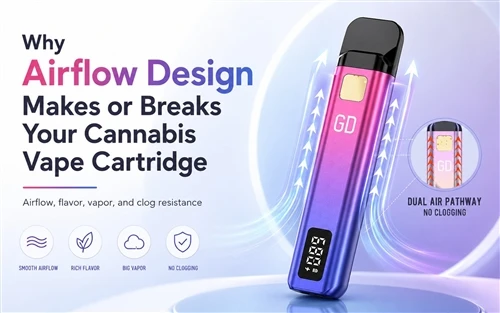
During a draw, air enters through the intake holes and moves across or around the heating element. The aerosol then travels through the center airway to the mouthpiece.
Any restriction, misalignment, or liquid buildup along this route can change cartridge performance. The effective airflow is therefore controlled by the entire pathway, not by one hole or one dimension.
How Airflow Affects Flavor, Vapor Density, and Temperature
Airflow changes how concentrated the aerosol feels and how quickly heat leaves the atomization area.
Flavor and Vapor Concentration
A moderately restricted draw can produce denser-feeling vapor because less outside air dilutes the aerosol. This may make terpene notes feel more concentrated.
A more open airflow path can create an easier draw and stronger cooling, but excessive airflow may make the vapor feel thin if the heating power is not adjusted to match it.
The best airflow is not simply the tightest or most open option. It should deliver enough vapor concentration without creating excessive draw resistance.
Cooling and Thermal Balance
Air acts as a cooling variable. Low airflow can allow heat to build around the ceramic core, especially when the voltage is too high. Excessive airflow can cool the system faster than the heater can vaporize the oil.
This relationship affects:
- Vapor temperature
- Flavor stability
- Terpene expression
- Aerosol density
- Puff-to-puff consistency
Airflow and heating power must be calibrated together. Changing one without considering the other usually creates a new performance problem.
Why Poor Airflow Causes Clogs, Flooding, and Leaks
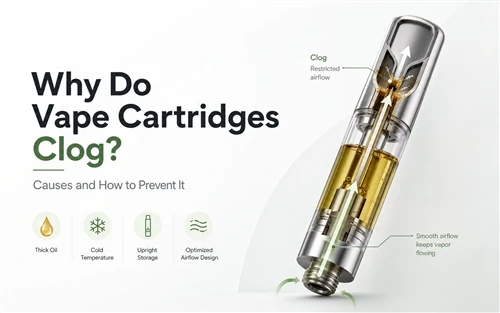
Clogging often develops inside the airway after repeated use. Vapor leaves the heating area, enters a cooler section of the cartridge, and partially condenses on the internal walls.
Over time, this residue narrows the effective airflow path. A cartridge that draws normally when new may become increasingly restricted as condensation accumulates.
Condensation and Airway Restriction
Common signs of a restricted airway include:
- Increasing draw resistance
- Oil or condensation near the mouthpiece
- Weak or inconsistent vapor
- A blockage after the cartridge has been left unused
- Complete loss of airflow
Short airways are not automatically clog-resistant, and wider airways are not automatically better. The mouthpiece cavity, temperature difference, internal surfaces, and condensation collection space all affect how residue builds up.
Pressure Imbalance, Flooding, and Leaks
When a cartridge becomes difficult to draw, users often inhale harder. This creates a larger pressure drop inside the device.
That stronger negative pressure can pull excess oil into the heating chamber or center airway. The result may be gurgling, spitback, internal flooding, mouthpiece leakage, or oil around the battery connection.
Clogging and leaking can therefore reinforce each other. Restricted airflow changes the internal pressure conditions, while excess oil and condensation further reduce the available airway.
Airflow Must Match Oil Viscosity and Heating Power
Oil viscosity describes how strongly a liquid resists flowing. In cannabis vape hardware, viscosity is not fixed. It changes with temperature, formulation, terpene content, and repeated heating.
A cartridge designed for one distillate formulation may not perform the same way with live resin or live rosin.
| Oil Type | Typical Hardware Concern | Airflow and Heating Priority |
|---|---|---|
| Distillate | Overfeeding or leakage in warm conditions | Controlled oil intake and stable draw resistance |
| Terpene-rich oil | Lower viscosity and greater volatility | Leak control and condensation management |
| Live resin | Variable viscosity and terpene content | Balanced heating, airflow, and vapor cooling |
| Live rosin | Thick flow and complex composition | Efficient oil feeding, gentle heat, and clog resistance |
High-viscosity oil does not automatically require a tighter draw. An overly restricted airflow path may force the user to pull harder and increase oil migration into the airway.
The correct solution is to match airflow with the intake aperture, ceramic core, preheat function, voltage, and actual oil behavior.
Key Airflow Design Variables Buyers Should Evaluate
The visible intake holes reveal only a small part of the airflow system.
Air Intake and Airway Geometry
Key structural questions include:
- Where does air enter the cartridge?
- How many airflow paths are available?
- What is the narrowest section of the airway?
- Does the cartridge use a center-post or postless structure?
- Can the battery connection partially block the intake?
- Is airflow distributed evenly around the heating element?
Dual airflow paths may reduce the effect of one localized blockage. Postless designs may remove some internal obstruction points. Neither design guarantees better performance unless sealing, heating, oil intake, and manufacturing tolerances are also controlled.
Heating Core, Mouthpiece, and Condensation Control
The airflow path should move aerosol away from the heating area without carrying unvaporized oil into the mouthpiece.
Useful design features may include:
- Space for condensation collection
- A mouthpiece structure that reduces spitback
- Smooth transitions without sharp restrictions
- Even airflow around the ceramic heating surface
- Separation between the oil reservoir and center airway
A good design remains stable after repeated use, not only during the first few test puffs.
Why the Same Cartridge Performs Differently on Different 510 Batteries
A 510-thread cartridge does not operate independently from the battery. The battery can change both airflow and heating performance.
Different batteries may have different:
- Top airflow hole positions
- Connection depths
- Voltage outputs
- Preheat programs
- Auto-draw sensor sensitivity
- Air intake clearances
Overtightening a cartridge can partially cover the intake or place stress on the connection. An airflow path that is too open may also create too little pressure change to trigger some auto-draw sensors reliably.
This is why 510 cartridge airflow should be tested across several common battery platforms. A cartridge that performs well on one battery may feel tighter, weaker, or less responsive on another.
How Cannabis Brands Should Test Airflow Before Mass Production
Airflow should be tested with the final oil formulation, not a substitute oil with a similar appearance.
Run a Pilot Test with the Real Oil
A pilot batch of approximately 50 to 100 filled cartridges can help reveal recurring compatibility or process problems before full production.
Initial testing should include:
- Low, room, and warm temperatures
- Upright and horizontal storage
- Long periods between uses
- Different voltage settings
- Several common 510 batteries
- Early, middle, and late cartridge life
A one- to two-week evaluation can expose early clogging, leakage, and oil migration problems. It should be treated as an initial screening stage rather than a full shelf-life study.
Measure Performance, Not Just First Impressions
Brands should record more than whether a cartridge "hits well."
Useful observations include:
- Initial and later draw resistance
- Vapor consistency
- Auto-draw activation
- Gurgling or spitback
- Mouthpiece condensation
- Bottom leakage
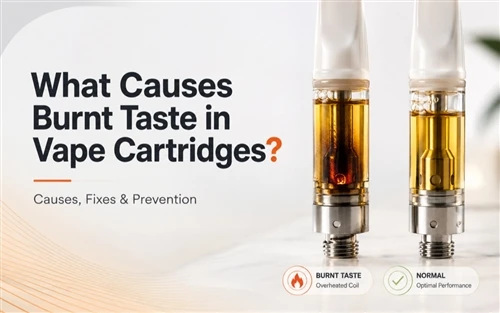
- Dry hits and burnt flavor
- Failure rate under each test condition
Filling temperature, fill volume, capping time, and post-fill resting procedures should also be standardized. Even a strong airflow design can fail when the filling and capping process forces oil into the airway.
The Best Airflow Is the One Designed for Your Oil
There is no universal best airflow setting for a cannabis vape cartridge. The right design is the one that keeps oil feeding, pressure, heating, aerosol transport, and condensation under control for the intended formulation.
ASM VAPE develops customizable cannabis vape hardware for distillate, live resin, live rosin, and other oil formulations. Explore our customization services or contact us to discuss cartridge airflow, ceramic core selection, voltage settings, sample testing, and OEM/ODM options for your next project.