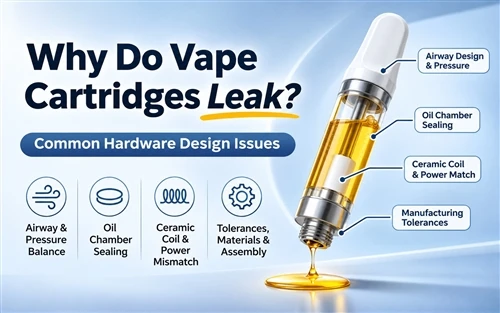
Oil intake design is the single most overlooked variable in cannabis vape hardware performance. Most weak vapor, clogging, and leaking complaints trace back to a mismatch between how oil reaches the heater and the physical properties of the oil itself - not to bad oil, not to a defective battery. The intake structure sits at the intersection of oil delivery, heating, and airflow, and getting it right determines whether a cartridge performs from the first puff or fails on the shelf.

What Oil Intake Design Controls in Cannabis Vape Hardware
Oil intake design refers to the engineered pathway - intake holes, ceramic wicking channels, and the gap between the oil reservoir and the heating element - that governs how cannabis oil travels from the tank to the atomizer core. It is not a single part. It is a system of openings, capillary structures, and sealing interfaces that together set the feed rate.
That feed rate controls three things simultaneously: how quickly oil reaches the heater on a cold start, how steadily oil replenishes the wick during continuous draws, and how much oil sits exposed to the airway where it can condense and cause clogging. Every performance symptom - weak first puff, flooding, dry hits, leaking - maps back to one of these three control points.
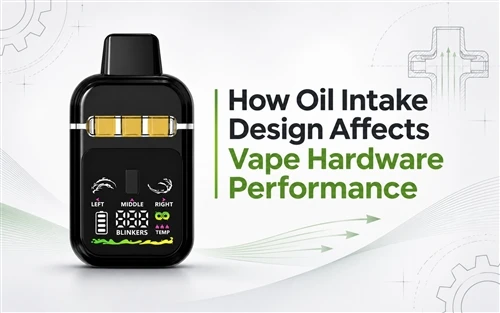
Hardware manufacturers produce vape cartridge oil intake holes in a range of diameters, commonly from roughly 1.2 mm to 2.0 mm. Thicker oils require wider intake openings to sustain flow; thinner oils need narrower openings to prevent the atomizer from flooding. There is no universal intake size. The correct diameter is always a function of the oil it must feed.
How Cannabis Oil Viscosity Affects Oil Intake Design
Cannabis oil viscosity is the measure of how resistant a given oil is to flow - effectively, how thick or thin it is at a given temperature. It is the primary physical property that oil intake design must accommodate, and it varies dramatically across extract types.
Distillate, the most processed and typically thickest extract, flows slowly and requires sustained heat to remain fluid. Live resin and live rosin, which retain more natural plant compounds, tend to be somewhat more workable but still demand careful hardware matching. Delta-9 oil and liquid diamonds occupy their own viscosity ranges. Each type behaves differently under the same intake geometry.
Temperature compounds the problem. Below approximately 20°C, cannabis oil thickens noticeably. A cartridge that performs well at room temperature can produce a weak or empty first puff in a cold environment because the oil has effectively stalled in the intake channel. This is not a hardware defect - it is a viscosity-driven flow failure that the intake design either mitigates or amplifies.
|
Extract Type |
Typical Viscosity |
Intake Requirement |
Common Hardware Match |
|
Distillate |
High (thick) |
Wider intake holes, sustained heat |
Center-post structure |
|
Live resin |
Medium-high |
Balanced intake, moderate wicking |
Postless or center-post |
|
Live rosin |
Medium |
Balanced intake, clean flavor priority |
Postless ceramic coil |
|
Delta-9 oil |
Medium-low |
Narrower intake to prevent flooding |
Postless ceramic coil |
|
Liquid diamonds |
Variable |
Tuned intake per batch |
Postless with large ceramic core |
Matching intake geometry to oil viscosity is not optional. It is the difference between a cartridge that delivers consistent vapor across its full life and one that clogs on day three.
How Ceramic Coils Control Oil Wicking and Vaporization
The porous ceramic core is the component that bridges the intake and the heater. It is a sintered ceramic body whose internal micro-pores draw oil from the intake channel to the heating surface through capillary action - the same physical principle that lets a paper towel pull water upward against gravity.
Ceramic atomizer oil flow depends on two structural properties of the core: porosity and contact area. Porosity determines how much oil the core can hold and how fast it can wick. Too low, and the heater starves between draws, producing dry hits and burnt flavor. Too high, and oil saturates faster than the heater can vaporize it, leading to flooding and leaking through the airway.
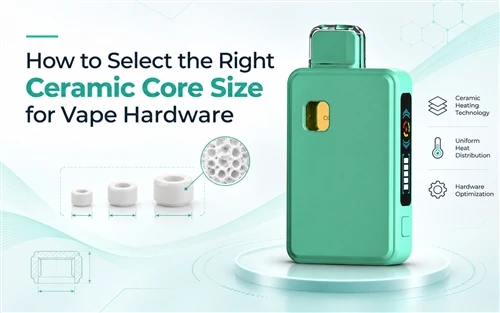
Contact area matters just as much. A smaller ceramic core has less surface area in contact with the oil, which means weaker first puffs and difficulty atomizing thicker extracts. A larger ceramic core increases heating efficiency while maintaining a low resistance value - the heater can draw more oil across a bigger surface and vaporize it faster. This is why low-resistance devices with undersized cores still struggle: resistance and core size must scale together.
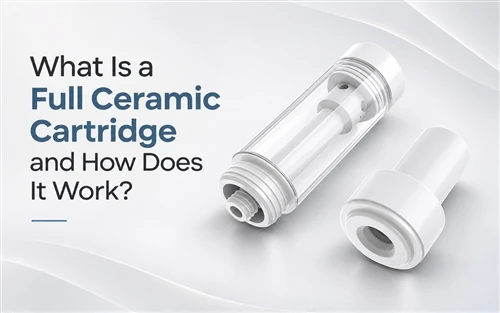
From internal product data, the relationship is straightforward. Increasing the ceramic core size raises the oil-to-heater contact area, which improves both cold-start performance and sustained vapor output. The trade-off is physical space - a larger core demands a larger cartridge footprint and tighter sealing tolerances. A full ceramic vape cartridge is one example of a hardware configuration built around ceramic components.
Center-Post vs. Postless Vape Hardware: Oil Intake Differences
The two dominant intake architectures in cannabis vape hardware are the center-post structure and the postless structure. They represent fundamentally different approaches to moving oil from the tank to the heater, and each has a clear extract-type affinity.
Center-Post Structure
A center-post cartridge uses a metal post running through the center of the oil chamber. The post contacts the oil directly and serves as the heating element - it carries resistance and generates heat, which melts thick oil and drives it toward the atomization surface.
This design excels with distillate. The metal post's direct heat transfer keeps high-viscosity oil fluid enough to flow through the intake and onto the wicking surface. The trade-off is that metal-to-oil contact introduces a risk of metallic contamination, and the post itself occupies center-channel space that could otherwise serve airflow.
Typical operating parameters for center-post hardware fall in the range of 1.0Ω to 1.2Ω resistance at 2.8V to 3.3V - a higher-power profile suited to melting and vaporizing thick distillate.
Postless Ceramic Coil
The postless ceramic coil eliminates the center post entirely. A full ceramic coil sits at the bottom of the chamber, creating an open oil delivery system with no metallic obstruction in the oil path. Oil feeds directly onto the ceramic heating surface through the intake structure. A postless vape cartridge provides a practical example of this hardware architecture.
The advantages are significant. Without a metal post in contact with the oil, flavor stays cleaner - no metallic aftertaste. Heat distributes more uniformly across the ceramic surface. The open delivery path reduces clogging because oil flows freely rather than being channeled through a narrow post gap. Fewer structural penetrations mean fewer leak points. And the first puff delivers large vapor volume because the full ceramic surface is immediately available for atomization.
The limitation is real, though. Postless hardware struggles with extremely thick oils because it lacks the direct conductive heating that a metal post provides. It is better suited to live rosin, live resin, and Delta-9 oil - extracts whose viscosity falls in a range the open ceramic surface can handle without a pre-melt stage.
Typical postless parameters range from 1.4Ω to 1.8Ω resistance at 2.2V to 2.8V - a lower-power, lower-temperature profile that preserves the terpene integrity of premium extracts.
|
Parameter |
Center-Post |
Postless Ceramic Coil |
|
Intake mechanism |
Metal post heats oil directly |
Open delivery to full ceramic surface |
|
Best oil match |
Distillate |
Live rosin, live resin, Delta-9 |
|
Resistance range |
1.0Ω – 1.2Ω |
1.4Ω – 1.8Ω |
|
Voltage range |
2.8V – 3.3V |
2.2V – 2.8V |
|
Flavor cleanliness |
Risk of metallic note |
Clean, no metal contact |
|
First-puff vapor |
Moderate (requires heat-up) |
Large (immediate surface contact) |
|
Leak points |
More (post seal, base junction) |
Fewer (no center penetration) |
|
Thick-oil handling |
Strong (conductive heating) |
Limited (no pre-melt stage) |
The choice between center-post and postless is not about which is better in isolation. It is about which intake philosophy matches the extract's viscosity and the brand's flavor priorities.
How Oil Intake Design Causes Clogging and Leaking
Clogging and leaking issues are the two most common failure modes in cannabis vape hardware, and both are frequently rooted in oil intake design rather than in the oil or the battery.
Clogging
Clogging in cannabis vape hardware occurs when oil or condensation blocks the airway, restricting or fully stopping airflow. The mechanism is straightforward: narrow single-path intakes create a strong directional pull that drags oil into the airway during a draw. When the device cools, that oil condenses and solidifies in the airway, narrowing it further with each cycle until flow stops entirely.
Cold temperatures accelerate this dramatically. Thick THC oil that solidifies in a cold environment can block the intake channel itself - not just the airway - so that no oil reaches the heater at all. The result is a first puff that produces little or no vapor, followed by improvement after several draws as residual heat thins the oil.
Draw-activated devices compound the problem because their heating time on the first puff is typically very short. The heater fires briefly, does not generate enough sustained heat to thin cold oil in the intake, and the user gets a weak hit. Button-and-draw dual activation addresses this directly: the user can preheat the coil with the button before drawing, giving the intake channel time to warm and the oil time to thin.
Leaking
Leaking in cannabis vape hardware happens when oil passes through the intake faster than the heater can vaporize it, or when a sealing interface fails. In intake terms, this means the intake diameter is too large for the oil's viscosity - thin oil floods through a wide opening and overwhelms the ceramic core's wicking capacity. The excess oil has nowhere to go but through the airway or base seals.
Porous ceramic cores with excessively high porosity produce the same effect from the wicking side: the core saturates faster than the heater can clear it, and the surplus leaks. Intake diameter and ceramic porosity must be tuned as a pair - one controls how much oil enters, the other controls how much the core can hold and feed.
Wall-Hanging: Why Oil Stops Reaching the Coil
A separate intake-adjacent issue is wall-hanging. When oil volume drops low in the tank, thick oil adheres to the tank walls instead of flowing down to the bottom-mounted intake and coil. The intake is starved not because it is poorly designed but because the oil never reaches it.
Tank material is the primary variable here. Glass tanks significantly reduce wall-hanging compared to PCTG or plastic tanks, because oil releases more readily from glass surfaces. For brands formulating with thicker extracts, specifying a glass tank is one of the simplest intake-performance improvements available.
|
Failure Mode |
Root Cause in Intake Design |
Primary Fix |
|
Clogging (cold) |
Oil solidifies in narrow intake channel |
Button preheat; wider intake for thick oil |
|
Clogging (condensation) |
Narrow airway traps condensed oil |
Wider or multi-path airway design |
|
Leaking (flooding) |
Intake too wide for oil viscosity |
Narrower intake; lower ceramic porosity |
|
Leaking (seal) |
Excess oil overwhelms base seal |
Match intake to heater capacity |
|
Weak first puff |
Short heating time on draw activation |
Dual activation; larger ceramic core |
|
Wall-hanging |
Oil sticks to tank walls at low volume |
Glass tank; wider base intake geometry |
Most field complaints labeled as "defective cartridge" are intake-design mismatches wearing a different name. Diagnosing from the intake pathway rather than from the symptom usually identifies the fix.
How Airflow Affects Cannabis Vape Oil Delivery
Airflow is the variable that completes the performance equation. THC/CBD vape cartridge airflow refers to the engineered air path - from intake vents through the atomization chamber to the mouthpiece - that carries vapor to the user. It is the third leg of the three-variable system that determines vapor output: enough heat, fast enough oil delivery, and enough airflow to carry the resulting vapor.
Airflow and oil intake are coupled. A narrow, single-directional airflow path creates suction that pulls oil through the intake aggressively - useful for thick oils but a flooding risk for thin ones. A wider, balanced airflow path reduces that suction, which stabilizes oil delivery but may feel weak to users accustomed to a tighter draw. The intake diameter and the airflow path must be designed as a matched pair, not specified independently.
Unregulated batteries add another wrinkle. As a battery drains, its output voltage sags, which lowers coil temperature and reduces both vaporization rate and the heat available to thin oil in the intake. A cartridge that performs well on a fresh battery can underperform on a partially drained one - not because the intake changed, but because the heat driving oil flow through it dropped. Regulated output or voltage-matched hardware pairing prevents this drift.
Voltage and resistance must match the oil. A low-resistance coil on a high-voltage battery generates excess heat that can degrade terpenes and burn the ceramic surface. A high-resistance coil on a low-voltage battery cannot generate enough heat to atomize thick oil, regardless of how well the intake is designed. The intake delivers oil to the heater, but the electrical parameters determine whether that oil actually vaporizes.
How to Choose Vape Hardware for Different Cannabis Oils
Selecting the right cannabis vape hardware for a given extract comes down to four intake-related decisions, each driven by the oil's properties:
- Intake diameter: Match to viscosity. Thick oils (such as distillate oil) need wider openings, typically toward the 1.8–2.0 mm range. Thinner oils (Delta-9, some live resin formulations) need narrower openings, toward 1.2–1.5 mm, to prevent flooding.
- Core architecture: Choose center-post for distillate and other high-viscosity extracts where conductive pre-heating is needed. Choose postless ceramic coil for live rosin, live resin, and terpene-rich extracts where flavor cleanliness and first-puff volume matter most.
- Ceramic core size: Specify a larger core for thicker oils and for any application where cold-start performance is critical. The increased contact area compensates for viscosity-driven slow wicking.
- Tank material: Specify glass for any oil prone to wall-hanging. The material cost difference is marginal; the performance difference at low oil levels is substantial.
From internal product knowledge and field feedback, the most common pairing errors come from treating hardware selection as a cost or aesthetics decision rather than an oil-matching decision. A postless cartridge chosen for its clean look but loaded with distillate will underperform. A center-post cartridge chosen for its low cost but loaded with live rosin will deliver a metallic note that degrades the extract's premium positioning. The oil should select the hardware, not the other way around.
For brands evaluating high-viscosity formulations, disposable vape hardware for thick cannabis oil provides an additional product option to consider during hardware selection.
FAQ
How Does Oil Intake Hole Size Affect Vape Performance?
Oil intake hole size controls how easily cannabis oil moves from the reservoir toward the ceramic heating core. Larger openings generally support faster oil delivery for high-viscosity extracts, while smaller openings help regulate the flow of thinner oils. If the intake is too restrictive, the coil may receive insufficient oil, causing weak vapor or dry hits. If it allows too much oil through, flooding and leaking may occur. The ideal size depends on oil viscosity, ceramic wicking capacity, and the heating configuration.
Why Do Thick Cannabis Oils Need Different Intake Designs?
High-viscosity cannabis oils flow more slowly through intake channels and porous ceramic structures, particularly at lower temperatures. Without sufficient oil delivery, the heating element may not receive enough oil to maintain consistent vapor production. Wider intake openings, suitable ceramic core structures, and appropriately matched heating parameters can improve performance with thicker formulations. Hardware selection should account for the actual oil formulation rather than relying only on the extract category.
Can Poor Oil Intake Design Cause Burnt Taste or Dry Hits?
Yes. When the oil intake structure cannot replenish the ceramic wick as quickly as the heating element consumes oil, the heating surface may become insufficiently saturated. This can lead to dry hits, inconsistent vapor production, and burnt taste. Properly matching intake dimensions, ceramic porosity, heating power, and oil viscosity helps maintain a consistent oil supply during repeated draws.
How Can Cannabis Vape Brands Reduce Leaking Through Better Oil Intake Design?
Cannabis vape brands can reduce leaking risks by matching the intake hole dimensions and ceramic core porosity to the oil's viscosity and expected flow behavior. Excessive oil delivery can saturate the heating chamber, while poorly designed seals may allow oil to escape through the airway or base. Evaluating intake geometry, airflow, ceramic wicking performance, and sealing reliability together is important when selecting or developing vape hardware.
Conclusion
Oil intake design is the structural variable that determines whether a vape cartridge delivers consistent vapor or fails in the field. Intake diameter, ceramic core porosity and size, center-post versus postless architecture, airflow path geometry, and tank material each govern a specific aspect of oil delivery - and each must be matched to the viscosity profile of the extract it carries. Weak vapor, clogging, leaking, and wall-hanging are not random defects; they are predictable consequences of an intake design that does not match the oil. Getting the match right is the difference between a product that earns repeat purchases and one that generates returns.
As a professional cannabis vape hardware manufacturer and OEM/ODM solutions provider, ASM VAPE specializes in oil-matched hardware solutions, helping THC/CBD brands select and customize ceramic heating cores, oil intake structures, airflow configurations, voltage, resistance, and tank designs for different cannabis oil formulations. If you're developing a product using distillate, live resin, live rosin, or other cannabis extracts, contact ASM VAPE to discuss your oil compatibility requirements and explore a hardware solution tailored to your project.