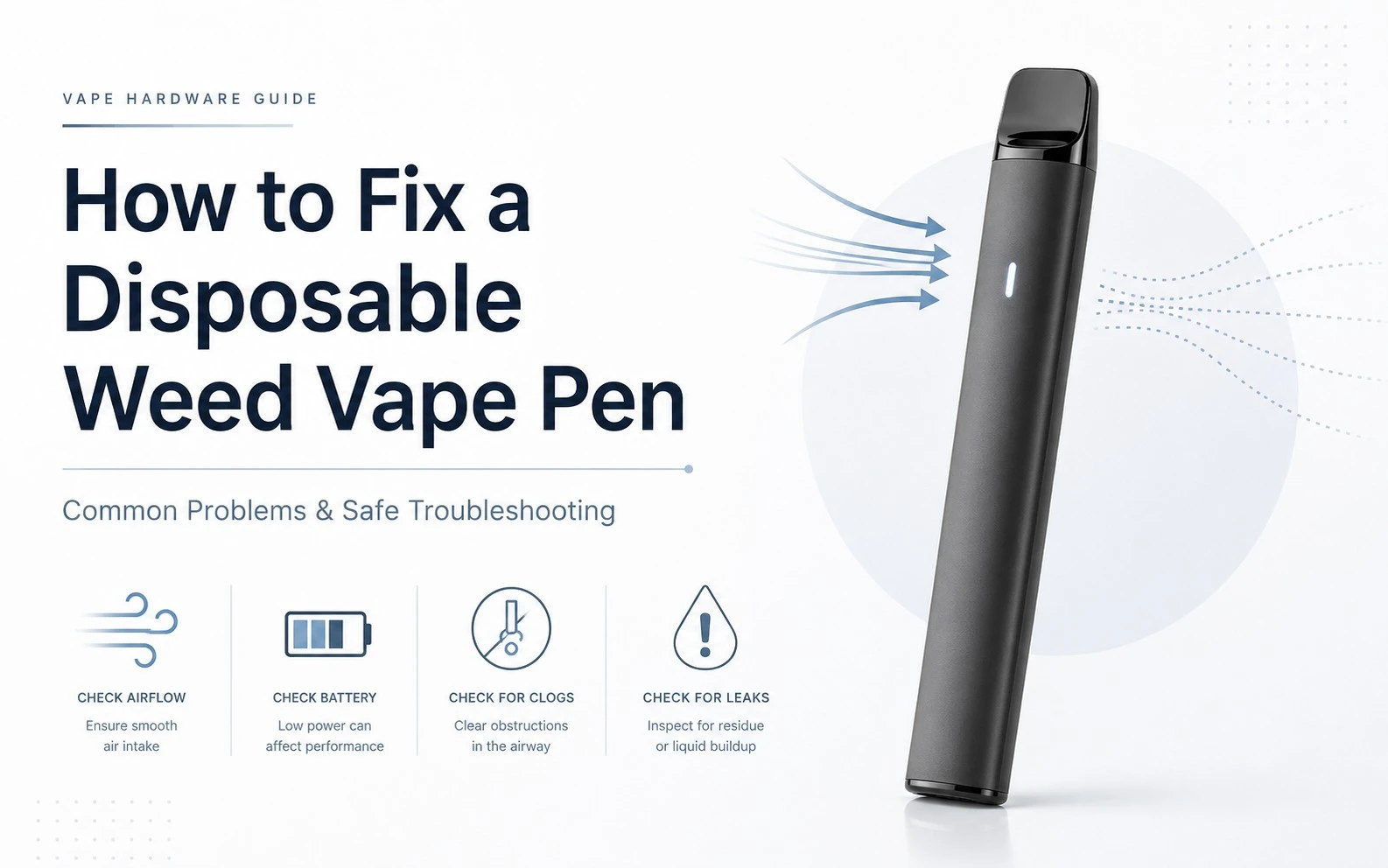
A disposable weed vape pen can stop working for several reasons: a dead battery, blocked airflow, thick cannabis oil, flooding, leaking, or a damaged heating core. Some problems can be solved with simple external checks. Others cannot be fixed safely. A disposable vape is not designed to be opened, rewired, refilled, or rebuilt, so the right approach is to identify the issue quickly, try safe troubleshooting, and stop using the device when the problem points to hardware failure.
Can You Really Fix a Disposable Weed Vape Pen?
A disposable weed vape pen is a one-time-use cannabis vaping device that combines the oil tank, heating core, battery, airflow channel, and mouthpiece into one sealed unit. Some models are rechargeable, but they are still not designed to be refilled or repaired like a reusable vape battery and cartridge system.
So the honest answer is this:
You can sometimes fix minor issues. You cannot fix serious hardware failure safely.
Safe troubleshooting usually means checking the mouthpiece, clearing visible residue, making sure the airflow holes are open, charging the device if it is rechargeable, and letting thick cannabis oil return to room temperature. These steps can help if the device is clogged, cold, or temporarily not feeding oil properly.
What you should not do is open the casing, reconnect wires, pry battery contacts, freeze the device, heat it aggressively, or transfer the remaining oil into another cartridge. Disposable vape pens contain lithium batteries, small electrical parts, and sealed oil chambers. Once those internal parts fail, the device is usually done.
If the pen has a burnt taste, severe leaking, a cracked body, charging problems, overheating, or no response after charging, replacing it is safer than forcing it to work.
How a Disposable Weed Vape Pen Works
A disposable weed vape pen works by heating cannabis oil into vapor through a small internal heating system. In cannabis vape hardware, the heating element is often a ceramic core, which is a porous ceramic heating structure designed to absorb and vaporize thick oils evenly.
The main parts include:
- Mouthpiece: the top part where vapor exits.
- Oil chamber: the sealed tank that holds cannabis oil.
- Ceramic core or heating core: the part that heats and vaporizes the oil.
- Battery: the power source of the device.
- Airflow path: the internal channel that allows air and vapor to move through the device.
- Air intake holes: small openings, often at the bottom or side, that allow air to enter.
- Charging port: only found on rechargeable disposable vape pens.
Cannabis oil refers to concentrated extract used in vape hardware, such as distillate, live resin, or live rosin. These oils do not always behave the same way. Distillate is often more stable and refined, while live resin and live rosin can contain more natural compounds and terpenes. High-viscosity oils move more slowly, especially in cold environments.
That is why many disposable weed vape problems are not random. If the battery cannot power the coil, the pen will not hit. If the airflow path is blocked, the sensor may not activate. If the oil is too thick or the ceramic core is not feeding properly, the device may light up but produce little or no vapor.
A disposable vape is simple for the user, but inside the device, battery output, airflow, oil viscosity, and ceramic heating must work together.
Quick Diagnosis: What Problem Are You Having?
Before trying to fix the pen, identify the symptom. This prevents unnecessary force and helps you decide whether the device is worth troubleshooting.
| Problem | Likely Cause | What You Can Try |
|---|---|---|
| Won't hit at all | Dead battery, blocked airflow, defective unit | Check airflow holes, charge if rechargeable, inspect for leakage |
| Light turns on but no vapor | Oil clog, poor oil feeding, damaged heating core | Warm gently in your hand, take short gentle pulls |
| Hard to pull | Mouthpiece clog or blocked airflow path | Remove visible debris, check intake holes |
| Blinking light | Low battery, long-puff cut-off, device protection | Recharge if possible, take shorter puffs |
| Gurgling or spitting | Flooding, excess oil in airflow path | Store upright, wipe mouthpiece, avoid hard pulls |
| Leaking oil | Heat exposure, pressure change, poor sealing, oil mismatch | Keep upright, wipe residue, stop if leaking is severe |
| Burnt taste | Dry hit, overheated coil, poor oil feeding, low oil level | Stop using it; usually not fixable |
| Dies before oil is empty | Battery capacity issue, oil too thick, hardware mismatch | Recharge if possible; non-rechargeable units cannot be restored |
Many disposable vapes also include an automatic cut-off after a long puff, often around 8–10 seconds. If the device stops during a long draw, it may not be broken. It may simply be protecting the battery and heating core from overheating.
A quick diagnosis saves time. More importantly, it helps you avoid turning a small clog into a leak, flood, or burnt coil.
How to Fix a Disposable Weed Vape Pen That Won't Hit
A disposable weed vape pen that won't hit usually has one of three problems: no power, blocked airflow, or poor oil feeding. Start with the simplest checks first.
Check the Airflow Holes and Mouthpiece
Airflow is the movement of air through the vape device. Most disposable vape pens have small intake holes at the bottom or side. If those holes are covered by your fingers, pocket lint, oil residue, or packaging debris, the device may feel hard to pull or may not activate at all.
Look at the bottom and mouthpiece area. If you see visible residue, wipe it gently with a clean dry cloth or cotton swab. Do not push metal tools deep into the device. Do not puncture the airway. The goal is to remove visible blockage, not to modify the internal structure.
If the pen is draw-activated, airflow is even more important. A draw-activated vape turns on when the device senses air movement. If the airflow path is blocked, the sensor may not trigger, even when the battery still has charge.
Check the Battery or Charging Port
A rechargeable disposable weed vape has a charging port, usually USB-C or micro-USB. If your device has one, connect it to a proper cable and a safe low-power charging source. Let it charge according to the brand's instructions.
If you are using a button-activated model, make sure the device is turned on correctly. For a more specific guide, read our article on how to use a disposable vape pen with button.
If the device has no charging port, do not try to charge it. A non-rechargeable disposable is not designed for external charging. Once the battery is dead, the device should be replaced.
A blinking light often means low battery, charging issue, or device protection. A solid light with no vapor usually means the battery is working, but the oil is not reaching the heating core properly or the coil is damaged.
Do not open the casing to inspect wires or battery contacts. That is not a consumer repair task.
If the Light Turns On but No Vapor Comes Out
If the light turns on but there is no vapor, the battery is probably still active. The problem may be oil feeding, clogging, or heating core failure.
Cannabis oil can thicken in cold temperatures. High-viscosity distillate, live resin, and live rosin may move slowly into the ceramic core when the device is cold. Hold the pen in your hand for 30–60 seconds and let it return to room temperature. Then take a few short, gentle pulls.
Do not take hard pulls. Hard suction can pull excess oil into the airflow path, creating gurgling, spitting, or leaking.
If the device still produces no vapor after airflow, charging, and gentle warming checks, the heating core may have failed. At that point, the pen is usually not fixable.
How to Unclog a Disposable Weed Vape Pen Safely
A clogged disposable weed vape is one of the most common problems with cannabis oil devices. A clog means vapor, oil residue, or condensed material is blocking the mouthpiece or airflow path.
Weed vape pens clog more easily than many nicotine disposables because cannabis oil is thicker. Live rosin disposable devices, live resin devices, and high-viscosity distillate devices can become harder to use in cold weather if the hardware is not matched to the extract. As vapor cools inside the mouthpiece, it may also condense and form sticky residue.
Light clogs can often be improved without damaging the device.
First, keep the pen upright. This allows oil to settle back toward the tank instead of pooling around the mouthpiece or airway. If the device has been stored sideways, give it a few minutes upright before using it again.
Next, warm it gently. Use your hand, not a flame, stove, boiling water, or aggressive heat source. The goal is only to reduce oil thickness slightly so it can move back toward the ceramic core.
Then take slow, short pulls. If the device has a preheat function, use it according to the manufacturer's instructions. A preheat function is a low-power warm-up mode designed to help thick oil flow before full vaporization.
Avoid these methods:
- Do not put the device in a freezer.
- Do not heat it with direct flame.
- Do not soak it in hot water.
- Do not force a metal tool deep into the mouthpiece.
- Do not pull extremely hard to "break" the clog.
- Do not open the device and move oil into another cartridge.
A light clog is manageable. A repeated clog is usually a sign of oil viscosity, airflow design, or ceramic core compatibility issues.
What to Do If Your Disposable Weed Vape Gurgles, Spits, or Leaks
Gurgling and spitting usually mean flooding. Flooding happens when too much oil or condensed vapor enters the heating chamber or airflow path. Instead of clean vapor, the device may produce bubbling sounds, weak vapor, hot droplets, or oil in the mouthpiece.
If your disposable weed vape gurgles, hold it upright and wipe the mouthpiece. Take shorter, slower pulls. Give the device 10–15 seconds between puffs so the ceramic core can stabilize and reabsorb oil properly.
Do not keep pulling hard. Hard draws can make flooding worse by pulling more oil into the airway.
Leaking is different. A leaking disposable weed vape may have oil around the mouthpiece, bottom airflow holes, charging port, or inside the package. Light residue can happen from condensation, but visible oil seepage is a warning sign.
Common leaking causes include high temperature, pressure changes during transport, long-term horizontal storage, overfilling, poor sealing, or oil that is too thin for the hardware. In cannabis vape hardware, leak resistance depends on the tank seal, airway structure, oil inlet design, and filling process. For a deeper breakdown of this issue, see our guide on how to fix a leaking AIO vape device.
If the device is badly leaking, stop using it. Oil near the battery area, charging port, or airflow sensor can affect performance and safety. A disposable vape that continues to spit oil into the mouthpiece should not be forced back into use.
A small amount of residue can be wiped. Active leaking is a hardware problem.
Why Your Disposable Weed Vape Tastes Burnt
A burnt taste is one of the clearest signs that a disposable weed vape pen should not be pushed further. It usually means the heating core is too hot, the oil is not feeding fast enough, or the oil level is too low to keep the ceramic core saturated.
A dry hit happens when the heating core heats without enough oil. The result is harsh vapor, burnt flavor, and sometimes a dry or metallic taste. Once the ceramic core or internal wick material is damaged, the flavor usually will not recover.
Burnt taste can come from several causes:
- The oil is too thick and cannot feed quickly enough.
- The user takes too many long puffs in a row.
- The voltage or wattage is too high for the oil.
- The oil level is low.
- The device was stored in heat and the oil degraded.
- The ceramic core does not match the oil viscosity.
Live resin and live rosin are especially sensitive to heat because their flavor depends heavily on terpenes. Terpenes are aromatic compounds that contribute to the flavor and aroma of cannabis extracts. Excessive heat can flatten the flavor, create harsh vapor, and increase the chance of burnt notes. For more detail, read our Live Rosin Vape Temperature Guide.
If your disposable weed vape tastes burnt once, let it rest. If the burnt taste continues, stop using it. A burnt disposable vape pen is usually not fixable.
When You Should Stop Trying to Fix It
Some disposable weed vape issues are not troubleshooting problems. They are failure signs.
Stop using the device if you notice:
- Severe leaking from the mouthpiece, bottom, or charging port
- Cracked body or broken mouthpiece
- Device overheating
- Battery swelling or unusual battery behavior
- No response after proper charging
- Persistent burnt, metallic, plastic-like, or chemical taste
- Oil repeatedly spitting into the mouthpiece
- Charging port damage
- No light and no vapor from a brand-new device
- A non-rechargeable disposable with a dead battery
A disposable weed vape should not be opened to repair internal wires, battery contacts, or the heating core. It should not be refilled unless it was specifically designed as a refillable product, which most disposable cannabis vape pens are not.
If the device was purchased through a legal dispensary or licensed channel, contact the retailer or brand for replacement guidance. If a new device arrives leaking, dead, or completely nonfunctional, it is likely a defective unit rather than something the user should repair.
The safest fix for a failed disposable is replacement.
How to Prevent Disposable Weed Vape Pen Problems
Most disposable vape problems can be reduced through better storage and use. The device is small, but cannabis oil is sensitive to temperature, pressure, and airflow conditions.
Store the pen upright when possible. This helps keep oil in the tank area instead of the mouthpiece or airflow channel. It also reduces the chance of flooding after long storage.
Keep the device at room temperature. A hot car can thin the oil and increase leaking. Cold weather can thicken the oil and cause clogging or weak vapor. If the pen is cold, let it warm naturally in your hand or pocket before use.
Take shorter, slower puffs. Long aggressive pulls can overheat the coil, trigger cut-off protection, or pull excess oil into the airway. If you take several puffs, wait 10–15 seconds between them. This gives the ceramic core time to re-saturate.
Keep the mouthpiece clean. Wipe visible residue before it hardens into a clog. Do not leave the device unused for months, especially if the oil begins to darken or taste off. Oil oxidation can affect flavor and performance.
For rechargeable disposables, use the proper cable and avoid overcharging. If charging becomes inconsistent, stop using the device rather than trying to repair the battery.
Good use habits cannot fix poor hardware, but they can prevent many common clogging, leaking, and burnt taste issues.
What These Problems Mean for Cannabis Brands
When one disposable weed vape pen fails, it may be a user issue, storage issue, or isolated defective unit. When many customers report the same problem, it is usually a hardware selection problem.
For cannabis brands, disposable vape performance depends on matching the device to the oil. Oil viscosity is the thickness and flow behavior of the extract. A live rosin device, live resin device, and distillate device may need different ceramic cores, oil inlet sizes, airflow paths, voltage settings, and preheat behavior.
A device that works well with thin oil may leak when filled with a lower-viscosity formula. A device with small oil inlets may clog or burn with thick solventless extracts. A battery with unstable output can create weak vapor at first and burnt flavor later.
Before mass production, brands should test:
- Ceramic core compatibility with the actual oil
- Oil inlet size for high-viscosity extracts
- Airflow smoothness and anti-clog design
- Leak resistance at high and low temperatures
- Battery capacity and contact reliability
- Stable low-voltage output
- Preheat performance
- Filling process compatibility
- Upright, inverted, and transport conditions
- Flavor stability over time
Common complaints such as "not hitting," "light on but no vapor," "burnt taste," "leaking," and "clogged after a few uses" should be treated as quality signals. They often point to oil feeding, sealing, airflow, or power output problems.
Better hardware reduces customer returns before they happen.
Final Thoughts
A disposable weed vape pen can sometimes be fixed with simple steps: check the airflow, clear visible mouthpiece residue, charge it if it is rechargeable, warm thick oil gently, store it upright, and avoid chain vaping. But if the device is burnt, badly leaking, cracked, overheating, or completely dead, it should be replaced rather than forced.
For cannabis brands, repeated disposable vape failures usually mean the hardware is not fully matched to the oil. ASM VAPE manufactures customizable cannabis vape hardware for distillate, live resin, and live rosin oils, with support for ceramic core selection, leak-resistant design, airflow optimization, and OEM/ODM customization. Contact us to discuss the right disposable vape hardware for your oil and market needs.
![How to Choose Vape Hardware for Delta 9 Oil [2026 Guide]](/uploads/43868/info/n20260923113103fe52e.jpg)