Live rosin oil is a solventless cannabis extract valued for its rich terpene profile, natural flavor, and premium positioning. But that same quality makes it sensitive to heat. For live rosin vape hardware, the goal is not simply to produce bigger vapor. The real target is stable low-temperature atomization that preserves flavor, feeds thick oil smoothly, and avoids burnt taste.
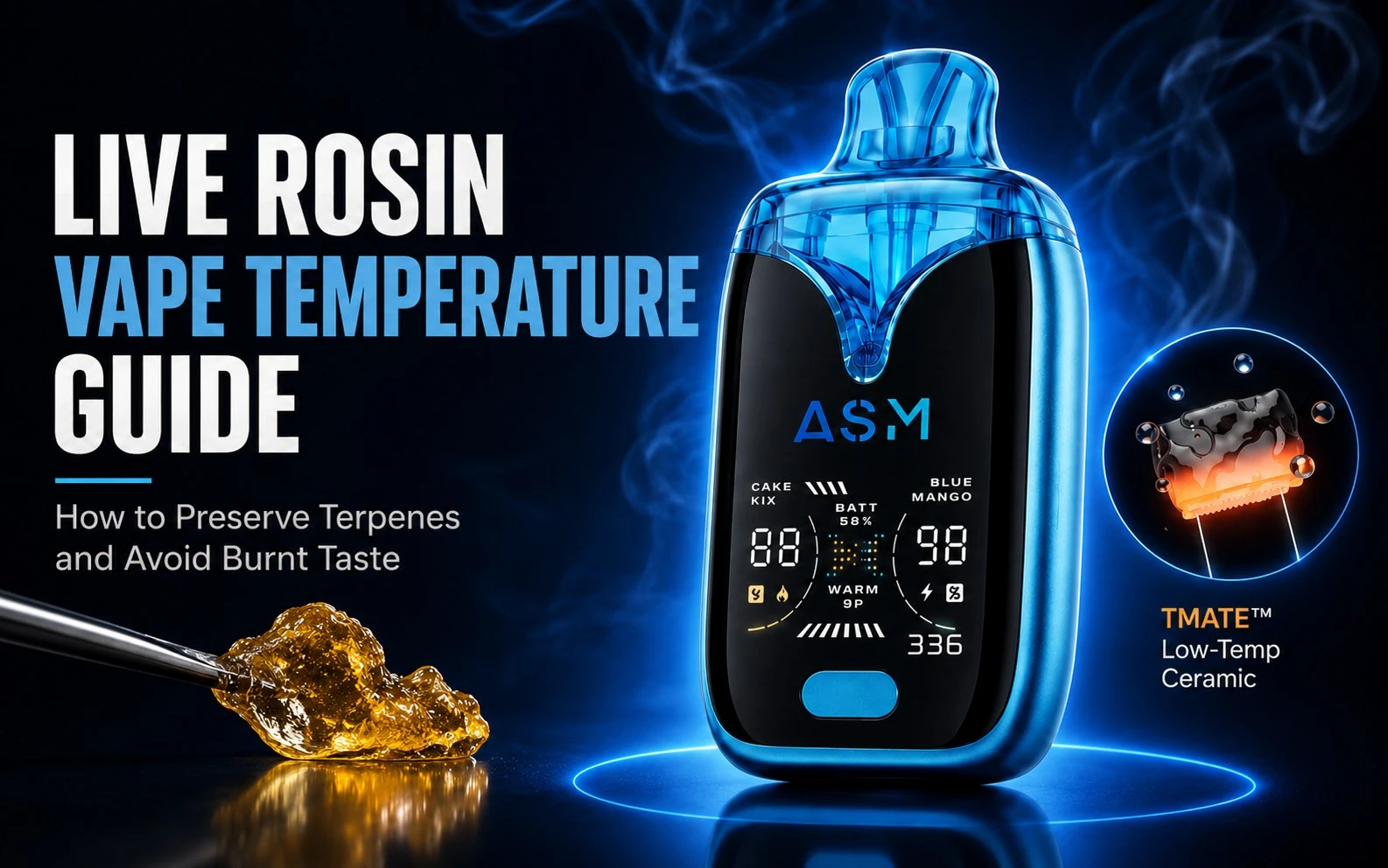
Why Live Rosin Oil Needs a Different Vape Temperature
Live rosin oil is made without solvents and usually carries more natural plant compounds than standard distillate oil. This gives it a fuller aroma and stronger strain-specific flavor, but it also makes the oil harder to vaporize correctly.
Compared with many distillate formulas, live rosin is often thicker. At lower room temperatures, it may move more slowly through the oil tank and into the ceramic heating core. If the hardware is not designed for high-viscosity oil, the coil may heat faster than the oil can feed. That is when dry heating, weak vapor, clogging, or burnt taste can happen.
Live rosin also contains delicate terpenes. Terpenes are aromatic compounds that shape the smell and flavor of cannabis oil. They are one of the main reasons customers choose live rosin instead of a lower-cost oil.
For this reason, live rosin vape hardware needs three things working together:
- Smooth oil feeding
- Stable low-temperature heating
- Controlled airflow and vapor path design
A device that works well for thin distillate may not be suitable for live rosin. The oil is different, so the heating strategy must be different.
What Is the Best Vape Temperature for Live Rosin Oil?
For live rosin oil, many professional customers prefer the atomization temperature to stay below 450°F, or about 232°C. This number is not random. It sits near the upper edge of a practical low-temperature range before flavor loss, harshness, and burnt notes become more likely.
In actual hardware tuning, a stable working range around 200–230°C is often more suitable for live rosin. This range gives enough heat to vaporize thick oil while reducing the risk of terpene degradation and localized overheating.
The point is not to make the device as cool as possible.
If the temperature is too low, the device may produce weak vapor, leave too much residue, or fail to move thick oil into the heating zone efficiently. If the temperature is too high, the vapor may become harsh and the terpene profile can flatten quickly.
The ideal live rosin vape temperature should be low, stable, and controlled. A short temperature spike can damage flavor even if the average output looks acceptable on paper.
Terpene Boiling Points and Why Heat Matters
Terpenes have different reference boiling points. These temperatures do not perfectly represent how every terpene behaves inside a complex cannabis oil formula, but they help explain why excessive heat can quickly affect live rosin flavor.
| Terpene | Reference Boiling Point |
|---|---|
| α-Pinene | 155°C / 311°F |
| β-Caryophyllene | 165°C / 320°F |
| β-Myrcene | 168°C / 334°F |
| Limonene | 176°C / 349°F |
| Linalool | 198°C / 388°F |
| Humulene | 198°C / 388°F |
Most common terpenes vaporize or become highly active below 220–230°C. That is why live rosin should not be treated like a high-temperature oil. Once the ceramic core overheats, the flavor may change before the user sees any obvious hardware failure.
The first sign is often not a burnt smell. It is a weaker, flatter flavor.
After that, the vapor may become dry, bitter, or harsh. At that point, the device is no longer protecting the terpene profile that gives live rosin its premium value.
Why Burnt Taste Happens in Live Rosin Vapes
Burnt taste in a live rosin vape is usually a warning sign of poor temperature control, slow oil feeding, or localized dry heating. It does not always mean the entire device is operating above one fixed temperature. In many cases, the problem happens in a small hot spot inside the ceramic core or around the oil inlet area.
Common causes include:
- The voltage or power output is too high
- The ceramic core heats faster than the oil can feed
- The oil is too thick for the intake hole design
- Residue or crystallization builds up around the heating area
- Airflow is not balanced with vapor production
- The device lacks a gentle preheat or stable output curve
For live rosin, burnt taste is more damaging than in lower-cost oil products. The customer is paying for natural flavor. Once the device burns the oil, the product experience feels cheap, even if the oil itself is premium.
A good live rosin vape should not force the user to choose between flavor and vapor. The hardware should provide enough heat for thick oil while avoiding the hot spots that cause carbonization and harshness.
Why Vape Temperature Is Hard to Measure Accurately
Vape temperature is not as simple as pointing an infrared thermometer at the device.
Infrared temperature guns work better for dry herb vaporizers, wax vaporizers, or other devices where the heating surface is exposed. In those cases, the measuring tool can read the surface temperature more directly.
Oil vape pens are different.
In a vape cartridge or disposable vape, the ceramic heating core is soaked with oil. The ceramic surface temperature, oil absorption rate, airflow cooling, oil viscosity, and battery output all affect the actual vaporization process. The number measured on the ceramic surface may not equal the true temperature of the oil as it vaporizes.
That is why professional hardware development cannot rely only on one surface reading. It needs heating curve data, oil compatibility tests, flavor testing, and clogging performance checks.
For live rosin, the final judgment must come from both data and real oil performance.
Heating Curve: How Stable Ceramic Heating Supports Live Rosin
A stable heating curve is one of the most useful ways to evaluate whether a ceramic core is suitable for live rosin oil. It shows how quickly the core rises in temperature and whether it stays within a controlled range instead of overshooting.
Below is a simplified test result from a 2403 black ceramic core.
| Item | Test Data |
|---|---|
| Ceramic Core | 2403 black ceramic |
| Resistance | 1.41Ω |
| Voltage | 1.58V |
| Core Size | 7.8 × 4.1 × 4.2 mm |
| Time | Ceramic Core Temperature |
|---|---|
| 0s | 27°C |
| 5s | 96°C |
| 10s | 152°C |
| 15s | 190°C |
| 20s | 216°C |
| 22s | 224°C |
| 24s | 228°C |
| 27s | 228°C |
The ceramic core rises from room temperature to about 216°C in 20 seconds, then stabilizes around 228°C after 24 seconds. Since 228°C is about 442°F, this heating curve stays below the commonly requested 450°F / 232°C upper limit.
This matters for live rosin because controlled heating helps reduce the risk of sudden temperature spikes. A smoother curve also gives thick oil more time to feed into the ceramic structure, which can reduce dry hits and burnt taste.
The data should be understood correctly. It shows the ceramic core's heating behavior under specific test conditions. The actual oil vaporization experience will still depend on oil viscosity, tank structure, airflow, and filling formula. But as a hardware indicator, a stable low-temperature curve is a strong foundation.

How TMATE™ Black Ceramic Helps Preserve Flavor and Prevent Clogging
TMATE™ Black Ceramic is designed for thick cannabis oils such as live rosin, rosin, live resin, and diamond blends. Its purpose is not only to heat oil, but to make the heating process more stable and oil feeding more reliable.
Faster Oil Feeding for High-Viscosity Extracts
Live rosin needs fast and consistent oil delivery. TMATE™ Black Ceramic uses micro-grooves and flow-channel structures on the ceramic surface. These structures increase capillary paths and surface area, helping thick oil move into the heating zone more smoothly.
Better feeding reduces the chance that the ceramic core runs dry during use. This is especially important for oils that become thicker in cooler environments.
Low-Temperature Ceramic Heating
Black ceramic has strong thermal performance and can support more even heat distribution. In practical use, this helps reduce localized overheating, which is one of the main causes of burnt taste.
For terpene-rich oils, even heating is more important than aggressive power. A stable ceramic core can vaporize thick oil without destroying the flavor profile too quickly.
Less Residue, Crystallization, and Clogging
High-viscosity extracts may leave more residue around the heating core and airway. Some formulas also have a higher risk of crystallization. TMATE™ Black Ceramic uses a special microstructure to reduce buildup and improve long-term oil movement.
This helps lower the risk of clogging, leaking, and inconsistent vapor output.
Stronger Ceramic Body
The ceramic body is made with ultra-high-temperature sintering to improve density and strength. This helps prevent ceramic powder shedding and improves crack resistance during use.
For brands working with premium oils, hardware stability is part of product quality. A good ceramic core should protect flavor, but it should also remain clean, durable, and consistent across the full oil volume.
How to Choose the Right Vape Hardware for Your Live Rosin Oil
There is no single vape setting that works for every live rosin formula. Different oils have different viscosity, terpene content, crystallization behavior, and distillate ratio. That is why hardware matching is critical before mass production.
Before choosing a disposable vape for rosin or cartridge for live rosin oil, prepare the following information:
| Information Needed | Why It Matters |
|---|---|
| Type of oil | Live rosin, live resin, rosin, distillate, or diamond blend require different heating strategies |
| Oil viscosity | Determines intake hole size, ceramic structure, and preheat needs |
| Distillate ratio | Affects flow speed and vapor output |
| Target experience | Flavor-first, balanced vapor, or stronger cloud production |
| Filling volume | Impacts tank design, oil pressure, and clogging risk |
For live rosin, the best hardware should keep temperature stable below the harsh zone, feed thick oil smoothly, and protect terpene flavor from the first puff to the last.
Live rosin vape temperature is ultimately about balance. Too much heat damages flavor. Too little heat weakens vapor and increases residue. The right ceramic hardware keeps the oil moving, the heating curve stable, and the flavor clean.
ASM VAPE provides customizable cannabis vape hardware solutions for live rosin, live resin, distillate, and high-viscosity extracts. Contact us to test the right ceramic core, voltage, airflow, and oil-feeding structure for your formula.
![How to Choose Vape Hardware for Delta 9 Oil [2026 Guide]](/uploads/43868/info/n20260923113103fe52e.jpg)