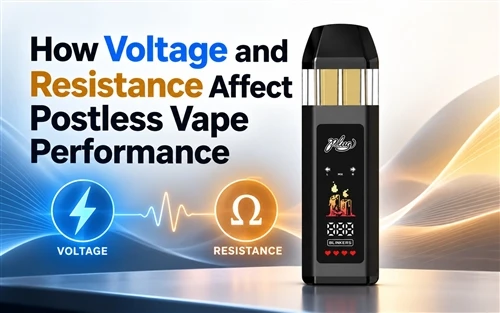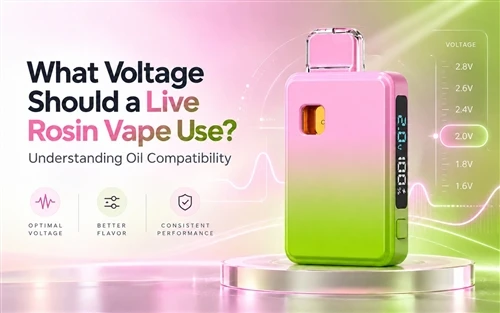
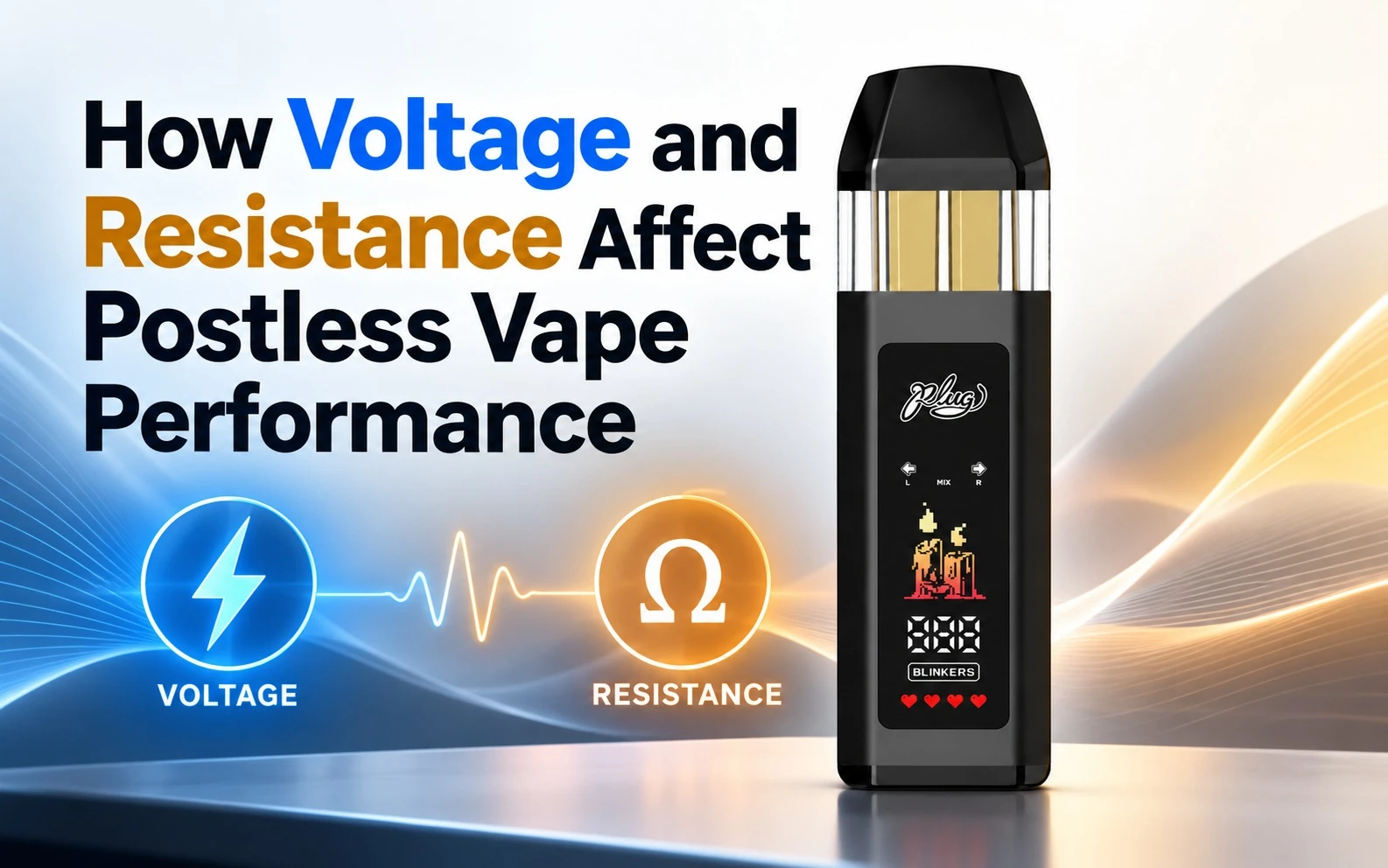
Voltage and resistance work together to determine how much electrical power reaches a postless vape's ceramic heating system. That power influences heating speed, vapor production, flavor delivery, oil consumption, and the risk of problems such as weak vapor or burnt taste.
For cannabis brands and hardware developers, however, there is no single "best voltage" or "best resistance." Postless vape performance depends on the complete oil-hardware combination: cannabis oil viscosity, ceramic coil architecture, heating surface area, airflow, intake design, resistance, voltage, and puff duration all matter.
Understanding how these variables interact makes it easier to select or customize postless vape hardware for distillate, live resin, live rosin, and other cannabis oil formulations.
How Postless Ceramic Coil Design Changes Oil Flow and Heating
Postless vape hardware-also called post-free vape hardware-removes the conventional metal center post from the oil chamber and typically moves the main ceramic heating structure toward the bottom of the reservoir. For a broader explanation of the architecture, see how postless vapes work.
This structural change affects much more than appearance. It changes how the oil reaches the heating surface, how heat is transferred into the oil, and how voltage and resistance should be configured.
Traditional Center Post Design
A conventional center-post structure routes oil and airflow around a central component. Depending on the hardware architecture, the metal post can also absorb and transfer heat into the surrounding oil.
Common characteristics include:
- A center post occupies space inside the oil reservoir.
- Oil can come into contact with additional metal surfaces.
- The heated center structure may help warm and mobilize thicker cannabis oil.
- Higher-voltage configurations are commonly used in some center-post hardware.
- The architecture can be well suited to distillate and formulations that require stronger heating.
In ASM VAPE's hardware experience, traditional center-post configurations are commonly associated with approximately 2.8–3.3V and 1.0–1.2Ω, particularly for distillate-focused vape hardware.
Postless Ceramic Design
A postless ceramic design removes the central metal post and provides a more open oil reservoir. In a common bottom-heating architecture, cannabis oil feeds directly toward a ceramic heating surface.
Potential advantages include:
- More open oil delivery pathways.
- A cleaner, more visually open oil chamber.
- Broad ceramic-to-oil contact area.
- Lower-temperature vaporization strategies.
- Strong first-puff vapor potential when ceramic size, wicking, and oil viscosity are properly matched.
- Greater suitability for flavor-sensitive oils such as live resin and live rosin.
ASM VAPE's postless hardware experience commonly falls around 1.4–1.8Ω and 2.2–2.8V, although actual configurations vary by ceramic platform and oil formulation. Its Unicore platform, for example, is used extensively across POST-FREE products and is positioned specifically around Resin/Rosin oil applications.
This illustrates an important point: removing the center post does not automatically make a device perform better. The postless ceramic coil still needs to be matched to the oil, voltage, resistance, intake design, and airflow.
How Voltage and Resistance Control Postless Vape Performance
Voltage and resistance are closely related, but they perform different roles inside a cannabis vape.
Voltage (V)
Voltage determines the electrical potential applied to the heating system. With the same resistance, increasing voltage increases electrical power significantly.
Typical performance tendencies include:
2.0–2.4V - Low Voltage
- Maximum flavor preservation
- Gentler heating
- Suitable for many terpene-rich formulations
- Commonly considered for live rosin and other heat-sensitive oils
2.4–3.2V - Medium Voltage
- Balanced vapor production and flavor
- Faster vaporization than low-voltage settings
- Useful across a wider range of cannabis oil formulations
3.2–4.2V - High Voltage
- Higher heating intensity
- Denser vapor potential
- Faster oil consumption
- Greater risk of overheating flavor-sensitive oils if the ceramic core and oil flow are not designed for the power level
These ranges should be treated as reference points rather than universal settings. A voltage that performs well with one ceramic coil may produce completely different results with another coil resistance, heater size, or oil viscosity.
Resistance (Ω)
Coil resistance influences how much current flows through the heater at a given voltage. For a deeper explanation of this relationship, see how resistance affects cannabis vape hardware.
In general:
Higher Resistance
- Requires less current at the same voltage
- Can support gentler heating strategies
- Often works well with lower-temperature cannabis vaporization
Lower Resistance
- Allows greater current at the same voltage
- Can support higher power output
- May generate more vapor when the ceramic heater and oil supply can keep up
A typical ceramic coil range for cannabis oil hardware is approximately 1.2–1.8Ω, but resistance alone does not tell you whether a postless vape will produce more vapor or better flavor.
This is particularly important in cannabis vape hardware. Two devices using the same 1.4Ω resistance can perform very differently if one has a larger ceramic heating surface, better oil contact, different airflow, or a different voltage output.
Ceramic core size also matters. A larger heating surface can increase the area contacting the cannabis oil, improving heating efficiency and vapor production without relying only on more aggressive electrical settings. This is why ceramic core size affects vape performance even when nominal resistance values appear similar.
For this reason, lower resistance does not automatically mean better postless vape performance. Resistance needs to be evaluated together with voltage, ceramic structure, oil flow, and heating surface area.
How Voltage and Resistance Work Together: Ohm's Law
The electrical relationship is straightforward:
P = V² ÷ R
Where:
- P = Power in watts
- V = Voltage
- R = Resistance
Because voltage is squared in the equation, relatively small voltage changes can create meaningful changes in electrical power.
For example, a 1.8Ω ceramic coil produces approximately:
- 1.8V → 1.80W
- 2.0V → 2.22W
- 2.2V → 2.69W
Increasing the voltage from 1.8V to 2.2V therefore raises theoretical electrical power by nearly 50%, even though the voltage changes by only 0.4V.
This relationship can be seen in actual post-free hardware configurations. ASM VAPE's UNIVERSE Pro variable-voltage post-free disposable vape uses a 1.8Ω ceramic configuration with 1.8V, 2.0V, and 2.2V settings, while the BLENDER post-free disposable vape uses 1.8Ω with 2.0V, 2.2V, and 2.4V. Another example, the PLUG dual-chamber postless cannabis vape hardware, uses 1.4Ω with 2.2V, 2.4V, and 2.6V settings.
These configurations demonstrate why resistance should never be evaluated in isolation.
Higher voltage combined with lower resistance increases available electrical power and can increase vapor output, but only when the ceramic heater receives oil quickly enough to support that heat. If power exceeds the oil delivery rate, flavor degradation or burnt taste can occur. If power is too low, weak vapor and incomplete vaporization may result.
Stable voltage delivery matters as well. Where an electrical design targets approximately ±0.1V output tolerance, maintaining that stability can help reduce puff-to-puff variation and provide a more consistent user experience.
The practical goal is therefore not maximum wattage. It is finding an appropriate operating window for the specific oil and ceramic platform.
Recommended Voltage and Resistance by Cannabis Oil Type
Different cannabis oils have different viscosity, terpene content, and thermal behavior. Hardware settings should reflect those differences.
|
Oil Type |
Characteristics |
Voltage |
Resistance |
Primary Goal |
|
Distillate |
High THC, low terpenes, medium viscosity |
2.8–3.2V |
1.3–1.6Ω |
Potency and efficient vaporization |
|
Live Resin |
High terpene content, fresh-frozen material, heat-sensitive |
2.4–2.8V |
1.4–1.7Ω |
Flavor preservation and balanced vapor |
|
Live Rosin |
Solventless, premium, high terpene content |
2.0–2.4V |
1.6–1.8Ω |
Maximum terpene preservation |
|
Liquid Diamonds |
THCA plus terpene sauce, relatively high viscosity |
2.8–3.2V |
1.2–1.5Ω |
Dense vapor and potency |
These figures are useful starting ranges rather than universal specifications. Even two live rosin formulations may behave differently because viscosity and formulation can vary significantly.
For terpene-sensitive formulations, brands evaluating live rosin vape temperature and terpene preservation should consider not only voltage but also ceramic heating characteristics and oil delivery. Hardware selection can also begin with oil-specific platforms designed for live rosin or live resin.
This is why oil-matched cannabis vape hardware should be developed from the formulation outward:
Cannabis oil → ceramic platform → heater architecture → voltage and resistance → airflow and intake → testing and refinement.
ASM VAPE applies this oil-matching approach across its cannabis vape hardware development. Rather than treating voltage or resistance as isolated specifications, configurations can be adjusted around oil type, viscosity, ceramic core, intake structure, airflow, and desired vapor performance.
For terpene-rich oils in particular, the objective is usually not maximum heat. It is controlled heat-enough energy for stable vaporization without unnecessarily overheating the oil.
Common Postless Vape Problems and How to Adjust Voltage or Resistance
Voltage and resistance mismatches often appear as familiar performance problems. However, electrical settings are only part of the diagnosis.
Burnt Taste
Possible cause: Voltage is too high for the oil, ceramic core, or available oil flow.
Optimization: Reduce voltage by approximately 0.2–0.4V and verify that coil resistance, ceramic saturation, and oil viscosity are compatible.
Increasing power faster than oil can reach the ceramic surface can create localized overheating even if the nominal voltage appears reasonable.
Weak Vapor
Possible cause: Voltage is too low, resistance is too high for the intended power level, the battery is undercharged, or the ceramic heater is not receiving enough oil.
Optimization: Increase voltage gradually and check battery charge, coil saturation, intake design, and ceramic heating area.
With thick THC oils, cold storage can also increase viscosity enough to delay the first puff. In these conditions, a preheat function or button-and-inhale activation system can help warm the oil before the main draw.
Ceramic size should also be considered. A heater with insufficient oil-contact area may struggle to produce a large amount of vapor quickly even if resistance appears suitable on paper. For more troubleshooting context, see the common causes of weak vapor in cannabis vape hardware.
Clogging
Possible cause: Oil is too viscous at the operating temperature, oil flow is restricted, or the device remains cold for extended periods.
Optimization: Use a preheat function where available, verify that the voltage is appropriate for the oil viscosity, and evaluate intake and airflow design rather than relying on voltage adjustment alone.
For high-viscosity cannabis oil, better oil delivery can be as important as additional power.
Short Coil or Battery Life
Possible cause: Excessive power draw, prolonged high-voltage operation, or unstable electrical output.
Optimization: Keep the device within its intended operating window, use stable voltage regulation, and implement temperature or power-management strategies where appropriate.
A higher voltage is not automatically an upgrade. Once adequate vaporization is achieved, extra power may simply increase battery drain, oil consumption, and thermal stress.
Best Practices for Matching Postless Hardware to Cannabis Oil
Match the Hardware to the Oil
Start with the target cannabis oil formulation rather than selecting a resistance number first.
Viscosity, terpene content, desired vapor density, ceramic heater geometry, intake size, airflow, voltage, and resistance should be evaluated as one system.
For an OEM/ODM project, the better question is not:
"What is the best voltage for a postless vape?"
It is:
"What voltage and resistance operating window works best with this oil on this ceramic platform?"
Prioritize Stable Output
Consistent electrical output helps maintain more predictable heating from puff to puff.
If a device is designed around tight voltage control, keeping the output close to its intended target-such as a ±0.1V design tolerance-can help improve consistency across the battery discharge cycle.
Validate the Oil-Coil-Voltage Combination
Electrical calculations are useful for narrowing the design range, but they cannot replace testing with the actual cannabis oil.
Brands should evaluate:
- Vapor production
- Flavor retention
- First-puff performance
- Burnt taste
- Clogging
- Oil consumption
- Oil flow and ceramic saturation
- Battery performance
- Performance after storage
- Consistency across repeated puffs
ASM VAPE's oil-based customization process can adjust heating core, voltage, resistance, capacity, and other hardware parameters according to the formulation and target performance, rather than forcing every oil into one fixed hardware configuration.
FAQs
What is the best voltage for a postless vape?
There is no universal best voltage for every postless vape. The correct setting depends on coil resistance, ceramic heater design, cannabis oil viscosity, terpene content, and desired vapor output.
Lower-voltage settings are commonly used for flavor-sensitive live resin and live rosin, while some distillate formulations may benefit from higher heating intensity.
Does lower resistance always produce more vapor?
No. Lower resistance can increase electrical power at the same voltage, but vapor production also depends on ceramic heating surface area, oil delivery, airflow, coil saturation, and voltage.
A smaller ceramic heater with low resistance may still produce weak vapor if it cannot transfer enough heat efficiently into the oil.
Why do many postless vapes use lower voltage?
Postless cannabis vape hardware often uses ceramic heating structures designed for controlled, relatively low-temperature vaporization. This approach can support terpene preservation and smooth vapor performance, particularly with live resin and live rosin.
The required voltage still depends on the resistance and ceramic architecture rather than the postless structure alone.
What voltage and resistance are suitable for live rosin?
A common starting range is approximately 2.0–2.4V with 1.6–1.8Ω resistance, but this should not be treated as a fixed rule.
Live rosin formulations vary in viscosity and terpene composition, so final settings should be validated using the actual oil and intended ceramic platform.
Can voltage and resistance be customized for an OEM cannabis vape project?
Yes. Voltage, resistance, heating core, airflow, intake design, capacity, and other parameters can be configured around a target cannabis oil formulation.
For cannabis brands developing private-label or ODM products, testing the actual oil before mass production provides a more reliable basis for selecting the final hardware configuration.
Conclusion
Voltage and resistance have a major effect on postless vape performance, but neither parameter should be optimized independently. Voltage determines the energy applied to the heater, resistance influences current and electrical power, while ceramic heater size, oil-contact area, wicking, airflow, and cannabis oil viscosity determine how effectively that energy becomes vapor.
For cannabis brands, the most useful approach is therefore not to search for one universally "best" voltage. The goal is to identify the right voltage-resistance operating window for a specific oil and ceramic platform, then validate it through real oil testing.
ASM VAPE is a dedicated cannabis vape hardware manufacturer and OEM/ODM development partner offering oil-matched postless, ceramic, AIO, POD, cartridge, and custom hardware solutions. If you are evaluating voltage, resistance, ceramic core, or other hardware parameters for a specific cannabis oil formulation, contact ASM VAPE to discuss your project and hardware requirements.