If you formulate, fill, or distribute live rosin vapes, you already know the problem: a batch ships out looking perfect, and within a week dispensary partners may start reporting clogged carts, burnt hits, weak vapor, or customers asking for refunds.
The culprit is not always the oil itself. In many cases, it is a mismatch between the extract's physical properties and the vape hardware architecture used to vaporize it.
Live rosin sits at the high-viscosity end of the cannabis oil spectrum. As a solventless cannabis extract, it retains a broad range of cannabinoids, terpenes, and other compounds while avoiding the use of hydrocarbon solvents during extraction. Like other cannabis concentrates, its physical behavior can differ substantially from less viscous oils used in conventional vape hardware.
When live rosin sits inside a vape cartridge or disposable device at room temperature-or especially in a colder environment-its flow behavior can change significantly. Oil may move more slowly through small intake channels, and residual material can accumulate in restricted vapor or airflow passages.
This is why the post-free vs center-post vape hardware comparison matters. The structure of the cartridge or all-in-one device can directly affect oil delivery, airflow, heating behavior, clog resistance, flavor, and overall vapor consistency.
For most live rosin applications, post-free vape hardware is a strong starting point. But architecture alone does not determine performance. The ceramic core, oil intake, airflow, resistance, voltage, and actual oil viscosity still need to work together.

How Post-Free and Center-Post Vape Hardware Differ
Before comparing their performance with live rosin, it helps to understand how the two hardware architectures work.
Center-Post Design: The Traditional Vape Architecture
A center-post cartridge is the architecture most people picture when they think of a conventional 510-thread vape cart.
A central post-often made from metal or incorporating ceramic components-runs vertically through the oil chamber. It provides a vapor path through the middle of the cartridge while the heating element is positioned around or near the bottom of the post.
Air enters from the base, passes the heating area, travels through the central vapor tube, and exits through the mouthpiece.
This design has been widely used in cannabis vape hardware because it is relatively simple, well understood by filling operations, and broadly compatible with conventional 510 battery systems. For thinner oils such as distillate, the predictable oil flow and established airflow structure can work very well.
In some center-post configurations, the central structure can also contribute to heat transfer around the oil chamber. For suitable formulations, this additional thermal energy can help keep oil moving toward the heating area and improve consumption of the remaining oil.
That is one reason center-post hardware remains useful rather than simply being an "older" technology. Brands working primarily with refined oils can also evaluate hardware specifically designed for distillate oil.
Post-Free Design: An Open Architecture for Resin and Rosin
Post-free vape hardware-also commonly called postless vape hardware-removes the conventional central post from the oil chamber.
Instead, the oil sits in a more open reservoir, while the ceramic heating element is typically integrated into the base of the chamber. Airflow can be routed through bottom or side channels rather than through one narrow central tube.
This creates more flexibility in how the manufacturer designs:
- Oil delivery
- Ceramic heating surface
- Intake geometry
- Vapor path
- Airflow
- Tank structure
For live rosin vape hardware, this can be especially useful because high-viscosity oil does not need to work around a conventional center post before reaching the heating area.
Post-free architecture is therefore more than simply "removing the metal post." It creates an opportunity to redesign the complete relationship between the oil reservoir, ceramic coil, intake system, airflow, and vapor path.
Brands comparing this architecture can review dedicated Postless Vapes platforms rather than judging hardware only by exterior form factor.
ASM VAPE's own hardware experience reflects this distinction. Conventional center-post configurations are generally better suited to formulations such as distillate, while post-free platforms are commonly used for Live Rosin, Live Resin, and similar oils. Typical post-free configurations also operate at lower voltage and heating power than many traditional center-post designs.
Why Live Rosin Is Harder on Center-Post Hardware
To understand why post-free vape hardware has gained traction for live rosin, it is useful to look at what can happen when a high-viscosity solventless extract is used in a more restricted center-post system.
The Clogging Problem
Live rosin's viscosity is one of the main challenges.
Unlike distillate, which is highly refined and generally flows more readily at room temperature, live rosin retains a broader range of plant-derived compounds and terpene-rich material. These characteristics contribute to its flavor and extract profile, but they can also make the oil behave more like a thick concentrate than a freely flowing liquid.
In a traditional center-post cartridge, the vapor channel inside the center structure can be relatively narrow.
When live rosin cools after a draw, residual oil or condensed vapor can settle in this restricted path. Over repeated use-or after sitting on a dispensary shelf-the buildup can gradually increase draw resistance and potentially contribute to clogging.
Post-free hardware reduces reliance on a narrow center tube. Wider bottom or side airflow paths provide more room for vapor to move through the device and can reduce the chance that one restricted passage becomes a complete blockage.
However, post-free does not mean clog-proof.
Very thick live rosin can still create poor oil flow if the oil intake, ceramic porosity, temperature, and airflow are poorly matched. Brands experiencing this problem should evaluate not only the architecture but also the broader hardware factors behind why live rosin vapes clog.
This is why evaluating cannabis oil viscosity should come before simply choosing an architecture.
Oil Starvation and Dry Hits
A second challenge is getting enough live rosin to the ceramic coil.
High-viscosity oil moves more slowly through porous ceramic and narrow oil intake structures. If the consumer takes a long draw or several draws in quick succession, the heating element may vaporize oil faster than the surrounding rosin can replenish it.
If the ceramic becomes insufficiently saturated, coil temperature can rise quickly. The result may be weak vapor followed by a harsh or burnt hit-exactly the type of experience premium live rosin brands want to avoid.
Many post-free designs place the ceramic heating structure directly below the oil reservoir, creating a wider oil-contact area and a shorter path between the oil and heater.
But the size of the ceramic heating area matters as much as its location.
One lesson from ASM VAPE's hardware development experience is that lower-voltage vaping does not necessarily have to produce weak vapor. A larger, properly designed ceramic heating surface increases the contact area between the oil and heating element, helping improve vaporization efficiency without relying only on higher voltage or excessive heat.
For live rosin, that balance can be more useful than simply increasing power.
Terpene Flavor and Heating Temperature
Live rosin's value is closely tied to flavor.
Consumers choose solventless extracts partly because of their terpene profile and strain-specific characteristics. Cannabinoids and terpenes are important chemical constituents of cannabis, and the broader scientific literature on cannabinoids and terpenes in cannabis helps explain why preserving the chemical profile of the extract matters to product quality.
Excessive heat, repeated dry heating, or unstable temperature can reduce the quality of that experience. Research on the thermal degradation of cannabis terpenes also supports the importance of avoiding unnecessary thermal stress.
This makes low-temperature ceramic vaporization particularly relevant when choosing vape hardware for live rosin.
Center-post hardware is not inherently too hot. However, a combination of slow oil replenishment, high power, and restricted airflow can create localized temperature spikes if the formulation is not properly matched to the hardware.
Post-free hardware can make it easier to design around lower-voltage ceramic heating and a larger oil-contact surface.
The key is not simply "lower temperature is always better." The goal is controlled heat transfer: enough energy to vaporize the rosin consistently, but not so much that the heater repeatedly outruns the oil supply. Controlled-temperature vaporization has also been studied in the context of cannabis vaporization.
Brands that want to explore this issue in more practical terms can also review how live rosin vape temperature affects flavor, terpene preservation, and burnt taste.
When Center-Post Vape Hardware Still Makes Sense
Post-free vape hardware is not universally better.
The right choice still depends on the formulation, production process, cost structure, and end-user requirements.
Distillate and Thinner Cannabis Oils
If the product contains distillate, CBD isolate, or certain thinner delta formulations, the extreme viscosity challenge may largely disappear.
These oils generally flow more readily through traditional oil intake structures and are less likely to behave like thick live rosin inside the device.
For suitable formulations, center-post hardware offers proven reliability, mature manufacturing, broad battery compatibility, and often a lower hardware cost.
ASM VAPE's own hardware knowledge also shows an important benefit of this design: in suitable center-post configurations, heat transferred through the central structure can help keep compatible oils fluid and assist in vaporizing oil remaining inside the tank.
This is why center-post hardware should not be treated as obsolete. It is simply better matched to certain oils.
Filling Line Compatibility
Center-post cartridges have been in mass production long enough that many automated and semi-automated filling lines are built around conventional cartridge dimensions and filling procedures.
The center structure provides a familiar geometry during filling, and standardized form factors can reduce adjustments between product runs.
If an operation already runs high-volume filling equipment designed around center-post cartridges, moving to a different post-free form factor may require adjustments to nozzles, jigs, filling depth, capping equipment, or operating procedures.
For large-volume projects, those considerations should be included in hardware selection.
Cost and Supply Chain Maturity
Center-post hardware also benefits from a highly mature manufacturing ecosystem.
Traditional configurations have been produced at scale for years, which can translate into competitive unit costs and broad component availability.
Post-free systems have become much more common, especially in premium resin and rosin categories, but the engineering complexity and ceramic platform used can still affect cost.
For a premium live rosin SKU, optimizing flavor and performance may justify the additional hardware investment.
For a high-volume distillate product, that calculation may be completely different.
Post-Free vs Center-Post Vape Hardware for Live Rosin: Side-by-Side Comparison
|
Dimension |
Post-Free Vape Hardware |
Center-Post Vape Hardware |
|
Clog resistance with live rosin |
Generally better because there is no conventional narrow central tube |
More dependent on center-channel geometry and oil behavior |
|
Oil delivery to ceramic |
Can use wider oil-feed geometry and larger ceramic contact area |
Often more dependent on inward wicking through intake and ceramic structure |
|
Airflow architecture |
Greater flexibility for bottom, side, dual, or multi-path airflow |
Usually routed through a central vapor path |
|
Low-temperature design |
Well suited to low-voltage ceramic configurations |
Can work well, but configuration must be carefully matched to high-viscosity oil |
|
Flavor preservation |
Strong potential when paired with stable low-temperature ceramic heating |
Performance depends heavily on saturation, power, and airflow |
|
Best oil match |
Live rosin, live resin, high-terpene oils and other suitable formulations |
Distillate and many thinner formulations |
|
Very thick rosin |
Still requires proper ceramic, intake, airflow, and preheat design |
May experience slow wicking or clogging depending on configuration |
|
Filling-line compatibility |
Depends on the device form factor |
Conventional designs are widely supported |
|
Cost |
Depends on ceramic platform and structural complexity |
Often benefits from a mature supply chain |
|
Customization potential |
High flexibility for ceramic, airflow and device architecture |
Mature platform with broad compatibility |
The most important takeaway from this comparison is that post-free does not automatically equal good live rosin performance.
It is an architecture-not a complete solution.
How ASM VAPE Matches Hardware to Live Rosin
At ASM VAPE, our hardware selection approach is based on a simple principle:
Not all cannabis oils work with the same vape hardware.
Rather than choosing a device based only on its appearance or whether it is labeled "post-free," we evaluate factors such as:
- Oil type
- Actual viscosity
- Ceramic core
- Ceramic heating surface
- Oil intake
- Airflow
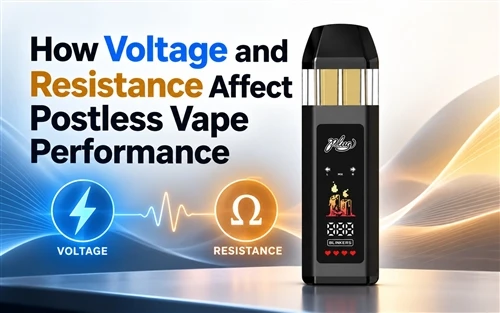
- Voltage
- Resistance
- Tank structure
- Activation method
- Intended vapor output
This Oil-Matched Hardware approach is designed to address common field problems such as clogging, leaking, burnt taste, weak vapor, poor airflow, and oil waste.
For live rosin, post-free architecture combined with low-temperature ceramic atomization is generally our preferred starting point. Brands comparing platforms can begin with a broader selection of vape hardware for live rosin and then narrow the configuration based on their actual formulation.
But it is not an absolute rule.
Extremely viscous rosin may still wick too slowly in a post-free device. In that situation, changing only the voltage may not solve the problem. The ceramic surface area, pore structure, oil intake geometry, airflow, and preheat behavior may also need to be adjusted.
This is why we describe hardware matching as a system rather than a single specification.
A Real Example: ASM VAPE's Unicore Post-Free Platform
ASM VAPE's current Unicore ceramic platform is positioned specifically for Resin/Rosin oils and is used extensively across POST-FREE hardware.
For example, several current Unicore devices use relatively low operating voltages:
- UNIVERSE: 1.8Ω, 2.2V
- UNIVERSE Pro: 1.8Ω, 1.8 / 2.0 / 2.2V
- UNICORN: 1.8Ω, 2.0V
- UNICORN Pro: 1.8Ω, 1.8 / 2.0 / 2.2V
- UNIT Pro: 1.8Ω, 1.8 / 2.0 / 2.2V
The UNIVERSE mini postless disposable vape, for example, combines a Post-Free structure with the Unicore platform and a 1.8Ω / 2.2V configuration.
The UNICORN postless live rosin vape pen provides another example of how the same Resin/Rosin-oriented ceramic platform can be implemented in a different device format.
These specifications illustrate an important engineering point: premium live rosin vape hardware does not need to depend on aggressive voltage to achieve useful vapor production. Heating efficiency, ceramic surface area, oil delivery, and the thermal characteristics of the complete system matter just as much.
ASM VAPE's product portfolio also includes Post-Free ceramic platforms operating at other resistance and voltage combinations, demonstrating that there is no single universal resistance or voltage for every resin or rosin formulation.
That is precisely why testing the actual oil matters.
How Cannabis Brands Should Choose Live Rosin Vape Hardware
If you are bringing a live rosin vape product to market, the following engineering decisions can have a significant impact on real-world performance.
Choose Post-Free Hardware as a Starting Point, Not a Guarantee
For most live rosin projects, post-free vape hardware is a logical first platform to evaluate.
An open reservoir, bottom ceramic heating structure, and flexible airflow architecture can make the device better suited to high-viscosity cannabis oils.
For brands that want a deeper explanation of the architecture itself, this guide to postless vape hardware covers how the design works, its advantages, and the oil types it is intended to support.
But always evaluate the complete system.
A poorly designed post-free device can perform worse than a well-matched center-post design.
Use a Ceramic System Designed for Resin and Rosin
A ceramic core developed around distillate does not automatically become a good ceramic coil for live rosin simply because it is installed in postless vape hardware.
Ceramic dimensions, surface area, porosity, heating behavior, and oil contact all affect vapor production.
ASM VAPE's development experience also indicates that increasing ceramic contact area can improve heating efficiency and vapor output without relying exclusively on higher voltage.
This is particularly useful when a brand wants strong vapor while maintaining a lower-temperature profile.
Consider Preheat for Cold or High-Viscosity Rosin
Environmental temperature matters.
When thick THC oil sits unused in colder conditions, viscosity can increase enough that the first draw produces very little vapor. In an inhale-activated device, the initial heating period may simply be too short to warm the oil and restore adequate flow.
A controlled preheat function-or a device offering both button and inhale activation-can help warm highly viscous oil before the main draw.
This also means that brands should not evaluate a live rosin device only immediately after filling under ideal laboratory conditions.
Shipping and storage environments matter too.
Do Not Choose Voltage in Isolation
It is tempting to ask:
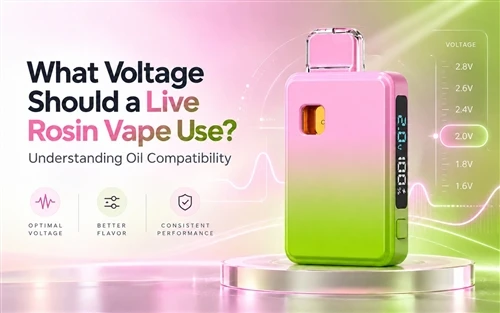
"What is the best voltage for live rosin?"
But voltage alone is not enough information.
The correct operating profile depends on:
- Resistance
- Ceramic structure
- Heater dimensions
- Ceramic surface area
- Oil viscosity
- Airflow
- Intake geometry
- Draw duration
ASM VAPE's existing post-free portfolio itself illustrates this variation. Unicore products can operate around 1.8–2.2V, while other Post-Free ceramic platforms use different voltage and resistance combinations.
For a deeper explanation of this relationship, see how resistance affects cannabis vape hardware.
The correct question is therefore not:
What voltage is best for live rosin?
It is:
What voltage, resistance, ceramic core, airflow, and intake configuration work together for this specific live rosin?
Validate the Hardware With Your Actual Oil
Generic specifications should be treated as a starting point rather than a final answer.
Two products both labeled "live rosin" may have significantly different viscosity, terpene content, and flow behavior.
Before committing to a large production run, test the actual formulation with the intended hardware.
Useful validation can include:
- Filling tests
- Initial draw testing
- Repeated draw testing
- Aging
- Cold-condition testing
- Clog evaluation
- Leak evaluation
- Flavor assessment
- Oil-consumption assessment
- Vapor consistency testing
This is especially important for OEM/ODM projects because the objective is not simply to select a standard device, but to match the ceramic core, operating parameters, airflow, intake structure, and activation behavior to the brand's formulation.
FAQ
Is post-free vape hardware better for live rosin?
For most live rosin applications, post-free vape hardware is a strong starting point because it removes the conventional central post and allows greater flexibility in ceramic placement, oil delivery, and airflow design.
However, post-free architecture alone does not guarantee better performance. The ceramic core, oil intake, resistance, voltage, airflow, and actual viscosity of the rosin still need to be properly matched.
Can live rosin be used in a center-post cartridge?
Yes. A center-post cartridge can work with some live rosin formulations if its heating system, oil intake, airflow, and operating parameters are appropriately designed.
However, highly viscous live rosin can be more demanding on a narrow center-post architecture, especially when the oil cools or the ceramic cannot replenish oil quickly enough.
What voltage is best for live rosin vape hardware?
There is no single voltage that works for every live rosin.
Many live rosin vape hardware designs favor relatively low-temperature operation, but the correct voltage depends on resistance, ceramic core design, heating surface, airflow, and oil viscosity.
For example, several ASM VAPE Post-Free Unicore products designed around Resin/Rosin applications use 1.8Ω ceramic systems operating between approximately 1.8V and 2.2V, while other ceramic platforms use different combinations.
Why does my live rosin vape clog when it gets cold?
Lower temperatures increase the viscosity of already-thick cannabis oils. This can slow oil flow through the intake and ceramic system and can also make condensed material inside the vapor path more difficult to clear.
A properly designed oil intake, suitable airflow, ceramic heating system, and controlled preheat function can improve cold-condition performance.
What should cannabis brands test before ordering live rosin vape hardware in bulk?
Brands should ideally test their actual formulation rather than relying only on a generic hardware specification.
Important evaluations include filling compatibility, oil flow, draw performance, repeated-use behavior, clogging, leaking, cold storage, vapor output, flavor, and long-term oil consumption. The results can then be used to adjust ceramic core, voltage, resistance, airflow, intake, or activation settings before mass production.
Conclusion
So, which works better for live rosin?
For most live rosin applications, post-free vape hardware is the better starting architecture. Its open reservoir, flexible airflow design, compatibility with bottom ceramic heating, and ability to support lower-temperature vaporization make it well suited to the demands of high-viscosity, terpene-rich oils.
But the more important conclusion is that post-free alone is not the answer.
A live rosin device can still suffer from weak vapor, slow wicking, clogging, or inconsistent flavor when the ceramic core, intake structure, airflow, resistance, and voltage are not matched to the actual formulation. Conversely, center-post hardware remains a practical and effective choice for many thinner oils and formulations that benefit from stronger heat transfer.
The real question is therefore not which architecture is universally better.
It is which hardware system is better for your oil.
ASM VAPE is a dedicated cannabis vape hardware manufacturer and OEM/ODM solutions provider specializing in Oil-Matched Hardware, ceramic atomization, Post-Free platforms, and customized hardware for Live Rosin, Live Resin, Distillate, and other cannabis oils. If you are developing a live rosin vape and want to evaluate the right ceramic core, voltage, resistance, airflow, or device architecture, contact us to discuss your formulation and project requirements.