The distinction between live resin and live rosin for vaping extends far beyond extraction methods. Their different viscosity, terpene content, lipid profile, and flow behavior can materially change how cannabis vape hardware should be selected and configured. The wrong combination of oil and hardware can lead to clogging, weak vapor, burnt taste, oil waste, or a flavor profile that does not reflect the extract itself.
For brands evaluating live rosin vs live resin vape hardware, the most important principle is that the extract name alone should not determine the device. The actual formulation, viscosity, desired vapor output, and flavor target should guide the ceramic core, intake, airflow, voltage, resistance, and tank structure. This oil-matched approach is central to ASM VAPE's hardware development process.
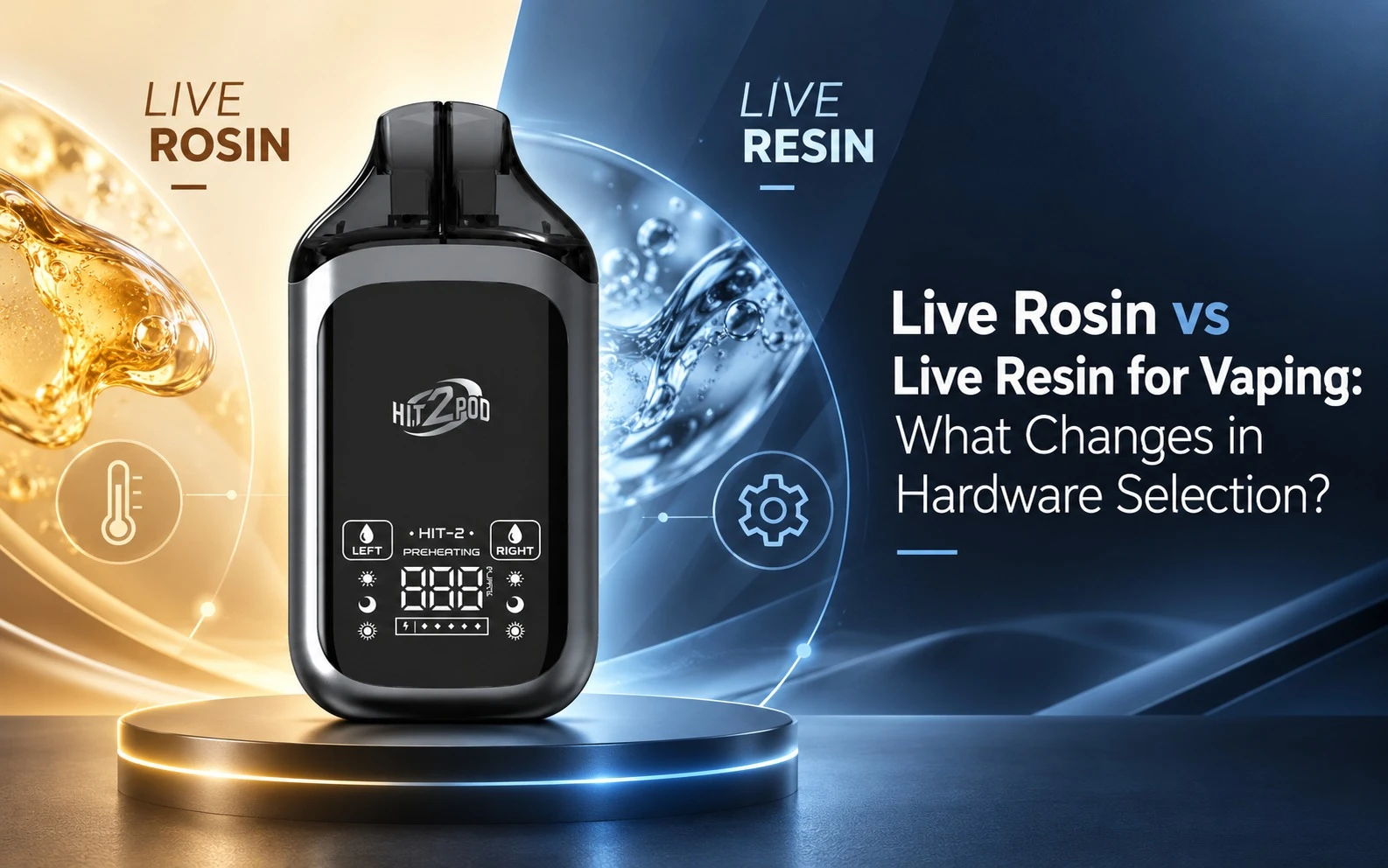
How Live Resin and Live Rosin Differ for Vape Hardware
Live Resin
Live resin is generally produced through solvent-based cannabis extraction, commonly using hydrocarbons such as butane or propane on flash-frozen cannabis.
Typical characteristics include:
- Saucy or waxy texture, with high terpene content that can often exceed 10%
- Lower viscosity and greater fluidity at room temperature
- Strong, intense aromatic profiles
- Relatively reliable oil movement in hardware when the formulation is properly matched
These properties can make live resin easier to wick than thicker formulations, although terpene level, cannabinoid composition, and formulation choices can still significantly change viscosity. Brands developing this category can compare different approaches to selecting the best vape hardware for live resin.
Live Rosin
Live rosin uses a solventless extraction process, typically involving ice-water hash followed by heat and pressure.
Typical characteristics include:
- Batter or budder-like consistency
- Natural waxes and lipids retained in the extract
- Higher viscosity and greater sensitivity to temperature
- Nuanced, true-to-plant flavor expression
These differences are why live rosin vape hardware often places more emphasis on efficient oil delivery, controlled heating, and clog resistance. For product developers comparing device architectures, ASM VAPE also provides a dedicated overview of vape hardware for live rosin.
The aromatic performance of both extracts is strongly tied to their volatile compounds. For additional scientific background on a common cannabis terpene, see the PubChem reference for limonene and its chemical properties.
Hardware implication: Live resin and live rosin labels are useful starting points, but they should not be treated as fixed hardware specifications. Two oils within the same category can behave differently enough to require different coil, intake, airflow, or voltage settings. ASM VAPE's oil-matched hardware approach therefore evaluates the actual oil type and viscosity before recommending ceramic core, intake, airflow, voltage, resistance, and tank structure.
How Ceramic Coils and Heating Surfaces Should Change
Live Resin Vape Hardware
Live resin can work with standard ceramic cores and moderate intake sizes, commonly around 1.2–1.6 mm in the type of hardware described here. Standard wattage settings may be sufficient when viscosity allows consistent wicking.
However, live resin should not automatically be treated like distillate. Terpene-rich or thicker live resin formulations may still benefit from a postless ceramic coil, lower-voltage operation, or customized oil intake.
Live Rosin Vape Hardware
Live rosin generally benefits from larger intake paths, approximately 1.6–2.0 mm in the configurations discussed here, or a postless design when greater oil flow is needed. Lower-temperature operation can help reduce overheating, while a wider ceramic heating surface can distribute heat more evenly.
ASM VAPE's internal hardware experience also highlights an important point: low voltage alone does not guarantee good rosin performance. Heating-surface area and oil-to-ceramic contact also determine whether enough oil can be vaporized during a short puff. A larger ceramic contact area can improve heating efficiency and vapor production without relying only on higher operating power.
This is one reason postless vape hardware is particularly relevant when evaluating thicker cannabis oils and terpene-focused products.
Why Ceramic vs. Metal Matters
Ceramic heating elements are widely preferred for terpene-rich cannabis oil because they can provide clean and relatively even heat distribution. This is important for both extracts, but especially where flavor preservation is a major product objective.
ASM VAPE's product architecture reflects this approach through ceramic platforms such as Unicore, Gemco, and Verve™, with Unicore specifically positioned for resin/rosin applications and Gemco focused strongly on terpene and flavor performance.
Recommended Voltage and Heating Approach for Live Resin vs Live Rosin
Live Resin
Typical range discussed here: 2.5–3.3 V
- Standard preheat is generally sufficient
- Moderate ramp-up can be acceptable
- Consistent vapor production remains the priority
Live Rosin
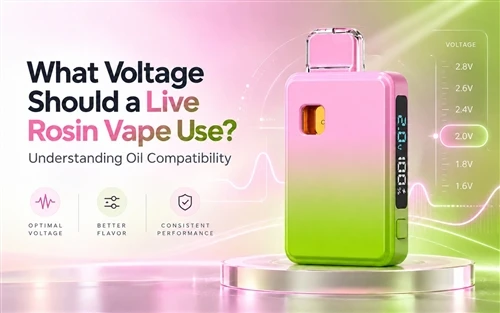
Typical range discussed here: 2.0–2.8 V
- Gentler ramp-up is preferred
- Preheat can become important with thicker oils
- Variable-voltage hardware gives brands more room to optimize flavor and vapor output
Higher temperatures can reduce aromatic complexity in live resin and create harsh or burnt flavors in live rosin. Lower-voltage operation can therefore be useful when the goal is a smoother draw and better terpene expression. For a more detailed discussion of temperature strategy, see our live rosin vape temperature guide.
These voltage ranges should be treated as starting points rather than universal specifications. ASM VAPE's current resin/rosin-oriented Unicore platforms show how actual hardware may operate outside a generic range: several post-free 1.8Ω models use approximately 1.8–2.2 V, depending on the device and setting.
For example, a low-voltage post-free disposable vape can provide multiple voltage settings so the hardware can be tuned more closely to a specific formulation rather than relying on a single fixed output.
This illustrates a broader hardware-selection principle:
Voltage, resistance, ceramic surface area, and wicking efficiency must work as a system.
A lower voltage can protect flavor, but if the ceramic core cannot replenish oil efficiently, the result may simply be weak vapor.
How Airflow and Chamber Design Affect Live Resin and Live Rosin
Live Resin
Standard airflow and conventional chamber structures can work well when the formulation has sufficient fluidity. Center-post designs may be compatible with some live resin oils, although post-free architectures are also widely applicable when the product requires lower-temperature operation, improved oil flow, or a different flavor profile.
Live Rosin
Live rosin often benefits from:
- Wider airflow channels
- Postless or post-free chamber structures
- Reduced metal contact where required by the product concept
- Anti-clogging features
- Efficient oil intake and ceramic wicking
ASM VAPE's product knowledge identifies postless hardware as particularly suitable for live rosin and live resin applications, with typical postless configurations using relatively lower operating power than traditional center-post hardware.
A purpose-built postless live rosin vape pen, for example, brings the oil path, ceramic core, power output, and chamber structure into a single integrated platform.
The Rosin Buildup Challenge
Rosin's natural waxes and lipids can accumulate around heating and airflow pathways. This can contribute to restricted draws, clogging, inconsistent vapor, and eventually burnt taste.
Purpose-built solventless vape hardware addresses the problem through a combination of anti-clog airflow, appropriate oil intake, ceramic wicking, postless construction, and controlled low-temperature heating.
Clogging should therefore be treated as a system-level problem rather than a viscosity problem alone. Oil viscosity, intake geometry, ceramic properties, heating cycles, airflow, and ambient temperature can all affect whether the device remains stable during its full use cycle. Our guide to why live rosin vapes clog explores this failure mode in more detail.
Choosing Between 510 Cartridges and All-in-One Vapes
|
Feature |
Live Resin |
Live Rosin |
|
510 Cartridge Compatibility |
Compatible with most 510 carts |
Requires careful matching; postless preferred |
|
AIO Suitability |
Standard AIOs can perform adequately |
Purpose-built low-temperature AIOs increasingly preferred |
|
Market Trend |
Established, mature category |
Rapid growth in specialized rosin hardware |
For live resin, conventional 510 cannabis cartridges and all-in-one disposable vape hardware can both work effectively when the oil and intake system are compatible.
For live rosin, an AIO gives the hardware developer greater control over the complete system: battery output, resistance, activation behavior, airflow, ceramic core, and preheat can all be engineered together. A 510 cartridge can still work, but the cartridge and battery should be selected as a matched system rather than independently.
Brands that prefer a modular 510 format can also evaluate a postless vape cartridge when reduced center-post obstruction and oil-path design are important to the project.
Across the premium extract market, more brands are adopting purpose-built hardware for solventless formulations, reflecting broader recognition that a one-size-fits-all cannabis vape does not always deliver consistent results.
For deeper product-selection guidance, see our articles on what vape hardware works best for live rosin and choosing live resin vape hardware.
How Tank Materials Affect Oil Compatibility and Shelf Stability
Live Resin
Standard glass, metal, and ceramic materials are generally compatible with live resin hardware. Lower lipid content can reduce some material-interaction concerns, while appropriate storage at moderate temperatures helps maintain consistency.
Live Rosin
Higher terpene and lipid content can interact with certain plastics over extended storage. Glass and suitable high-quality materials are therefore often preferred, while storage below approximately 70°F can help maintain consistency and reduce degradation.
Tank material also affects oil behavior inside the device. ASM VAPE's internal hardware experience indicates that glass tanks can reduce oil adhesion to the reservoir wall, helping more oil return toward the heating area instead of remaining on the chamber surface.
ASM VAPE's current product portfolio includes combinations of plastic, sustainable plastic, aluminum, glass, and ceramic, allowing material selection to be evaluated together with oil compatibility and product positioning.
Common Hardware Problems and How to Address Them
Common Live Resin Issues
Leakage
High-terpene formulations can have a thinner consistency, increasing the importance of appropriately sized intake holes and reliable seals.
THCA Crystallization
"Diamonds" formulations may crystallize, potentially interfering with consistent oil delivery.
Hardware approach: Proper intake sizing, quality seals, and temperature-stable storage.
Common Live Rosin Issues
Clogging
Natural waxes and lipids can accumulate on the ceramic coil or inside airflow pathways.
Burnt Taste
Excessive heat can overheat plant-derived components and reduce the flavor quality expected from premium rosin.
Inconsistent Flow
Live rosin can become significantly less mobile at lower ambient temperatures.
Weak First Puff After Storage
ASM VAPE's hardware experience shows that thick THC oil can become difficult to wick after extended storage or exposure to colder temperatures. Because an inhale-activated device may provide only a short initial heating cycle, the first puff can produce little vapor. A button + inhale activation system or dedicated preheat function can help warm the oil before normal inhalation.
Hardware approach: Low-temperature settings, anti-clog design, postless architecture, suitable oil intake, efficient ceramic wicking, and preheat capability where needed.
How Brands Should Select and Customize Vape Hardware
For cannabis brands, extractors, and product developers, live resin vape hardware and live rosin vape hardware should be chosen through an oil-specific validation process rather than by selecting a generic device and filling it with different concentrates.
Match Hardware to the Actual Oil
Evaluate the extract's viscosity, terpene level, flow behavior, and target consumer experience before selecting the ceramic core, voltage, resistance, airflow, and tank structure.
Avoid a One-Size-Fits-All Approach
Hardware optimized for distillate may not deliver the same performance with live rosin or live resin. Even two formulations marketed under the same extract category can require different settings.
Test the Oil in the Actual Device
Specifications provide a useful starting point, but real-oil testing remains one of the most important steps before production.
ASM VAPE is a B2B cannabis vape hardware manufacturer and OEM/ODM solution provider focused on oil-matched hardware. Its customization scope includes capacity, heating core, voltage and resistance, materials, exterior design, functions, branding, molds, and packaging.
For U.S.-market projects, ASM VAPE also operates a California product laboratory supporting sample testing, filling, troubleshooting, product refinement, and technical assistance, allowing hardware parameters to be evaluated against the customer's actual cannabis oil before scaling into production.
Brands should also ensure that product development, labeling, and distribution comply with the rules applicable to their target market. The U.S. Food and Drug Administration provides additional information on FDA regulation of cannabis and cannabis-derived products.
Live Rosin vs Live Resin Vape Hardware Requirements at a Glance
|
Specification |
Live Resin |
Live Rosin |
|
Intake Hole Size |
1.2–1.6 mm |
1.6–2.0 mm or postless |
|
Optimal Voltage |
2.5–3.3 V |
2.0–2.8 V |
|
Preheat Function |
Standard |
Essential |
|
Airflow Design |
Standard |
Wider channels, anti-clog |
|
Chamber Design |
Center-post acceptable |
Postless/metal-free preferred |
|
Material Requirements |
Standard glass/ceramic |
Medical-grade materials, glass preferred |
|
AIO Preference |
General-purpose |
Purpose-built low-temperature hardware |
These values are practical reference ranges rather than universal requirements. Final hardware settings should be validated against the actual oil formulation, because viscosity, terpene concentration, cannabinoid composition, ambient temperature, ceramic design, and desired vapor output can all change the best configuration.
FAQs
Can I use live rosin in a standard 510 cartridge?
Technically, yes, but the cartridge must be matched carefully to the oil. Standard 510 cartridges with relatively small intake holes and conventional center-post structures can struggle with higher-viscosity rosin, causing poor wicking, clogging, or burnt flavor. Postless or wider-intake cannabis cartridges are often better suited to thick live rosin formulations.
Why does live rosin usually require lower voltage than live resin?
Live rosin retains natural waxes and lipids and is particularly sensitive to excessive heat. Lower-voltage operation can reduce the risk of harsh or burnt flavor while helping preserve its nuanced terpene profile. The ideal setting still depends on ceramic-core design, resistance, heating surface, and the specific oil.
What causes live rosin cartridges to clog?
Clogging can result from waxes and lipids accumulating or becoming less mobile in the ceramic and airflow system, particularly at lower temperatures. Wider oil pathways, efficient ceramic wicking, postless construction, anti-clogging airflow, and appropriate heating cycles can help reduce the problem.
Is ceramic always better than metal for heating elements?
Ceramic is often preferred for terpene-rich cannabis extracts because it supports controlled, even heating and can reduce direct oil-to-metal contact. However, ceramic quality, porosity, surface area, resistance, and the surrounding hardware architecture all matter. The material alone does not determine vapor quality.
How do I choose between a cartridge and an AIO for my live rosin product?
A purpose-built AIO gives the manufacturer control over the battery, voltage, resistance, airflow, heating core, activation method, and preheat behavior as one integrated system. If using a 510 cartridge, select a cartridge designed for the oil's viscosity and pair it with a compatible low-voltage battery rather than treating the cartridge and power source as separate decisions.
Conclusion
The key difference in live rosin vs live resin vape hardware selection is not that each extract requires one fixed device. Live rosin generally demands closer attention to low-temperature heating, wicking, postless architecture, airflow, and clog resistance, while live resin may tolerate a broader range of hardware. In both cases, the best result comes from matching the actual oil formulation to the ceramic core, intake, voltage, resistance, airflow, and tank structure instead of relying on the extract name alone.
ASM VAPE provides oil-matched cannabis vape hardware and OEM/ODM customization for live resin, live rosin, distillate, CBD, and other cannabis oils. If you are developing a new resin or rosin vape product, contact ASM VAPE and discuss your project requirements, including oil specifications, hardware configuration, sample testing, and custom development needs.