Live rosin is prized for its solventless extraction process, full-spectrum terpene profile, and true-to-plant flavor. Those same characteristics also make it more demanding in a vape device. Push the voltage too high and flavor can become harsh or burnt; go too low without the right ceramic coil, wicking system, or preheat strategy and the thick oil may not atomize efficiently, resulting in weak vapor, clogging, and wasted product.
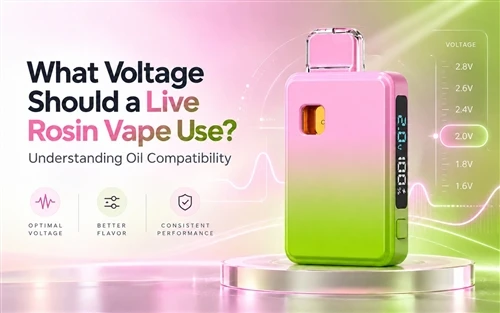
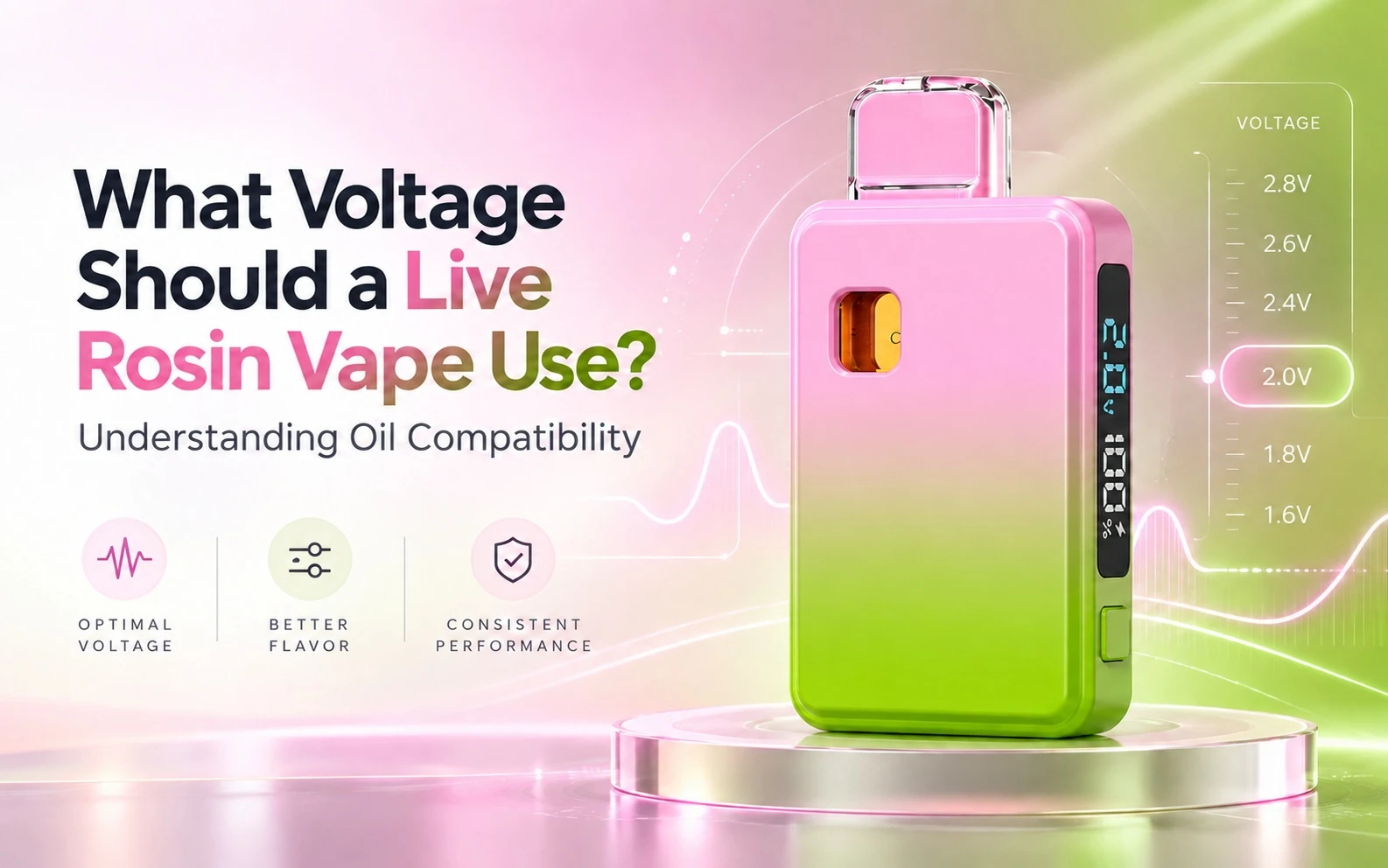
As a practical starting point, many live rosin vape applications perform well in a lower-voltage range of roughly 2.0V to 2.8V. But there is no universal best voltage for live rosin. The correct setting depends on coil resistance, ceramic heating area, cannabis oil viscosity, airflow, intake design, and the overall atomization architecture. In other words, live rosin vape voltage should always be considered as part of oil-hardware compatibility rather than as a standalone number.
How Voltage Affects Live Rosin Flavor and Vapor
Voltage is one of the most important variables affecting how a live rosin vape performs, but it does not determine coil temperature by itself. Resistance, ceramic core design, heating surface area, airflow, draw duration, and oil delivery all influence the actual heat generated at the atomizer. For a deeper explanation of this relationship, see our guide on how resistance affects cannabis vape hardware.
Live rosin is different from distillate. It retains a broad range of cannabinoids, terpenes, and flavonoids naturally present in Cannabis sativa without solvent extraction. That full-spectrum composition is one of the reasons consumers value live rosin, but it also means hardware must provide enough heat for consistent vaporization without unnecessarily overheating the oil.
Common cannabis monoterpenes such as myrcene, limonene, pinene, and linalool have different thermal characteristics and boiling points. Research discussing cannabis terpenes and their boiling-point characteristics helps explain why excessive heating can flatten delicate flavor notes and produce a harsher experience.
Higher voltage generally increases electrical power, heat-up speed, and vapor output. That can work well for certain distillate formulations, but live rosin hardware normally benefits from a more controlled, lower-temperature approach. Research on vaporization temperature and cannabinoid delivery also supports the broader principle that heating conditions materially affect vaporization behavior.
The relationship between voltage and resistance is especially important. For example, using the basic relationship P = V²/R, a 2.2V device with a 1.8Ω coil operates at approximately 2.69W, while a 2.2V device with a 1.4Ω coil operates at approximately 3.46W.
That means two devices both labeled "2.2V" can deliver very different heating performance.
This is why asking only for the best live rosin vape voltage gives an incomplete picture. Voltage, resistance, ceramic architecture, and oil viscosity need to work together.
|
Oil Type |
Typical Viscosity |
Terpene Characteristics |
Typical Voltage Range |
Hardware Priority |
|
Live Rosin |
Very high / thick |
Full-spectrum, native profile |
2.0V–2.8V |
Low-temp ceramic, efficient wicking, preheat when needed |
|
Live Resin |
Medium-high |
Full-spectrum, extracted |
2.4V–3.2V |
Ceramic core, efficient oil delivery |
|
Distillate |
Lower / more fluid |
Often formulated with added terpenes |
3.2V–4.0V |
Stable ceramic atomization, airflow |
|
Liquid Diamonds |
High |
High cannabinoid content plus terpenes |
2.2V–3.0V |
Oil-matched atomization |
Recommended Live Rosin Vape Voltage: 2.0V to 2.8V
For this guide, 2.0V to 2.8V is a practical starting range for live rosin vaporization. Within this range, properly matched hardware can provide enough energy to atomize thick rosin while maintaining the lower-temperature performance associated with better flavor.
However, this range should not be treated as a universal rule.
ASM VAPE's current Resin/Rosin-oriented Unicore platform demonstrates this clearly. Several current post-free products use a 1.8Ω ceramic configuration with voltage settings as low as 1.8V, 2.0V, and 2.2V, showing that a purpose-built live rosin vape can operate below the conventional 2.0V–2.8V range when the complete atomization system is designed around it.
Brands comparing devices can also review our guide to the best vape hardware for live rosin for a broader hardware-level perspective.
2.0V–2.4V: Best for Flavor-Focused Live Rosin Vaping
At the lower end of the range, the ceramic coil heats more gently. This can help preserve the strain-specific flavor and terpene character that make live rosin attractive to consumers.
Vapor production may be somewhat lighter, but flavor can remain more pronounced. For a live rosin cart or disposable focused primarily on terpene expression rather than maximum cloud production, this range is a useful starting point.
The trade-off is viscosity.
Thick live rosin may move more slowly through the oil delivery system at low temperatures. If the ceramic core, intake openings, or wicking structure cannot supply oil quickly enough, weak vapor or inconsistent first draws can occur.
Preheating can therefore be helpful, especially when the oil has been stored in colder conditions or has become less fluid. For more detail on the relationship between heat and flavor preservation, see our live rosin vape temperature guide.
2.4V–2.8V: A Balance Between Flavor and Vapor Production
The 2.4V–2.8V range can provide a useful balance between vapor production and flavor for many live rosin formulations.
The additional heat can improve oil flow and vapor output while still remaining considerably lower than the settings commonly associated with many distillate-oriented systems.
For brands developing a live rosin disposable vape or live rosin cartridge, this range can serve as a useful testing point rather than an automatic factory default.
The final setting should be validated against the actual oil formulation and hardware configuration.
Above 3.0V: Use Caution With Live Rosin
Higher voltage produces more electrical power when other variables remain unchanged. In a system not specifically engineered for live rosin, settings around or above 3.0V can increase the risk of excessive heat, harsh vapor, faster oil darkening, and burnt flavor.
That does not mean every device operating above 3.0V will automatically damage rosin. Coil resistance and atomizer design still matter.
A better rule is:
Do not judge live rosin compatibility by voltage alone.
If a device requires aggressive heat simply to produce acceptable vapor from rosin, the underlying ceramic core, oil delivery system, or airflow architecture may not be properly matched to the oil.
Why Live Rosin Oil Compatibility Involves More Than Voltage
Live rosin vape settings are only one part of the hardware equation.
Live rosin can be significantly more viscous than many distillate formulations. It may move slowly through narrow oil passages, struggle to replenish the heating surface quickly enough, or become harder to atomize after exposure to lower ambient temperatures.
A vape device that works reliably with distillate can therefore perform poorly with live rosin even when the voltage appears correct.
At ASM VAPE, this is the basis of our Oil-Matched Hardware approach: ceramic core, intake design, airflow, voltage, resistance, tank structure, and oil characteristics should be considered together rather than selecting hardware from voltage specifications alone. Brands evaluating a complete rosin project can also review our live rosin vape hardware solutions.
Three hardware factors are particularly important.
Preheat Can Help Thick Live Rosin Flow Before the Draw
A preheat cycle briefly warms the oil before the main draw. For thicker live rosin, this can reduce viscosity around the ceramic heating area and improve initial oil delivery.
This becomes particularly useful after the vape has been sitting unused or stored in a colder environment.
ASM VAPE's hardware experience shows that high-viscosity THC oil may become difficult to atomize immediately under colder conditions. With short inhale-activated heating cycles, the first draw can therefore produce little vapor. On products that support button activation and preheating, warming the coil before inhalation can help improve performance.
Preheat is useful, but it is not mandatory on every rosin-compatible product. The appropriate activation strategy depends on the oil and the complete hardware design.
Ceramic Coil Design Determines How Efficiently Rosin Reaches the Heating Surface
Ceramic atomization is particularly important for high-viscosity cannabis oils.
The ceramic heating element must receive enough oil to keep pace with vaporization. If oil delivery is too slow relative to heat generation, the ceramic surface can become undersupplied, creating weak vapor, dry hits, or burnt taste.
Heating surface area also matters.
A common assumption is that more vapor always requires more voltage. In practice, increasing the effective contact area between the ceramic heating core and the oil can improve atomization efficiency without relying entirely on higher electrical output. Our detailed guide on how ceramic core size affects vape performance explains this relationship in more depth.
This creates an important design principle for live rosin vape hardware:
More vapor does not necessarily require more voltage. Better ceramic design can improve vapor production while maintaining lower-temperature operation.
ASM VAPE's Unicore platform is positioned specifically for Resin/Rosin oils, while its low-temperature ceramic development focuses on faster oil delivery, controlled heat transfer, anti-clogging structures, and terpene expression.
Postless Vape Designs Can Improve Live Rosin Compatibility
Postless, or post-free, vape hardware removes the traditional central metal post and places the ceramic atomization system toward the bottom of the oil reservoir.
ASM VAPE's hardware experience shows that postless structures are particularly relevant for live rosin, live resin, and similar cannabis oils, and are commonly paired with lower voltage and higher resistance than traditional central-post configurations.
As a general engineering reference, traditional central-post structures used for distillate may operate around 2.8V–3.3V with approximately 1.0Ω–1.2Ω resistance, while postless configurations for resin/rosin-type oils commonly fall around 2.2V–2.8V with approximately 1.4Ω–1.8Ω resistance.
Current ASM VAPE products extend this concept further. For example, several Unicore post-free models use 1.8Ω coils at 1.8V–2.2V.
Readers who want a deeper explanation of the structure itself can refer to our guide to postless vapes for live rosin.
Postless architecture is not automatically suitable for every live rosin formulation, however. Extremely thick cannabis oil can still exceed the oil-delivery capability of a particular ceramic system.
The correct conclusion is therefore not "postless works with every rosin," but rather:
Postless ceramic hardware provides a strong architecture for live rosin when viscosity, intake, heating area, resistance, and voltage are properly matched.
Match Vape Hardware to the Oil, Not Just the Voltage
One of the most common mistakes in cannabis vape hardware selection is assuming that a single device can perform equally well with every oil.
The same voltage, coil geometry, intake structure, and airflow design that perform well with distillate may not deliver the same results with live rosin.
That is why the hardware should be selected around the oil formulation.
|
Design Factor |
Distillate-Oriented Hardware |
Live Rosin-Oriented Hardware |
|
Typical Voltage Approach |
Higher |
Lower and more controlled |
|
Preheat |
Optional depending on formulation |
Often useful for high viscosity |
|
Ceramic Design |
Standard oil delivery |
Designed for thicker oil and stable delivery |
|
Airflow Architecture |
Central-post or conventional |
Postless/post-free or oil-matched airflow |
|
Oil Flow |
Easier due to lower viscosity |
Requires careful intake and ceramic matching |
|
Heating Strategy |
Higher-output operation possible |
Gentle, controlled atomization preferred |
Current ASM VAPE products illustrate why voltage cannot be separated from the rest of the system.
- UNIVERSE uses a 1.8Ω Unicore system at 2.2V.
- UNIVERSE Pro post-free disposable vape uses a 1.8Ω Unicore configuration with 1.8V / 2.0V / 2.2V settings.
- BLENDER uses a 1.8Ω Gemco system with 2.0V / 2.2V / 2.4V settings.
- PLUG and TRINITY use 1.4Ω Gemco configurations with 2.2V / 2.4V / 2.6V settings.
These examples show why there is no single voltage specification that defines oil compatibility.
A 2.2V, 1.8Ω Unicore system does not behave the same way as a 2.2V, 1.4Ω multi-core system, even though the voltage printed on the specification sheet is identical.
For cannabis brands, the better development process is:
Oil formulation → ceramic platform → intake and airflow structure → voltage and resistance → activation strategy → testing and refinement.
That is more reliable than selecting a generic device first and trying to force the oil to work with it later.
How Embedded Control Technology Can Improve Heating Consistency
Another approach to cannabis oil compatibility is electronic control of the heating profile.
Instead of relying only on one fixed voltage, an embedded controller can regulate maximum output, heat-up behavior, and power delivery throughout a draw. For live rosin, the goal is to achieve consistent atomization without unnecessary temperature spikes.
This can be especially useful because the best live rosin vape setting is not simply the highest or lowest available voltage. What matters is how energy is delivered over time.
Variable-voltage hardware provides a simpler version of the same idea. Multiple voltage settings allow brands and users to test different combinations of flavor, vapor output, and oil flow. An adjustable voltage AIO disposable vape can therefore be useful when a project requires more flexibility during formulation and hardware evaluation.
However, adjustable voltage cannot compensate for fundamentally incompatible hardware.
A distillate-oriented ceramic core with inappropriate oil intake or wicking will not suddenly become an ideal live rosin coil simply because the voltage is reduced. The physical architecture still needs to match the viscosity of the oil.
For OEM/ODM projects where the selected hardware platform supports adjustable voltage or electronic control, these parameters can be evaluated alongside resistance, ceramic heating performance, activation method, and oil characteristics during product development.
Common Live Rosin Vape Problems and What Usually Causes Them
Understanding the relationship between live rosin vape voltage, viscosity, resistance, and ceramic design makes troubleshooting much easier.
Not every problem should be solved by increasing voltage.
|
Symptom |
Possible Cause |
Hardware or Configuration Approach |
|
Device does not hit / weak first draw |
Thick oil after cold storage or insufficient initial heating |
Preheat where supported; evaluate activation and oil delivery |
|
Burnt or harsh taste |
Excessive heat for the oil and atomizer combination |
Reduce voltage or reassess resistance/heating configuration |
|
Weak vapor production |
Ceramic heating area or oil delivery cannot keep pace |
Optimize ceramic core, intake, and heating surface |
|
Clogging after storage |
Oil movement into airflow path or poor oil-flow design |
Evaluate postless architecture and airflow structure |
|
Inconsistent flavor across draws |
Unstable electrical output or uneven oil delivery |
Regulated output and better oil-hardware matching |
|
Oil darkening in cartridge |
Repeated or sustained excessive heating |
Lower-temperature, more controlled atomization |
Weak vapor deserves particular attention.
If a live rosin vape is not producing enough vapor, simply increasing voltage can mask rather than solve the underlying problem. Oil viscosity, ambient temperature, ceramic surface area, intake size, draw duration, resistance, and activation method should all be evaluated first.
Clogging is another system-level issue rather than a voltage-only problem. Our guide on why live rosin vapes clog explains how viscosity, airflow structure, oil migration, and hardware geometry interact.
ASM VAPE's internal hardware experience also indicates that a larger effective ceramic heating area can increase contact between the coil and cannabis oil, improving atomization efficiency and vapor production without relying entirely on higher voltage.
This is one reason oil compatibility should be treated as a system-level engineering problem.
How ASM VAPE Approaches Live Rosin Vape Hardware
ASM VAPE is a dedicated cannabis vape hardware manufacturer and OEM/ODM engineering partner focused on THC/CBD hardware for legal cannabis markets.
Our development approach starts with a simple principle:
Not all cannabis oils work with the same vape hardware.
Instead of choosing a generic device and then adapting the oil around it, hardware can be matched to the formulation through ceramic platform selection, intake and airflow design, voltage, resistance, capacity, activation method, and other performance parameters.
For Resin/Rosin applications, ASM VAPE's current product portfolio includes the Unicore platform, which is positioned specifically for Resin/Rosin oils and is widely used in POST-FREE hardware. Current Unicore products include both fixed low-voltage configurations and adjustable 1.8V / 2.0V / 2.2V options. One example is the postless live rosin vape pen, which illustrates the type of post-free architecture used for rosin-focused applications.
Gemco configurations provide another example of oil-specific engineering, with products available in 1.8Ω and 1.4Ω configurations across low-voltage ranges such as 2.0V–2.4V and 2.2V–2.6V.
For OEM/ODM projects, ASM VAPE can adjust hardware parameters including heating core, voltage, resistance, capacity, activation configuration, materials, product structure, branding, and packaging according to formulation and project requirements.
For U.S. partners, ASM VAPE also operates a California product laboratory supporting sample and product testing, filling support, troubleshooting, product refinement, and technical collaboration.
The objective is not simply to offer a "live rosin vape at 2.2V." It is to build a complete hardware configuration in which voltage, resistance, ceramic atomization, airflow, and cannabis oil viscosity work together.
FAQ
What is the best voltage for a live rosin vape?
A practical starting range for many live rosin vape applications is approximately 2.0V to 2.8V, but there is no universal best voltage. Some purpose-built Resin/Rosin hardware operates as low as 1.8V. Coil resistance, ceramic design, oil viscosity, airflow, and heating area must also be considered.
Is 2.2V good for live rosin?
Yes, 2.2V can be an effective live rosin vape setting when paired with appropriate hardware. For example, ASM VAPE currently uses 2.2V in several Post-Free Unicore and Gemco configurations. However, a 2.2V setting on one resistance and ceramic architecture may behave differently from 2.2V on another.
Does lower voltage give live rosin better flavor?
Lower voltage generally reduces electrical power and can support a gentler heating profile, which may help preserve flavor. However, voltage that is too low for the specific coil and oil can cause weak vapor or poor atomization. The goal is controlled heating, not simply the lowest possible voltage.
Why does my live rosin vape produce weak vapor at low voltage?
Weak vapor can result from thick oil, cold storage, insufficient ceramic heating area, slow oil delivery, a short activation cycle, or a mismatch between resistance and voltage. Increasing voltage is only one possible solution and may introduce burnt flavor if the real problem is oil delivery.
Is a postless vape better for live rosin?
Postless or post-free cannabis vape hardware can be well suited to live rosin because it can support ceramic-focused, lower-voltage atomization and a simplified internal structure. However, postless architecture alone does not guarantee compatibility. Very thick rosin still requires appropriate intake design, ceramic heating capacity, resistance, and airflow.
Final Thoughts
So, what voltage should a live rosin vape use?
For many applications, 2.0V–2.8V is a useful starting range, while modern rosin-focused hardware can operate even lower. The more important conclusion is that there is no universal live rosin vape voltage that works independently of the hardware.
The best results come from matching voltage, resistance, ceramic core design, heating surface area, airflow, intake structure, activation method, and oil viscosity as one system. Higher voltage is not automatically better for vapor production, and lower voltage is not automatically better for flavor. The correct setting is the one that allows a particular live rosin formulation to vaporize consistently without unnecessary heat.
For cannabis brands, processors, and product developers building a live rosin program, ASM VAPE provides cannabis vape hardware manufacturing and OEM/ODM solutions based on the characteristics of your formulation. Contact our team to discuss your live rosin viscosity, target performance, voltage/resistance requirements, and hardware format so we can evaluate a configuration for your project.