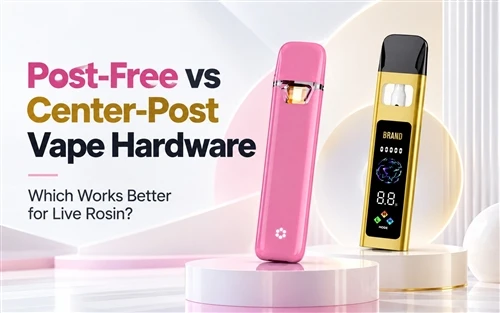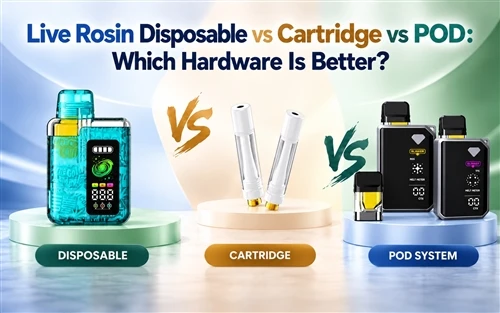
The cannabis vape hardware market has moved far beyond the early days when simple 510-thread cartridges and relatively thin distillate dominated many product lines. Today, cannabis brands can choose from All-in-One disposables, 510 cartridges, proprietary POD systems, postless ceramic platforms, full-ceramic structures, variable-voltage devices, and other specialized hardware designed for different cannabis oils.
For live rosin, however, choosing between a disposable, cartridge, and POD is not simply a matter of convenience or appearance. Live rosin vape hardware must handle high viscosity, temperature-sensitive terpenes, cold-start behavior, oil flow, clogging, and consistent atomization. In practice, the internal heating architecture can matter more than whether the finished product is labeled a disposable, cartridge, or POD.
There is therefore no universal "best" hardware format. The better choice depends on the live rosin formulation, viscosity, desired flavor profile, target consumer, brand positioning, cost structure, and the level of control a brand wants over the complete vaping experience. Brands comparing formats can also review a broader guide to the best vape hardware for live rosin.
This guide compares live rosin disposables, 510 cartridges, and POD systems from the perspective of oil compatibility, atomization performance, cost, common failure modes, and commercial use.

Disposable vs 510 Cartridge vs POD: What Each Hardware Format Is
Before comparing live rosin performance, it helps to understand how the three hardware formats differ.
|
Feature |
Disposable / AIO |
510 Cartridge |
POD System |
|
Structure |
Battery, reservoir, and atomizer integrated into one device |
Atomizer cartridge used with a separate 510 battery |
Proprietary pod paired with a dedicated battery |
|
Battery |
Built in |
Separate |
Separate rechargeable device |
|
Typical Oil Capacity |
Approximately 0.5mL–3mL, with some larger formats |
Approximately 0.5mL–2mL |
Approximately 0.5mL–2mL per pod |
|
Reusability |
Oil unit is generally single-use; many modern units are rechargeable |
Cartridge is disposable, battery reusable |
Pod is replaceable, battery reusable |
|
Consumer Entry Cost |
Low because no separate battery is required |
Requires compatible battery |
Higher initial commitment because of dedicated device |
|
Ecosystem Lock-In |
Low |
Low because 510 is broadly standardized |
High because pod and battery are normally proprietary |
|
Hardware Control |
High |
Lower because battery may vary |
High |
Disposable Vape Pens / All-in-One Devices
A cannabis disposable, also called an All-in-One disposable, combines the battery, oil reservoir, atomizer, airflow system, and electronics into one integrated product.
This gives hardware engineers relatively broad control over the complete vaporization system. Battery output, ceramic coil resistance, airflow, intake geometry, activation method, and oil chamber can all be designed around the target formulation.
That integration makes purpose-built live rosin disposable hardware especially attractive when a brand wants a ready-to-use product without relying on a consumer's external battery.
For thick live rosin, the most important benefit is not simply convenience. It is the ability to coordinate the entire oil path and heating system around one formulation.
510-Thread Cartridges
The 510 cartridge remains one of the most recognizable cannabis vape formats. The cartridge contains the oil reservoir and atomizer and screws onto a compatible external battery.
Its advantages include:
- Broad battery compatibility
- Familiar consumer experience
- Relatively low cartridge hardware cost
- Strong retail familiarity
- Reusable battery ecosystem
For distillate and lower-viscosity oils, a conventional 510 cartridge can remain highly effective.
Live rosin is more demanding. A standard cartridge designed around thin oils may use restricted intake paths, limited heating surface area, or battery settings that are not ideal for high-viscosity rosin.
However, this does not mean all cartridges are unsuitable for live rosin. Full-ceramic construction, glass reservoirs, appropriate oil intake geometry, properly selected resistance, and a compatible low-voltage battery can make a purpose-built rosin vape cartridge a viable premium format.
Brands evaluating this format should consider both the cartridge and the power source. A dedicated 510 battery with appropriate output can provide more predictable performance than an unknown third-party battery. For a deeper selection framework, see this guide on how to choose 510 cannabis vape cartridge hardware.
POD Systems
POD systems use replaceable pods that connect mechanically or magnetically to a dedicated battery.
Because the pod and battery are developed as one ecosystem, a manufacturer has more control over:
- Voltage
- Resistance
- Airflow
- Activation behavior
- Preheating
- Oil flow
- Ceramic coil geometry
This gives optimized rosin POD systems more engineering freedom than a standardized cartridge while maintaining a reusable battery platform.
The commercial trade-off is that consumers must buy into the proprietary ecosystem. For established cannabis brands, that can strengthen customer retention. For newer brands, the additional consumer commitment can make market adoption more challenging.
Brands weighing the ecosystem advantages against the simplicity of an AIO can also review this disposable vs POD cannabis vape hardware comparison.
Why Live Rosin Is Harder to Vape
Live rosin presents a different hardware challenge from distillate.
It is a solventless cannabis concentrate produced from fresh or fresh-frozen plant material, typically through ice-water hash processing followed by heat-and-pressure extraction. It is valued for preserving a rich terpene and cannabinoid profile.
Those same characteristics create several hardware challenges.
High Viscosity
Live rosin can be very thick at normal temperatures and can become even less fluid in colder environments.
When the oil does not reach the ceramic heating surface quickly enough, users may experience:
- Weak vapor
- Dry or harsh hits
- Delayed first-puff performance
- Inconsistent vapor output
ASM VAPE's product experience with high-viscosity THC oils shows that oil can become difficult to atomize after sitting in a cold environment. In inhale-only hardware, the short activation period may not provide enough initial heating, while a button plus inhale-activated device can allow the user to preheat the oil before drawing.
This makes cold-start performance an important but often overlooked factor when selecting live rosin vape hardware.
Terpene Sensitivity
Premium live rosin is purchased largely for flavor and extract character. Excessive heating can mute that experience and create harsh vapor.
For that reason, live rosin hardware generally benefits from controlled, relatively low-temperature ceramic atomization instead of simply maximizing power. Brands developing flavor-focused products may also want to review how live rosin vape temperature affects terpene preservation.
However, "lower voltage" should not be treated as a complete engineering solution.
Voltage, resistance, ceramic heating surface area, oil intake, wicking behavior, and airflow must operate as a coordinated system.
Clogging
As thick cannabis oil cools after a draw, material can accumulate in the airway or near the heating system.
Cold temperatures can make this problem more obvious.
Reducing clogging therefore requires more than increasing power. Depending on the design, engineers may use:
- Shorter and wider airflow paths
- Optimized oil intake channels
- Postless architecture
- Ceramic structures designed for faster oil transfer
- Preheat functions
- Better matching between formulation and heating parameters
For a more detailed breakdown of the root causes, see why live rosin vapes clog.
Residue and Coil Fouling
Live rosin is less refined than highly processed distillate and can contain compounds that gradually affect heating performance.
The atomizer therefore needs to deliver consistent vaporization over the intended oil volume without developing premature flavor degradation or unstable output.
How Atomization Technology Affects Live Rosin Performance
The atomizer is one of the most important components in any live rosin vape device.
Ceramic Coils vs Traditional Wick-Based Coils
Traditional atomizers often use fiber-based wick structures. These designs can work effectively with thinner formulations, but thick cannabis oils may create inconsistent saturation.
If the heating area becomes insufficiently supplied with oil, localized overheating can produce an unpleasant burnt taste.
Porous ceramic heating structures use capillary action to move oil toward the heating surface while distributing heat over a broader area.
For live rosin vape hardware, ceramic technology offers several useful characteristics.
Thermal Stability: Ceramic heating structures tolerate repeated heating cycles without relying on an exposed fiber wick.
More Even Heating: A larger, more uniform heating surface can help reduce localized hot spots.
Material Stability: High-quality ceramic is widely used because it is relatively inert when paired with cannabis oils.
Consistency: Properly engineered ceramic platforms can provide more predictable oil delivery throughout the life of the device.
ASM VAPE's Oil-Matched Hardware approach is built around matching the ceramic core, intake configuration, airflow, voltage, resistance, and reservoir structure to the oil type and viscosity rather than using one hardware configuration for every cannabis extract.
Why Postless Architecture Matters for Live Rosin
A center-post structure can work well for many cannabis oils, especially distillate.
For live rosin, however, postless vape hardware can provide several advantages:
- More open reservoir geometry
- Reduced metal contact inside the oil chamber
- Greater flexibility in bottom-mounted ceramic design
- A relatively direct path between oil and heating element
- More design freedom for high-viscosity formulations
ASM VAPE's internal product experience identifies postless hardware as particularly suitable for live rosin, live resin, and similar cannabis oils, with lower-power configurations commonly used than traditional center-post designs. At the same time, extremely thick oil can still exceed what a specific postless structure can wick effectively.
This leads to an important hardware-selection principle:
Postless is a strong starting point for live rosin, but postless alone does not guarantee oil compatibility.
The actual formulation still needs to be matched to the ceramic core, oil intake, airflow, resistance, and voltage. Brands unfamiliar with the architecture can review how postless vape hardware works with live rosin and other cannabis oils.
Lower Voltage Is Not the Whole Solution
One of the most common oversimplifications in rosin hardware discussions is:
Live rosin = use the lowest possible voltage.
In reality, very low energy combined with an undersized heating surface can also create weak vapor.
ASM VAPE's product experience indicates that when the ceramic heating area is too small, increasing ceramic-oil contact area can improve heating efficiency and vapor output without depending solely on aggressive power.
For live rosin, the engineering target should therefore be:
controlled temperature + sufficient ceramic surface area + stable oil delivery + appropriate airflow
rather than simply chasing the lowest voltage specification.
How Disposable, Cartridge, and POD Atomization Designs Differ
Live Rosin Disposable
An integrated live rosin disposable gives manufacturers the greatest freedom to coordinate:
- Battery output
- Ceramic core
- Resistance
- Airflow
- Oil reservoir
- Intake structure
- Activation behavior
- Preheating
This is why a purpose-built disposable can perform very well with thick live rosin.
ASM VAPE's Unicore platform is positioned for Resin/Rosin oils, and several Unicore products use post-free architecture with relatively low-voltage configurations.
For example, the UNIVERSE Pro post-free live rosin disposable vape uses post-free Unicore architecture with variable-voltage settings and button-and-inhale activation. This type of configuration illustrates how adjustable power and preheating capability can provide additional tuning options for thick formulations.
These examples illustrate a broader engineering point: variable voltage, preheating capability, and postless ceramic architecture can be more meaningful to live rosin performance than the disposable label itself.
Live Rosin Cartridge
A standard 510 cartridge has less available internal space than many AIO devices, so atomizer dimensions and oil channels can be more constrained.
But cartridge performance depends heavily on construction.
A premium rosin cartridge can use:
- Full-ceramic components
- Ceramic center posts
- Glass tanks
- Wider oil intake paths
- Low-voltage compatible resistance
ASM VAPE's BULLET full ceramic vape cartridge, for example, combines a 1mL glass tank with a full-ceramic format, ceramic central post, ceramic mouthpiece, and 1.4Ω resistance.
It should not be assumed that every full-ceramic cartridge automatically matches every live rosin formulation, but it demonstrates how cartridge architecture can move well beyond traditional metal-heavy 510 designs.
Live Rosin POD
POD systems can offer much of the engineering control of an AIO while maintaining a reusable battery.
ASM VAPE's ASM-ERA postless POD system uses a post-free Unicore configuration. ASM VAPE's product matrix also includes other post-free POD architectures using Unicore-based heating systems.
For brands developing a long-term product platform, this type of architecture can make a POD system an attractive live rosin hardware option.
Which Hardware Fits Different Cannabis Oils
There is no absolute compatibility rule because formulation varies substantially between producers.
The following matrix is better used as a starting point than as a rigid rule.
|
Oil Type |
Typical Viscosity |
Disposable / AIO |
510 Cartridge |
POD System |
|
Live Rosin |
Very High |
Excellent when purpose-built |
Fair to Good when specifically engineered for thick oil |
Good to Excellent with optimized pod |
|
Live Resin |
High |
Excellent |
Fair to Good |
Good |
|
Liquid Diamonds |
High |
Excellent |
Fair to Good |
Good |
|
Distillate |
Low–Medium |
Good |
Excellent |
Good |
|
CBD Isolate Oil |
Low |
Good |
Excellent |
Good |
|
Full-Spectrum CBD |
Medium–High |
Excellent |
Good |
Good |
The important distinction is between a format and a hardware architecture.
A generic 510 cartridge developed for distillate may perform poorly with live rosin, while a carefully engineered ceramic or full-ceramic cartridge may perform much better.
Likewise, a disposable is not automatically good for live rosin simply because it is an AIO. If its ceramic core, airflow, intake, voltage, or resistance do not match the oil, the device can still clog, produce weak vapor, or develop burnt flavor.
The practical rule is:
Choose the atomization system for the oil first, then choose the product format for the brand.
For additional format-specific examples, brands can review this guide to live rosin vape hardware selection.
How Cost, MOQ, and Market Strategy Differ by Format
Hardware selection is also a commercial decision.
Unit Cost Structure
Disposables generally have the highest individual hardware cost because every unit contains a battery, charging circuit, atomizer, and reservoir.
For premium live rosin, that additional hardware cost may be acceptable because the brand gains control over the full experience.
510 cartridges normally have the lowest hardware cost per oil unit because the consumer reuses a separate battery.
The trade-off is that the brand cannot completely control the battery. A customer may use a higher-voltage or lower-quality battery than intended, which changes the actual vaporization experience.
POD systems sit between the two. The pod itself can be economical at scale, but launching the ecosystem requires a dedicated battery and additional investment in consumer adoption.
Minimum Order Quantities and Customization
OEM/ODM requirements vary significantly by supplier and customization depth.
Standard disposable and cartridge programs may be available at relatively modest order volumes, while deeper customization involving proprietary structures, tooling, materials, electronics, or mold development requires greater investment.
ASM VAPE separates this into two general development paths:
- Private Label Customization: logo, colors, finishes, UI, packaging, and selected performance parameters
- Mold Customization: deeper development involving structure, materials, functions, appearance, molds, and packaging
Oil-based customization can also include capacity, heating core, voltage, and resistance adjustment.
For a live rosin brand, that distinction matters. A proven platform may offer the fastest route to market, while a proprietary POD or customized AIO may make more sense when long-term differentiation is the priority.
Regulatory and Market Fit
Cannabis hardware requirements vary by jurisdiction, so brands should verify current requirements before launch. For federal background, the FDA maintains information on the regulation of cannabis and cannabis-derived products, while individual state regulators publish their own cannabis rules. California brands, for example, can consult the state's official cannabis laws and regulations.
Packaging requirements also vary by market. Where child-resistant packaging applies, brands should review relevant state rules as well as the federal framework under the Poison Prevention Packaging Act.
The three hardware formats also create different commercial considerations.
A disposable gives the brand control over the complete device but creates more electronic waste. Because many rechargeable AIO devices contain lithium-ion batteries, brands should also consider appropriate end-of-life handling and the EPA's guidance on lithium-ion battery disposal and recycling.
A 510 cartridge benefits from a large installed battery ecosystem but gives the brand less control over the power source.
A POD system gives the brand more control over battery-to-atomizer matching but requires consumers to adopt a proprietary system.
There is no single commercial winner.
Common Live Rosin Vape Problems and Hardware Solutions
Burnt Taste
Burnt flavor usually occurs when the heating surface receives insufficient oil or operates at excessive temperature.
With high-viscosity live rosin, restricted oil flow can leave part of the ceramic heating surface temporarily under-saturated.
Possible hardware solutions include:
- Matching intake size to formulation viscosity
- Increasing effective ceramic/oil contact area
- Using a ceramic core designed for high-viscosity oil
- Reducing unnecessary power
- Improving oil-path geometry
The objective is not simply low temperature. It is stable saturation at the intended temperature.
Clogging
Clogging is one of the most common concerns in live rosin and live resin hardware.
Cold oil can accumulate in narrow air paths or around areas where vapor condenses after a draw.
Hardware strategies can include:
- Postless architecture
- Shorter or wider air paths
- Optimized airflow
- Preheat functions
- Better oil-flow geometry
- Appropriate ceramic porosity and intake design
For especially thick oils, button preheating can also improve first-puff performance after the device has been sitting in a cold environment.
Leaking
Leaks can originate from:
- Reservoir seals
- Atomizer interfaces
- Mouthpiece joints
- Improper filling conditions
- Temperature and pressure changes during shipping
Leak resistance depends on the specific mechanical design rather than the format name alone.
A well-engineered disposable, POD, or cartridge can all perform reliably when oil viscosity, filling conditions, sealing structure, and pressure behavior are properly accounted for.
Inconsistent Vapor Production
Weak or inconsistent vapor often results from unstable oil delivery.
Possible causes include:
- High viscosity
- Low ambient temperature
- Oil not reaching the heating element
- Air pockets
- Insufficient ceramic contact area
- Poorly matched voltage or resistance
Another practical issue is residual oil adhering to the reservoir wall.
ASM VAPE's internal product experience notes that, particularly when little oil remains, wall adhesion can prevent the remaining oil from reaching the bottom heating area. Glass reservoirs can help reduce this type of oil hang-up in some applications.
This is why reservoir material should also be considered when evaluating premium rosin vape hardware.
How to Choose the Right Live Rosin Vape Hardware
The following framework provides a practical starting point.
|
If Your Priority Is... |
Recommended Starting Point |
Key Reason |
|
Purpose-built live rosin product |
Disposable or optimized POD |
Full control over ceramic core, battery, airflow, and preheat |
|
Premium 510 ecosystem |
Purpose-built ceramic/full-ceramic cartridge |
Universal format while retaining premium oil-contact materials |
|
Distillate at high volume and low cost |
510 Cartridge |
Low unit cost and proven compatibility with thinner oils |
|
Building a proprietary brand ecosystem |
POD System |
Brand-controlled battery and recurring pod ecosystem |
|
Premium full-spectrum positioning |
Disposable, POD, or premium ceramic cartridge |
Depends on oil formulation and desired consumer experience |
|
Broad retail compatibility |
510 Cartridge |
Familiar and widely compatible battery format |
|
Flavor-first craft rosin |
Low-temperature ceramic platform |
Better ability to prioritize controlled heating and terpene expression |
The most important point is that this is a selection framework, not a universal ranking.
Many cannabis brands may use multiple formats:
- Live rosin in a purpose-built AIO
- Distillate in 510 cartridges
- A premium POD as a flagship ecosystem
Others may successfully launch live rosin in a carefully engineered ceramic cartridge.
A better engineering workflow is:
Oil formulation and viscosity → Ceramic/heating architecture → Oil intake and airflow → Voltage and resistance → Capacity and activation → Disposable, Cartridge, or POD format
That is also consistent with ASM VAPE's broader development process, which moves from cannabis oil and formulation through oil-matched hardware selection, ceramic architecture, operating parameters, OEM customization, testing, refinement, and scalable production.
How ASM VAPE Matches Live Rosin to Hardware
ASM VAPE does not treat every cannabis oil as interchangeable.
The company's hardware development philosophy is based on Oil-Matched Hardware: selecting and adjusting ceramic core, intake, airflow, voltage, resistance, capacity, and tank architecture around the actual formulation.
Oil-First Hardware Selection
For a live rosin project, the process should begin with the oil rather than with a catalog model.
The key questions include:
- How viscous is the formulation?
- How does viscosity change at lower temperatures?
- Is flavor preservation the highest priority?
- How much vapor output is required?
- Does the product need preheat?
- What capacity is appropriate?
- Is a postless structure preferable?
- Which voltage and resistance range should be tested?
ASM VAPE's California product laboratory supports U.S. projects with sample and product testing, filling support, troubleshooting, product refinement, and on-site technical assistance.
Ceramic Platforms for Different Performance Goals
ASM VAPE's current product architecture includes several ceramic platforms.
Unicore is positioned for Resin/Rosin oils and appears across multiple post-free, lower-voltage products.
Gemco is positioned around terpene and flavor expression, with single, dual, and triple ceramic configurations.
Verve™ covers a broader hardware range, including full-ceramic, glass-tank, display, magnetic, recyclable, and other product structures.
These platforms reinforce an important point for cannabis brands:
The best live rosin hardware should be selected by the required vaporization behavior first and by exterior form factor second.
FAQ
Is a Disposable or Cartridge Better for Live Rosin?
A purpose-built disposable is often easier to optimize because the manufacturer controls the battery, atomizer, airflow, and oil reservoir as one system. However, a properly engineered ceramic or full-ceramic 510 cartridge can also work with live rosin. The oil formulation and internal atomization architecture matter more than the format name alone.
What Voltage Is Best for Live Rosin Vape Hardware?
There is no universal voltage for all live rosin. Many rosin-oriented ceramic systems operate at relatively low voltage, but resistance, ceramic surface area, oil flow, and airflow must also be considered. Testing the actual formulation is more reliable than choosing hardware only by voltage.
Why Does Live Rosin Vape Hardware Clog?
Live rosin is highly viscous and can become even thicker in cold environments. After a draw, condensed material may also accumulate inside the airway. Postless structures, optimized airflow, wider oil paths, proper ceramic architecture, and preheat functions can help reduce clogging.
Is Postless Vape Hardware Better for Live Rosin?
Postless hardware is often a strong choice for live rosin because it allows a more open reservoir and flexible bottom ceramic design. However, extremely thick formulations may still require additional tuning of the ceramic core, oil intake, airflow, voltage, and resistance.
Can Live Rosin Be Used in a 510 Cartridge?
Yes, but the cartridge should be designed for the formulation. A standard distillate cartridge may struggle with thick live rosin, while a purpose-built ceramic or full-ceramic cartridge with suitable oil intake and a compatible battery can perform much better.
Final Thoughts
So, Live Rosin Disposable vs Cartridge vs POD: which hardware is better?
There is no universal winner. A purpose-built disposable provides the greatest control over the complete vaporization system, a well-engineered 510 cartridge offers broad compatibility and a familiar consumer format, and an optimized POD system can combine strong hardware control with a reusable brand ecosystem. For live rosin, the more important decision is whether the ceramic core, oil intake, airflow, voltage, resistance, activation method, and reservoir structure are actually matched to the formulation.
ASM VAPE is a cannabis vape hardware manufacturer providing All-in-One devices, cartridges, POD systems, ceramic atomization platforms, and oil-matched OEM/ODM development. If you are evaluating hardware for a specific live rosin formulation, contact ASM VAPE to discuss oil compatibility, ceramic platform selection, testing, and custom product development.