The coil inside a cannabis vape pen is the single component that decides whether cannabis oil delivers clean flavor or a burnt, metallic mess. Three coil technologies dominate the market - wick, quartz, and ceramic - and each interacts with THC and CBD concentrates in fundamentally different ways. Getting this pairing wrong is the most common cause of product returns, harsh hits, and brand-damaging reviews.
So, what is the best coil type for cannabis vape pens? The answer depends on the oil formulation, viscosity, product format, heating requirements, and desired vapor and flavor performance. Understanding how wick, quartz, and ceramic coils work is the first step toward choosing the right cannabis vape hardware.

What Is a Vape Pen Coil?
A vape pen coil (also called a heating element or atomizer coil) is the resistive component that converts electrical energy from the battery into heat, aerosolizing the cannabis oil or concentrate drawn into the heating zone. In cannabis vaporizers, the coil must handle oils ranging from thin CBD distillate to extremely viscous live resin and wax - viscosities that span roughly 10 to over 1000 mPa·s depending on extract type and terpene content.
The coil's material and architecture determine heat distribution, oil delivery rate, flavor fidelity, vapor production, and the risk of combustion byproducts. For brands selecting cannabis vape hardware, coil type must therefore be evaluated together with oil viscosity, voltage, resistance, airflow, and overall cartridge or device architecture. For a deeper look at electrical matching, see how resistance affects cannabis vape hardware.
Wick Coils for Vape Pens
How Wick Coils Work
A wick coil uses an absorbent fiber material - traditionally organic cotton, though silica wick and synthetic fiber blends have also been used - wrapped around or threaded through a metal heating wire (typically Kanthal, NiChrome, or stainless steel). The wick draws oil from the reservoir to the heating wire through capillary action, and the wire heats the saturated wick to produce vapor.
This is the oldest coil architecture in vaporizer history, dating back to the first-generation e-cigarette designs. In the cannabis space, wick coils appeared in early 510-thread cartridges and remain in use for some budget-oriented products.
Strengths of Wick Coils
- Flavor intensity at first draw: Cotton wicks saturate quickly and deliver a dense, full-bodied hit on the very first puff, often described as more "authentic" to the raw extract taste.
- Low manufacturing cost: The materials - cotton fiber and resistance wire - are inexpensive and the assembly process is simple, keeping per-unit cost low.
- No preheating required: Unlike some ceramic configurations that benefit from a brief warm-up, wick coils produce vapor immediately on activation.
Weaknesses of Wick Coils
The problems with wick coils in cannabis applications are severe and well-documented.
Cotton and fiber wicks degrade at the elevated temperatures required for thick cannabis concentrates. As the wick carbonizes through repeated heating cycles, it releases burnt-taste compounds and particulate matter into the vapor. This degradation accelerates with high-viscosity oils, which do not re-saturate the wick fast enough to prevent localized dry spots - the direct cause of the characteristic "burnt cotton" flavor that consumers associate with failing cartridges.
Research on metal and silicate particles in electronic cigarette aerosol also illustrates why material selection and thermal stability deserve close attention in vapor hardware.
Wick coils also suffer from inconsistent performance across the product's life. The first several puffs may taste excellent, but output typically declines in a wave pattern as the fiber compacts, chars, and loses its capillary structure. For THC and CBD brands, this means a product that starts strong and ends poorly - exactly the kind of experience that drives negative reviews.
Additionally, fiber-based wicks can shed micro-particles under thermal stress. Industry migration testing has flagged potential inhalation concerns with degraded cotton and silica fibers, particularly in products subjected to high-power batteries or extended session use.
Brands comparing fiber and ceramic systems in more detail can also review this guide to ceramic vs. cotton coils.
When Wick Coils Still Make Sense
Wick coils remain viable for very thin oils - low-viscosity CBD formulations and certain nicotine-style e-liquid bases - where rapid re-saturation prevents dry burning. They also appear in ultra-low-cost disposable formats where product longevity is not a priority.
For any premium cannabis brand positioning on quality and consistency, however, wick coils are a liability.
Quartz Coils for Dab Pens and Concentrates
How Quartz Coils Work
A quartz coil (sometimes called a quartz rod coil) uses one or more solid quartz rods as the heating substrate, with a metal wire wrapped around or embedded within the rod. Unlike wick coils, there is no absorbent fiber - quartz is non-porous and does not wick oil. Instead, oil drips or is loaded directly onto the heated quartz surface, where it flash-vaporizes on contact.
Quartz coils are most commonly found in dab pens and wax vaporizers designed for solid and semi-solid concentrates such as shatter, crumble, rosin, and wax, rather than in liquid-oil cartridges.
Strengths of Quartz Coils
- Rapid heat-up: Quartz heats to operating temperature in roughly one to two seconds, faster than most ceramic alternatives. This responsiveness suits dab-style consumption where users want instant vapor.
- High-temperature tolerance: Quartz withstands temperatures well above 600°C without degrading, making it suitable for high-power devices and dense concentrates that require more thermal energy to vaporize fully.
- Clean flavor at high heat: Because quartz is chemically inert and non-absorbent, it does not retain residue from previous sessions or impart material taste - flavor comes purely from the concentrate itself.
- Large vapor production: The combination of fast heat and direct surface vaporization produces dense clouds that many concentrate users prefer.
Weaknesses of Quartz Coils
Quartz coils have a critical limitation for liquid-oil applications: they do not wick. Without capillary oil delivery, a quartz coil in a standard liquid cartridge would either flood or starve depending on oil viscosity and feed rate. This restricts quartz almost entirely to manually loaded concentrate pens, not the self-feeding cartridges that dominate the THC oil market.
Heat distribution on quartz is also less uniform than on porous ceramic. The heating wire creates hot spots along the rod surface, which can scorch delicate terpenes and produce harsh vapor if the user applies too much power. Research into high-temperature terpene degradation during cannabis concentrate vaporization helps explain why excessive heat can compromise flavor chemistry.
Temperature control depends heavily on the battery's output regulation - a variable-voltage battery set too high will degrade oil quality quickly on a quartz coil. Studies have also examined carbonyl compounds produced during cannabis oil vaporization, reinforcing the importance of controlling operating temperature and hardware conditions.
Quartz coils also tend to have shorter effective lifespans in heavy-use scenarios. Residue buildup on the non-porous surface requires frequent cleaning, and the wire-to-quartz bond can fail under thermal cycling.
When Quartz Coils Are the Right Choice
Quartz is the preferred coil type for dab pens and wax vaporizers where the user manually loads concentrate for each session. It excels with thick, solid extracts that would overwhelm a wick and that do not require self-feeding wicking.
For pre-filled liquid cannabis oil cartridges - the dominant format in U.S. cannabis retail - quartz is rarely the right engineering choice.
Ceramic Coils for Cannabis Oil Vape Pens
How Ceramic Coils Work
A ceramic coil (more precisely, a porous ceramic heating element) uses a sintered porous ceramic body as both the oil-delivery medium and the heating substrate. The ceramic is engineered with a controlled network of micro-pores - typically in the range of 2 to 30 micrometers depending on the design - that wick oil through capillary action, similar in principle to a fiber wick but with far greater thermal and chemical stability.
A conductive heating element is embedded within or printed onto the ceramic body. In the most common manufacturing approach, a metal paste (often containing silver, palladium, or gold alloys) is applied via thick-film printing and then co-fired with the ceramic substrate at high temperature, creating an integrated heating circuit bonded directly to the ceramic.
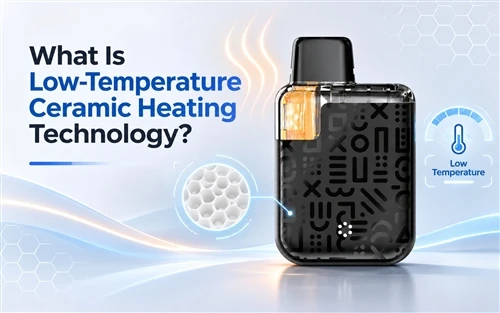
This architecture means the oil is heated as it passes through the ceramic's pore network, rather than being heated on a surface or in a saturated fiber. The result is more uniform heat distribution across the entire vaporization zone.
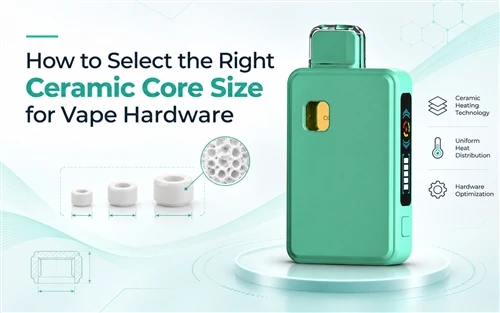
Brands evaluating ceramic hardware can also compare how ceramic core size affects vape performance, including heating area, vapor output, and oil contact.
Why Ceramic Coils Dominate Cannabis Vaping
Ceramic coils have become the de facto standard for cannabis oil cartridges, and the reasons are directly tied to the physical properties of cannabis concentrates. For brands comparing ceramic vs. quartz coils for pre-filled THC oil, ceramic offers the major advantage of combining capillary oil delivery with controlled, uniform heating.
Thermal stability eliminates burnt taste. Porous ceramic withstands continuous operating temperatures in the 200–300°C range without degrading, carbonizing, or releasing fiber particulate. Unlike cotton wicks that char over time, the ceramic substrate maintains its structural integrity across hundreds of heating cycles. This is the single most important advantage for cannabis brands: the product tastes the same on puff one and puff three hundred.
Capillary wicking handles viscous oils. The micro-pore network in a well-engineered ceramic coil provides consistent oil delivery even for high-viscosity THC distillate and live resin. Industry data suggests that leading manufacturers have pushed ceramic porosity from a traditional range of roughly 35–45% up toward 55% and beyond in recent years, improving oil delivery rates and reducing dry-hit incidence. The pore structure acts as a built-in reservoir, buffering against momentary oil supply interruptions that would cause a wick coil to burn.
For high-viscosity formulations, hardware selection should extend beyond the coil itself. Brands working with resin can compare vape hardware for live resin, while solventless formulations often benefit from hardware designed specifically for live rosin.
Chemical inertness protects flavor and safety. Sintered ceramic - typically based on alumina, silica, or cordierite formulations - is chemically inert under normal vaping conditions and does not react with terpenes, cannabinoids, or carrier agents. This inertness preserves the full terpene profile of the extract and avoids the metallic or chemical off-tastes that degraded wick materials can introduce.
Consistent aerosol particle size. The uniform heat field across the ceramic pore network produces aerosol droplets in a narrower, more controlled size distribution than surface-heating designs. This consistency translates to smoother vapor and more predictable cannabinoid delivery per puff - a meaningful advantage for both recreational and medical-format products.
Potential Drawbacks of Ceramic Coils
Ceramic coils are not without trade-offs, and an honest assessment requires acknowledging them.
Manufacturing cost is higher than wick alternatives. The sintering, thick-film printing, and quality-control processes required to produce consistent porous ceramic elements are capital-intensive. Per-unit cost typically exceeds that of a comparable wick coil, though economies of scale at high volumes narrow this gap considerably.
Flavor character differs from wick coils. Some users and extractors report that ceramic coils produce a slightly smoother but marginally less "punchy" flavor compared to the intense first-draw taste of a fresh cotton wick. Whether this is a drawback or an advantage depends on the product positioning - for brands emphasizing terpene fidelity and smoothness, ceramic's profile is preferable.
Material safety scrutiny is real. Thick-film heating circuits in some ceramic coils use metal pastes containing silver, palladium, or other conductive metals. Under aggressive high-temperature conditions or with poorly controlled manufacturing, there is a potential for trace metal migration into the aerosol.
Brands operating in regulated markets should also remain aware of broader FDA regulation of cannabis and cannabis-derived products. Reputable manufacturers address material concerns through appropriate ceramic formulations, testing, manufacturing controls, and supporting compliance documentation.
Ceramic Coil Variants Worth Knowing
The ceramic coil category is not monolithic. Several sub-architectures exist, each with distinct performance characteristics:
|
Variant |
Heating Element |
Key Characteristic |
Typical Application |
|
Thick-film printed |
Silver/palladium paste printed on ceramic |
Most common; cost-effective at scale |
Standard 510 oil cartridges |
|
Embedded mesh |
Metal mesh embedded in ceramic body |
Larger heating area, longer lifespan |
Premium cartridges, high-volume disposables |
|
Glass co-fired |
Ceramic and glass sintered together |
Enhanced structural strength, reduced powdering |
Medical-grade CBD formats |
|
Aerogel composite |
Ceramic with aerogel layer |
Controlled oil delivery rate, anti-leak |
High-viscosity oil, live resin |
The embedded mesh variant has gained traction among premium brands because the expanded heating surface extends coil life - some manufacturers report lifespan improvements on the order of 50% or more compared to standard thick-film designs - while maintaining the flavor consistency that defines the ceramic category.
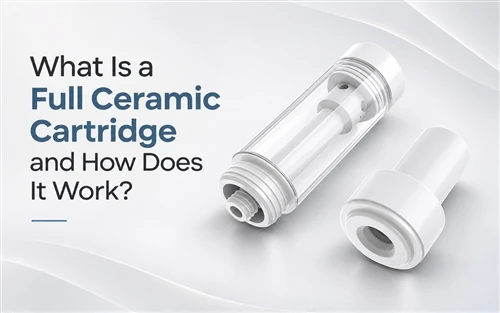
Brands that want to evaluate finished ceramic hardware architectures can also review a full ceramic vape cartridge or a full ceramic cartridge designed around ceramic-based oil delivery and vaporization.
Wick vs. Quartz vs. Ceramic Coil Comparison
The following comparison consolidates the key performance dimensions across all three vape pen coil types, with specific attention to cannabis oil applications.
|
Dimension |
Wick (Cotton/Fiber) |
Quartz (Rod) |
Ceramic (Porous) |
|
Oil delivery mechanism |
Capillary wicking through fiber |
Direct surface loading (no wicking) |
Capillary wicking through micro-pores |
|
Best-suited oil viscosity |
Low (thin CBD, e-liquid bases) |
High (wax, shatter, rosin - manual load) |
Medium to high (distillate, live resin, full-spectrum) |
|
Heat-up speed |
Fast (instant) |
Very fast (1–2 seconds) |
Moderate (brief warm-up beneficial) |
|
Heat distribution uniformity |
Low - hot spots on wire |
Low to moderate - hot spots on rod surface |
High - uniform across pore network |
|
Burnt-taste risk |
High - fiber degrades and chars |
Low - inert surface, but scorching possible at high power |
Very low - ceramic does not combust |
|
Flavor consistency over product life |
Poor - declines after initial puffs |
Good - if cleaned regularly |
Excellent - stable across full lifecycle |
|
Typical lifespan |
Short (tens to low hundreds of puffs) |
Moderate (requires cleaning) |
Long (hundreds of puffs, minimal degradation) |
|
Aerosol particle uniformity |
Variable |
Variable |
High - narrow distribution |
|
Manufacturing cost |
Lowest |
Moderate |
Highest (but scales well) |
|
Primary format |
Budget liquid cartridges |
Dab pens, wax vaporizers |
Pre-filled oil cartridges, disposables, medical formats |
|
Material safety concerns |
Fiber shedding, combustion byproducts |
Minimal (inert quartz) |
Trace metal migration if poorly manufactured |
|
Self-feeding cartridge compatible |
Yes |
No |
Yes |
For pre-filled cannabis oil cartridges - the format that accounts for the majority of U.S. dispensary sales - ceramic coils are the clear engineering leader on nearly every dimension that matters to brand reputation and consumer experience. Quartz serves a different product category, primarily concentrate dab pens, while wick coils are increasingly relegated to the lowest-cost market segments where performance expectations are minimal.
Best Coil Type for Different Cannabis Oils
The coil-versus-oil pairing is where many product failures originate. Even the best ceramic coil will underperform if matched to an oil outside its design range, and a wick coil that works adequately with thin CBD will fail rapidly with thick live resin.
For brands choosing the best coil for THC oil, live resin, live rosin, CBD distillate, or full-spectrum formulations, oil viscosity and product format matter more than a generic ranking of coil materials.
|
Oil Type |
Typical Viscosity Range |
Recommended Coil |
Reasoning |
|
CBD distillate (thin) |
~10–50 mPa·s |
Ceramic (standard porosity) or wick |
Low viscosity saturates wicks well; ceramic provides consistency advantage |
|
THC distillate |
~50–200 mPa·s |
Ceramic (medium to high porosity) |
Viscosity exceeds reliable wick re-saturation rate; ceramic pore network handles it |
|
Live resin / live rosin |
~200–1000+ mPa·s |
Ceramic (high porosity or aerogel composite) |
Extreme viscosity requires engineered pore structure; wicks will dry-burn |
|
Wax / shatter / crumble |
Solid to semi-solid |
Quartz (dab pen format) |
Non-flowing concentrates require direct surface loading, not wicking |
|
Full-spectrum oil with high terpene load |
Variable, often high |
Ceramic (embedded mesh preferred) |
Terpene preservation demands uniform low-temperature heating; mesh extends life |
A practical rule: if the oil flows on its own at room temperature, a ceramic coil cartridge is almost always the right choice. If the oil must be manually loaded or heated to flow, a quartz dab pen is the appropriate device. Wick coils should be reserved for the thinnest formulations where cost sensitivity outweighs performance consistency.
Brands working primarily with distillate can further compare vape hardware for distillate oil to see how heating and oil-delivery configurations change with formulation requirements.
Common Vape Pen Coil Failures and Root Causes
Understanding why vape pen coils fail helps cannabis brands diagnose field complaints and set correct consumer expectations.
Burnt or harsh taste. The most frequent complaint. In wick coils, the cause is fiber carbonization from dry burning or oil depletion. In ceramic coils, a burnt taste usually indicates either oil starvation - viscosity too high for the pore structure, or oil nearly depleted - or a battery voltage setting above the coil's design range. Diagnosing which requires checking the oil viscosity against the coil's rated range.
Weak vapor production. Often misdiagnosed as a dead battery. In ceramic coils, weak vapor can result from pore clogging - thick oils with high wax or lipid content can partially occlude the micro-pore network over time, reducing oil delivery to the heating zone. Preheating the cartridge (a low-power warm-up cycle available on most modern batteries) temporarily reduces oil viscosity and can restore flow. In wick coils, weak vapor typically means the fiber is saturated with degraded residue and needs replacement - which usually means the cartridge is finished.
Clogging and airflow blockage. Common in high-viscosity cannabis oil cartridges, particularly in colder environments. This is not strictly a coil failure but an oil-delivery issue. Cannabis oils thicken significantly at low temperatures, and the narrow intake ports on many cartridge designs cannot accommodate the increased viscosity. Ceramic coils with adequate porosity and properly sized intake holes handle this better than wick designs, but no coil type is immune. Educating consumers to warm the cartridge in their hand before use prevents most clogging complaints.
Metallic taste. Rare with properly manufactured ceramic coils, but can occur with low-quality thick-film heating elements if the conductive paste is inadequately bonded or if the device is operated at excessive voltage. This is a manufacturing quality issue, not an inherent flaw of the ceramic architecture - and it is exactly why sourcing from suppliers who provide migration test documentation matters.
Final Thoughts
The coil type question resolves cleanly once the product format and oil characteristics are defined.
For pre-filled liquid cannabis oil cartridges - including THC distillate, live resin, and full-spectrum oil - ceramic coils are generally the best engineering choice. They deliver the flavor consistency, cannabis oil compatibility, and lifespan that brands need to build consumer trust and minimize returns. The higher unit cost is recovered through lower failure rates and stronger brand reputation.
For dab pens and concentrate devices where users load wax or shatter manually, quartz coils remain the standard. Their fast heat-up and high-temperature tolerance suit the consumption format, and the lack of wicking is irrelevant when concentrate is applied directly.
Wick coils have a narrow remaining niche in ultra-thin, ultra-low-cost formats. For anything positioned as a quality cannabis product, they introduce more risk than they are worth.
Ultimately, there is no universally "best" vape coil independent of the oil and hardware around it. The best coil type for a cannabis vape pen is the one properly matched to the extract's viscosity, terpene profile, desired vapor output, operating voltage, resistance, airflow, intake structure, and overall device architecture.
The coil is not a commodity component. It is the interface between the extract and the consumer's experience - and choosing it correctly is one of the highest-leverage hardware decisions a cannabis brand can make.
ASM VAPE is a B2B cannabis vape hardware manufacturer, engineering partner, and OEM/ODM solutions provider specializing in Oil-Matched Hardware for THC/CBD brands. We can help match ceramic core, airflow, intake structure, voltage, resistance, and other hardware parameters to your oil formulation and performance requirements - contact our team to discuss your cannabis vape hardware or custom OEM/ODM project.
FAQs
What is the best coil type for cannabis vape pens?
For most pre-filled cannabis oil cartridges and disposable vape devices using THC distillate, live resin, or full-spectrum oil, porous ceramic coils are generally the best overall choice because they combine capillary oil delivery, uniform heating, flavor consistency, and compatibility with medium- to high-viscosity oils.
However, the best coil depends on the oil formulation, viscosity, voltage, resistance, airflow, intake design, and product format rather than coil material alone.
Is ceramic better than quartz for THC oil?
For pre-filled liquid THC oil cartridges, ceramic is generally more suitable than quartz. Porous ceramic can wick oil continuously through its micro-pore network, while quartz is non-porous and normally relies on direct surface loading.
Quartz is better suited to dab pens and manually loaded concentrates such as wax, shatter, and crumble.
What coil is best for live resin and live rosin?
Live resin and live rosin typically require hardware capable of handling relatively high viscosity while maintaining stable, low-temperature vaporization. High-porosity ceramic coils or other ceramic architectures designed for thick cannabis oils are generally better suited to these formulations than conventional fiber wick coils.
The ceramic core should still be matched to the specific oil formulation, viscosity, voltage, resistance, intake size, and airflow configuration. A purpose-designed ceramic coil vape pen is one example of how the heating element can be integrated into the complete hardware architecture.
Why does a ceramic vape coil taste burnt?
A burnt taste from a ceramic coil does not necessarily mean the ceramic itself is burning. Common causes include insufficient oil reaching the heating zone, an oil that is too viscous for the pore structure, low remaining oil volume, or operating voltage that exceeds the coil's intended range.
Matching the cannabis oil to the correct ceramic core and operating parameters is therefore essential for preventing dry or harsh hits.
Does coil type affect vape cartridge clogging?
Yes, but coil type is only one part of the system. High-viscosity cannabis oils can thicken in cold conditions and restrict oil flow through the intake or airflow path. A properly engineered ceramic coil with suitable porosity and correctly sized intake holes can improve oil delivery, but airflow design, oil viscosity, temperature, voltage, and the overall tank structure also influence clogging performance.