Live resin performs best in vape hardware designed around controlled heating, reliable oil flow, and terpene preservation. A strong starting point is a ceramic-based system with sufficient intake geometry, stable airflow, and a low-temperature heating profile. Postless structures, larger oil inlets, variable voltage, and preheat can further improve performance.
There is no single cartridge specification that fits every formulation. The best vape hardware for live resin still needs to be matched and tested with the actual oil before production.

Why Live Resin Needs Different Vape Hardware
Live resin is a cannabis extract valued for retaining a rich terpene profile and a flavor closer to the original plant. Compared with many distillate formulations, its viscosity, oil-flow behavior, and temperature sensitivity can place different demands on the atomizer.
Natural waxes, lipids, or crystalline cannabinoids may also affect how consistently the oil reaches the heating element. Hardware designed around a typical distillate formulation can therefore develop problems when filled with live resin.
Common symptoms of poor oil-hardware matching include:
- Clogging or restricted airflow
- Weak first puffs
- Harsh or burnt flavor
- Inconsistent vapor output
- Flooding or leaking
The solution is not simply to increase power. Good live resin hardware keeps the ceramic supplied with enough oil while avoiding excessive heat that can damage terpene-driven flavor.
The same principle explains why live resin and live rosin vape hardware can share several engineering requirements even though the two extracts are different products.
What Hardware Features Matter Most for Live Resin?
The atomizer gets most of the attention, but the complete oil path matters. Tank structure, intake geometry, ceramic porosity, airflow, and power output must work as one system.
Ceramic Core and Wicking
A ceramic core uses porous ceramic to absorb cannabis oil and distribute heat across the active heating area. For terpene-rich oil, this can provide more controlled heating and reduce localized hot spots that contribute to burnt taste.
High-porosity ceramic is especially useful when the formulation needs faster oil delivery. Ceramic size also matters. A larger effective contact area can improve vapor production without relying entirely on higher power, provided the wick remains saturated.
For a broader comparison of heating materials, see this guide to ceramic vs. cotton coils for thick cannabis oil.
Intake Hole Geometry
Intake openings control how quickly oil moves from the tank toward the ceramic.
Some distillate-oriented hardware uses intake openings around 1.0–1.4 mm, while live-resin-focused designs may use openings around 2.0 mm or larger to support more viscous oil flow.
Larger is not automatically better. Intake geometry must be matched with ceramic porosity, viscosity, and heating rate. Insufficient flow can create dry heating and weak vapor, while excessive flow can contribute to flooding and leakage.
Postless and Oil-Contact Materials
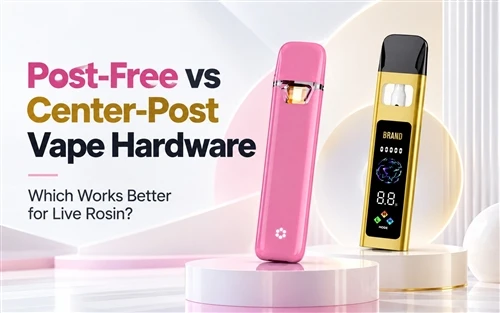
Postless vape hardware removes the conventional center post and generally positions the ceramic heating structure toward the bottom of the tank. This simplifies the internal oil path and can reduce unnecessary metal contact.
Brands evaluating this architecture can review how postless vape hardware works or compare dedicated Postless Vapes designed around this structure.
Materials also matter. Check what actually touches the oil: ceramic, glass, plastics, seals, silicone, and exposed metals. Full-ceramic options such as a 1mL full ceramic vape cartridge can be useful when minimizing mixed oil-contact materials is a project priority.
What Voltage and Heating Profile Is Best for Live Resin?
Live resin generally benefits from controlled, relatively low-temperature heating. Voltage is important, but it does not determine ceramic temperature by itself.
A Practical Starting Voltage Range
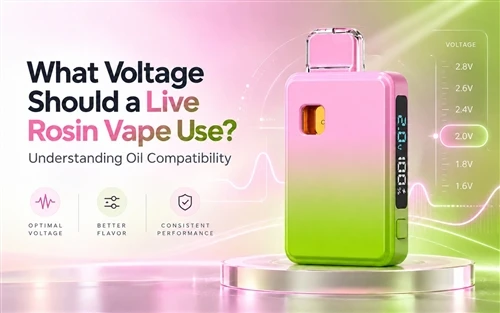
For many ceramic live resin systems, approximately 2.0–2.8V is a useful testing range. Lower settings around 2.0–2.4V are often explored when flavor preservation is the priority.
Actual performance also depends on:
- Coil resistance
- Ceramic surface area
- Heating duration
- Airflow
- Oil viscosity
A 2.2V setting on one atomizer can behave very differently from the same voltage on another. This is why voltage and resistance should be evaluated together.
Variable Voltage vs. Preheat
Variable voltage allows different power levels to be tested against the same formulation. It is useful for finding the best balance between flavor, vapor output, and oil flow.
Preheat serves a different purpose. It can warm cold or highly viscous oil before the draw, improving startup wicking and first-puff performance.
An adjustable-voltage AIO vape can therefore be useful during formulation evaluation. A validated fixed-voltage system can also perform well once the correct operating profile has been established.
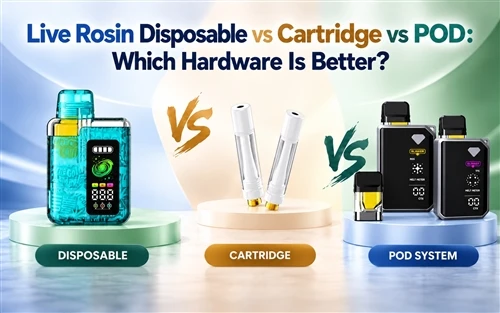
510 Cartridge vs. AIO vs. Pod: Which Is Better for Live Resin?
There is no universal winner. The right format depends on how much control is needed over the complete vaporization system.
|
Format |
Main advantage |
Main consideration |
|
510 cartridge |
Standardized format and broad battery compatibility |
Less control over the battery used by the consumer |
|
All-in-One |
Battery, ceramic, airflow, and voltage can be tuned together |
Complete device must perform consistently through its full oil capacity |
|
Pod system |
Battery and pod can operate as a matched system |
Requires users to remain within the pod platform |
A 510 cannabis vape cartridge can be attractive when battery compatibility and an established retail format are important.
An All-in-One Disposable gives the hardware designer more control over battery output, airflow, and atomizer behavior. POD Systems offer similar system-level control while separating the pod from the reusable power unit.
For a more detailed format comparison, see disposable vs. POD cannabis vape hardware.
Format matters, but formulation compatibility matters more. A properly matched 510 cartridge can outperform a poorly tuned AIO, and the reverse is also true.
How to Prevent Clogging, Leaking, and Weak Vapor
Live resin clogging is not one single failure mode. Different symptoms often point to different mismatches between the oil and hardware.
Clogging and Weak First Puffs
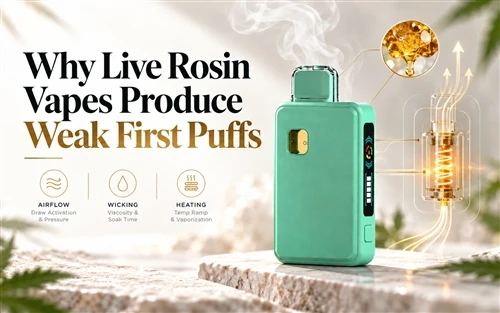
Cold oil moves more slowly through intake channels and porous ceramic. Crystallization or insufficient wicking can make the first draw especially weak.
The better approach is usually to improve oil delivery through appropriate intake geometry, ceramic porosity, airflow, or preheat rather than simply increasing voltage.
Leaking and Flooding
Live resin should not be treated as permanently "thick." Its viscosity can drop as temperature rises. Hardware that feeds correctly when cold may begin supplying too much oil after the device warms.
Intake design therefore has to work across realistic operating temperatures, not at a single room-temperature test point.
Cold Storage and Temperature Cycling
Hardware should also be tested after exposure to colder storage conditions. Important observations include:
- Oil re-flow after warming
- Crystallization behavior
- Clogging
- Leakage
- Draw consistency
- First-puff recovery
Reliable anti-clog performance means the device can recover after real storage and transportation conditions, not merely work immediately after filling.
How Should Brands Test Live Resin Hardware Before Mass Production?
Specifications help narrow the options. Actual oil testing determines whether the hardware is ready for launch.
Test With the Actual Formulation
Small changes in viscosity, terpene profile, and cannabinoid composition can alter wicking, vapor production, and leakage behavior. Supplier reference oil is useful during development, but it cannot fully represent the formulation that will be sold.
Test From First Draw to Final Draw
A useful oil-compatibility program should evaluate:
- First-puff performance
- Flavor consistency
- Vapor output
- Draw resistance
- Clogging and leaking
- Remaining oil
- Performance near the end of device life
Large-capacity hardware requires particular attention because the ceramic and battery must remain stable through more heating cycles.
Test Storage and Production Repeatability
Validation should also cover cold cycling, side or inverted storage, aging, material compatibility, and any finished-device testing required for the target market.
The approved sample must then be reproducible in production. Atomizer specifications, bill of materials, assembly processes, and QC limits should remain controlled from pilot units through mass production.
The best vape hardware for live resin is therefore not defined by one voltage, one intake size, or one cartridge architecture. It is a ceramic-based system in which heating, wicking, airflow, oil-contact materials, and power have been matched to the actual formulation and proven through testing.
ASM VAPE develops oil-matched hardware for cannabis formulations, from ceramic and parameter configuration through sample testing and scalable production. If you are developing a live resin program, contact our team to evaluate the oil and identify a hardware configuration suited to your formulation.