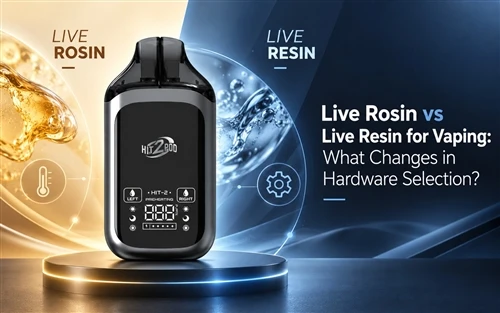
Live rosin is a solventless cannabis concentrate valued for its flavor, aroma, and relatively unprocessed character. Those qualities also make hardware selection more demanding. Excessive heat can flatten flavor, while poor oil delivery can cause weak vapor, dry hits, or clogging.
For most formulations, the best vape hardware for live rosin starts with a ceramic heating system, controlled low-temperature output, sufficient oil intake, and an oil path designed for viscous extracts. Postless designs and preheat functions can improve performance further when they are properly matched to the oil.

What Makes Live Rosin Different for Vape Hardware?
Live rosin is typically produced without hydrocarbon solvents, often by applying heat and pressure to hash made from fresh or frozen cannabis material. Unlike highly refined distillate, live rosin is commonly selected for its natural flavor and aromatic characteristics.
That changes what matters in the hardware.
A live rosin vape needs to vaporize the extract efficiently without exposing it to unnecessarily aggressive heat. At the same time, the oil must move from the reservoir to the heating element fast enough to keep the ceramic properly supplied.
Viscosity can vary considerably between formulations. Storage temperature, terpene content, processing, and formulation choices all influence how an oil behaves inside the device.
This is why live rosin vape hardware should be selected around the actual oil rather than the product name alone.
What Vape Hardware Is Best for Live Rosin?
For many formulations, good live rosin vape hardware combines five characteristics:
- A well-designed ceramic heating system
- Controlled, relatively low-temperature output
- Sufficient oil intake and wicking
- Balanced airflow and oil-path design
- Stable, compatible oil-contact materials
Postless or center-post-free hardware is also a strong option because it can simplify the internal oil path and reduce the amount of structure inside the reservoir.
No single feature determines performance by itself. A device labeled "full ceramic" can still perform poorly if its intake system cannot keep up with the oil. Likewise, a large inlet does little if the heater runs too aggressively or airflow is poorly balanced.
The best live rosin vape hardware is therefore a matched system, not simply a cartridge shape or a marketing label.
Why Ceramic Heating and Low-Temperature Output Matter
Ceramic heating is one of the most important characteristics to evaluate in live rosin hardware. Porous ceramic can spread heat across a larger surface instead of concentrating it into a small hot spot, supporting more controlled vaporization.
That matters when flavor quality is just as important as vapor production.
Ceramic Heating for More Even Vaporization
A ceramic coil for live rosin should do two things well: receive oil consistently and transfer heat evenly.
Good ceramic design can reduce localized overheating and help maintain stable vapor across repeated draws. But "ceramic" alone does not guarantee performance. Ceramic porosity, heating area, resistance, intake geometry, and operating voltage all affect the result.
It is also important to distinguish a ceramic heating core from full ceramic vape hardware. "Full ceramic" may refer to additional oil-contact components such as the center structure or mouthpiece, while the heating core itself is only one part of the device.
What Voltage Is Best for Live Rosin?
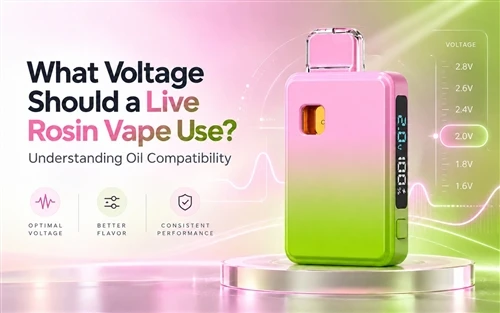
Many live rosin-oriented devices operate in the low-2V range, with roughly 2.0V to 2.4V serving as a useful reference point for some ceramic systems.
It is not a universal setting.
The same voltage can produce very different heating behavior depending on resistance, ceramic size, airflow, and heater architecture. A 2.2V device built around one ceramic core may perform very differently from another device running at the same voltage.
The goal is controlled heat, not simply the lowest voltage possible.
Oil Intake, Wicking and Airflow: Why Live Rosin Vapes Clog
A good heater cannot vaporize oil that never reaches it.
With viscous cannabis oil, slow feeding can leave the ceramic partially dry during a draw. The result may be weak vapor, inconsistent output, harsh flavor, or a clog. This is why understanding why live rosin vapes clog requires looking at the complete oil-delivery system rather than blaming the coil alone.
Why Larger Oil Inlets Can Help
For thick live rosin formulations, some hardware uses oil inlets around 2.0mm or larger to improve oil delivery.
Larger openings can help viscous oil reach the ceramic, particularly after storage or in cooler conditions. But inlet size should not be considered in isolation. Excessive oil delivery can create its own problems if the ceramic, airflow, and heating output are not designed around that flow rate.
Wicking and Airflow Must Work Together
|
Hardware factor |
What it affects |
|
Oil inlet size |
How easily oil reaches the heater |
|
Ceramic porosity |
How oil moves through the heating element |
|
Airflow |
Draw resistance and vapor movement |
|
Resistance and voltage |
Heating intensity |
|
Oil viscosity |
How quickly the formulation moves |
|
Internal oil path |
How consistently oil reaches the ceramic |
For live rosin, reliable oil delivery is just as important as the heating element itself.
Postless vs. Center-Post Hardware for Live Rosin
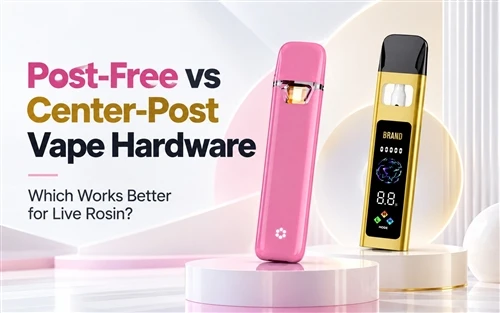
A postless vape removes the conventional central post from the oil chamber and typically places the ceramic heating structure near the bottom of the reservoir.
This architecture can simplify the oil chamber and reduce the amount of internal structure contacting the extract. Brands evaluating this approach can review how postless vape hardware differs from conventional center-post designs.
|
Postless design |
Center-post design |
|
Fewer internal structures |
More traditional architecture |
|
Simpler visible oil chamber |
Central structure remains in reservoir |
|
Can create a more direct oil path |
Oil path depends on center-post geometry |
|
Frequently paired with bottom ceramic heating |
Can still work well with suitable ceramic and temperature control |
Postless hardware should not be treated as automatically superior in every formulation. Very thick oil can still feed poorly if the ceramic or intake system is not suited to it.
Postless is a strong architecture for live rosin, but it does not replace proper formulation testing.
Does Live Rosin Vape Hardware Need a Preheat Function?
Preheat can be useful when a formulation becomes slow-moving after storage or exposure to lower temperatures.
A short, gentle preheat warms the oil before the primary draw and can temporarily improve flow. This may help with:
- Weak first puffs
- Slow cold-start performance
- Inconsistent oil feeding
- Some viscosity-related clogging problems
Preheat should not be treated as a complete anti-clogging solution. If the intake, airflow, or ceramic structure is poorly matched to the oil, the device can still develop performance problems.
It works best as part of a properly matched heating and oil-delivery system.
510 Cartridge vs. All-in-One: Which Is Better for Live Rosin?
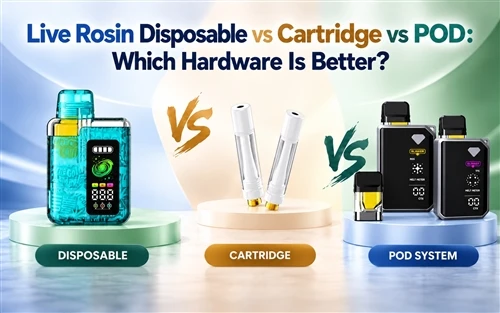
Both formats can work well with live rosin. The difference is how much control the hardware system gives the brand over heating, airflow, activation, and battery output.
510 Live Rosin Cartridges
A 510 cartridge uses the common 510-thread connection to attach the oil tank and heating element to a separate battery. This gives users flexibility to pair the cartridge with different 510 batteries, including variable-voltage models.
Smaller formats such as 0.5g and 1g cartridges are common choices for premium concentrates. A full ceramic vape cartridge is one possible format when brands want to minimize internal metal structures and emphasize ceramic oil-contact components.
The main limitation is that the cartridge manufacturer cannot fully control the battery voltage that the consumer eventually uses.
All-in-One Live Rosin Devices
An all-in-one, or AIO, vape integrates the battery, heating system, airflow, activation system, and oil tank into one device.
That gives the manufacturer more control over the complete vaporization system. Voltage, resistance, airflow, preheat, and activation can all be configured around the formulation before the product reaches the consumer.
A purpose-built live rosin vape pen, for example, allows the battery and heating system to be evaluated as one complete platform rather than as separate components.
|
Feature |
510 Cartridge |
AIO |
|
Battery |
Separate |
Integrated |
|
Voltage control |
Depends on battery |
Can be preset or built in |
|
Preheat |
Battery-dependent |
Can be designed into device |
|
System control |
More user-dependent |
More brand-controlled |
|
Typical advantage |
Flexible platform |
Fully calibrated experience |
For live rosin, heating and oil-delivery quality matter more than whether the device is a cartridge or AIO.
How Cannabis Brands Should Test Live Rosin Hardware Before Production
Specifications narrow the options. Actual oil testing decides whether the hardware works.
Before mass production, live rosin hardware should be evaluated for more than initial vapor output. Testing should cover:
- Filling and capping performance
- First-puff behavior
- Repeated-draw consistency
- Flavor stability
- Clogging and leakage
- Burnt taste
- Cold-start performance
- Storage stability
- Oil consumption and residual oil
Testing should use the actual formulation intended for sale. Two oils both labeled "live rosin" can behave differently enough to require different voltage, intake, or heating configurations.
This is the basis of an oil-matched hardware approach: ceramic core, intake, airflow, voltage, resistance, capacity, and tank architecture are evaluated as one system rather than selected independently.
FAQ: Choosing Vape Hardware for Live Rosin
What voltage is best for live rosin?
Around 2.0–2.4V is a useful low-voltage reference for some ceramic live rosin systems, but the correct setting depends on resistance, heater design, airflow, and formulation.
Is postless hardware better for live rosin?
Postless hardware is a strong option because it can simplify the oil path and work well with bottom ceramic heating. It is not automatically better if the oil intake and heating configuration are poorly matched.
Is full ceramic necessary for live rosin?
No. Ceramic heating is highly desirable, but the performance of the complete system matters more than the "full ceramic" label. Intake, airflow, voltage, resistance, materials, and heater design still need to work together.
Can the same vape hardware be used for distillate and live rosin?
Sometimes, but the same configuration should not automatically be assumed to be optimal. Distillate and live rosin can place different demands on heating, oil flow, and flavor preservation.
The best vape hardware for live rosin is not one universal cartridge or disposable. A ceramic heating system, controlled low-temperature output, sufficient oil intake, stable oil-contact materials, and formulation-matched architecture provide the strongest foundation. Postless designs and preheat can improve that foundation when the oil benefits from them.
As a cannabis vape hardware manufacturer, ASM VAPE develops POST-FREE, ceramic, cartridge, POD, and customizable AIO platforms around different cannabis oil formulations. If you are evaluating hardware for a new live rosin product, contact ASM VAPE to test your oil and match the ceramic core, intake, voltage, airflow, and device architecture before mass production.