A vape pen is a portable vaporization device that gently heats cannabis oil into inhalable aerosol without combustion. Whether you are formulating a THC distillate cartridge or filling a disposable CBD pen, the cannabis vape hardware you choose determines flavor fidelity, draw consistency, and how often your customers come back complaining about clogs and leaks.
Every vape pen on the market - from a $9 auto-draw battery to a premium variable-voltage device - is built from the same handful of core components. The essential parts of a vape pen generally include the mouthpiece, cartridge or tank, atomizer or heating element, battery, and airflow system.
Understanding these vape pen components, how each part works, and how they interact is the difference between a product that performs consistently and one that fails in the field.

The Vape Pen Mouthpiece
The mouthpiece, sometimes called the drip tip, is the interface where vapor exits the device and enters the user's mouth. It looks simple, but its geometry directly shapes the draw experience.
A narrow bore concentrates vapor and intensifies flavor perception. A wider bore cools the vapor slightly and suits high-volume clouds. For cannabis oil vape pens, the mouthpiece also has to resist the stickiness of thick concentrates - a poorly designed bore will accumulate reclaimed oil and restrict airflow within days of use.
Material choice matters as much as geometry. The three common options are:
|
Material |
Taste Neutrality |
Durability |
Typical Use |
|
Borosilicate glass |
Excellent - chemically inert |
Fragile on drop |
Premium cartridges |
|
Ceramic |
Excellent - inert, heat-resistant |
Moderate |
High-end mouthpieces |
|
Medical-grade plastic (BPA-free) |
Good - slight warm-off note |
High, shatter-proof |
Disposable pens, cost-sensitive SKUs |
Glass and ceramic are the preferred materials for brands targeting a premium or medical-adjacent positioning. Plastic remains the workhorse for disposables where unit cost drives every decision.
The mouthpiece is often the first thing a consumer touches, and a cheap-feeling tip can undermine confidence in an otherwise well-built device.
The Vape Cartridge or Oil Tank
The cartridge - also referred to as the tank, reservoir, or cart - holds the cannabis oil and houses the heating element.
In a 510-thread vape pen system, the cartridge is a separate, replaceable component that screws onto the battery. In a disposable or all-in-one (AIO) vape, the tank and battery are permanently sealed together and discarded as a unit after the oil is depleted. If you want a broader overview of this integrated architecture, see how a disposable vape pen works.
Cartridge capacity typically ranges from 0.3 mL to 2.0 mL for cannabis oil applications. The reservoir wall material affects both shelf presentation and oil stability:
- Borosilicate glass - the gold standard for clarity and chemical inertness; lets consumers see oil color and fill level.
- Polycarbonate / thermoplastic - lighter and cheaper, but certain aggressive terpene profiles, especially limonene-heavy citrus strains, can stress-crack or haze plastic over time.
- Full-ceramic body - niche but growing; eliminates plastic entirely and pairs naturally with ceramic heating cores. A full ceramic vape cartridge is one example of this type of construction.
One underappreciated design element is the oil intake hole - the opening through which oil travels from the reservoir into the heating element.
Smaller intake holes suit thin, low-viscosity oils like some CBD isolates. Larger or multiple intake holes are necessary for thick distillates and live resin, which may not flow adequately at room temperature. Mismatching intake size to cannabis oil viscosity is a leading cause of dry hits, clogging, and inconsistent dosing.
The cartridge is where oil chemistry and cannabis vape hardware engineering meet. Getting the reservoir material, capacity, and intake geometry right for your specific extract is the single highest-leverage decision in product development.
The Atomizer and Heating Element
The atomizer is the vape pen component that converts electrical energy from the battery into heat, vaporizing the oil.
In cannabis vape hardware, the atomizer is almost always integrated into the cartridge or disposable unit rather than being a standalone replaceable coil head, as in many nicotine e-cigarette systems.
Ceramic Cores vs. Cotton Wicks vs. Quartz Rods
Three heating-element architectures dominate the cannabis market today:
|
Feature |
Ceramic Core |
Cotton Wick |
Quartz Rod |
|
Heat distribution |
Even, no hot spots |
Uneven near coil |
Concentrated, rapid |
|
Flavor purity |
High - inert material |
Good initially, degrades |
Moderate |
|
Oil compatibility |
Broad - handles thick distillate |
Thin oils preferred |
Thick concentrates |
|
Lifespan |
Long - resists carbonization |
Short - dry burns, scorching |
Moderate |
|
Dry-burn risk |
Low |
High |
Moderate |
The ceramic heating core - a porous ceramic substrate, typically alumina or zirconia-based, with an embedded heating film or wire - has become the de facto standard for cannabis vape pens.
Its micro-porous structure wicks oil through capillary action while distributing heat across a large surface area, which avoids the localized hot spots that carbonize oil and produce burnt, harsh vapor.
According to industry reporting, ceramic cores now account for an estimated 85% or more of the Chinese-manufactured vape hardware market, which supplies the majority of global cannabis vape components.
Cotton wicks, the older technology, still appear in some budget disposables. They offer strong initial flavor but degrade quickly - the fiber scorches, collapses, and introduces off-notes after a fraction of the tank's capacity.
Quartz rod heaters, which use a quartz crystal wrapped in wire, heat up fast and suit very thick concentrates, but their concentrated heat pattern can still char oil if power isn't carefully managed.
For THC and CBD oil applications, ceramic is the clear default. The only reason to deviate is extreme cost pressure on a disposable where short service life is acceptable.
Vape Coil Resistance and Power
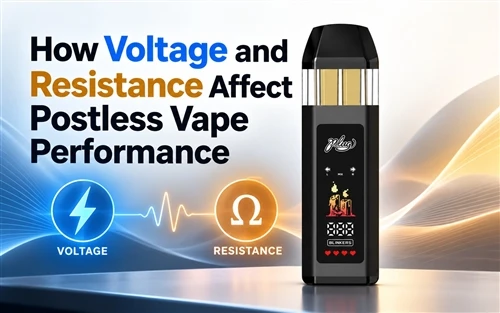
The atomizer's electrical resistance - typically in the range of 0.8 to 2.0 ohms for cannabis oil pens - determines how much heat a given voltage produces. This relationship follows the basic principles of electrical resistance and Ohm's law.
Lower resistance draws more current and generates more heat; higher resistance runs cooler and gentler. The vape pen battery and atomizer must therefore be matched correctly.
A high-voltage battery paired with a low-resistance atomizer will overheat oil, volatilize terpenes prematurely, and produce a harsh, burnt taste. A battery that can't deliver enough power to a low-resistance coil will produce weak, anemic vapor.
For cannabis vape hardware, voltage and resistance should be considered together with oil viscosity, ceramic core design, and the desired vapor output rather than selected independently. For a more detailed explanation, see how resistance affects cannabis vape hardware.
The Vape Pen Battery
The battery is the power source - almost universally a rechargeable lithium-ion or lithium-polymer cell - that stores energy and delivers it to the atomizer on demand.
In a vape pen, battery capacity is measured in milliamp-hours (mAh), with cannabis pens typically ranging from about 280 mAh in ultra-compact disposables to 900 mAh or more in premium 510-thread batteries.
For brands developing cartridge-based systems, a dedicated 510 thread battery provides the power platform for compatible 510 cartridges.
510 Thread: The Industry Standard
The 510 thread is the universal screw-type connection standard - 7 mm diameter, 0.5 mm pitch - that links a vape cartridge to a battery.
It originated in the early nicotine e-cigarette industry and has become the dominant interface in cannabis vaporization because it allows cartridges and batteries from different manufacturers to be interchanged.
A 510-thread cartridge from one supplier will screw onto a 510-thread battery from another, though performance - including voltage, preheat behavior, and draw activation - may vary.
The 510 standard's openness is both its greatest strength and a source of consumer confusion. Compatibility exists at the physical level, but electrical compatibility - resistance matching, voltage range, and current delivery - is not guaranteed.
A thick-oil cartridge designed for 3.7 V may underperform on a battery capped at 3.2 V. Brands evaluating these systems can also review the key considerations for 510 cannabis vape cartridge hardware.
Vape Pen Activation Methods
|
Type |
How It Works |
Best For |
|
Auto-draw (draw-activated) |
Airflow sensor detects inhalation and fires automatically |
Disposables, beginner-friendly pens |
|
Button-activated |
User presses and holds a button to fire |
Power users, variable-voltage devices |
|
Variable voltage |
Button cycles through preset voltage levels, e.g. 2.4 V / 3.2 V / 4.0 V |
Enthusiasts, thick-oil cartridges |
Auto-draw batteries are the default for disposables and entry-level pens because they require no user instruction.
Button-activated and variable-voltage batteries give users control over heat output, which matters for thick distillates and live resin that need more power to vaporize cleanly. For a closer comparison of these control methods, see button vs inhale activation.
Vape Pen Battery Safety Features
A well-engineered vape pen battery should include:
- Short-circuit protection - cuts power if a fault is detected.
- Over-discharge protection - prevents the cell from draining below a safe voltage threshold, typically around 2.4–2.75 V.
- Over-time / timeout cutoff - auto-shuts after 8–10 seconds of continuous firing to prevent overheating.
- Overcharge protection - stops charging once the cell reaches its maximum voltage, 4.2 V for standard lithium-ion.
These protections are not optional features. A battery without them is a product liability waiting to happen, and any brand sourcing vape hardware should verify that the protection circuit is present and tested - not just listed on a spec sheet. The U.S. Food and Drug Administration also provides guidance on lithium-ion vape battery safety.
The Vape Pen Airflow System
The airflow system is the network of channels and intake holes that allow air to mix with vaporized oil and carry it to the mouthpiece. It is one of the least-discussed but most failure-prone parts of a vape pen.
Airflow design determines draw resistance - how hard the user must pull - vapor temperature, and, critically for cannabis oil, whether the device clogs.
Thick oils like distillate and live resin can migrate into airflow channels when the device is not in use, especially in cold environments or during air transport where pressure changes force oil outward. Once in the channel, the oil cools, thickens, and solidifies into a blockage.
Effective anti-clog design relies on several engineering choices working together: intake hole sizing matched to oil viscosity, labyrinth or baffle structures that intercept stray oil before it reaches the mouthpiece, and PTFE or PEEK surface treatments that reduce oil adhesion to channel walls.
No single feature solves clogging - it is a system-level problem.
Airflow is where many field failures originate. A pen that vapes perfectly in a lab at 72°F can clog on a dispensary shelf at 60°F. Testing across temperature ranges - not just at room temperature - is essential before committing to a hardware order. For more detail on this design variable, see cannabis vape airflow design.
How Vape Pen Parts Work Together
A vape pen is not simply a collection of independent components. It is a tightly coupled system where every part constrains the others.
The battery voltage must match the atomizer resistance. The atomizer's intake geometry must match the cannabis oil viscosity. The cartridge's material must be compatible with the terpene profile. The airflow channel must be sized for the oil's flow characteristics at the lowest temperature the product will encounter.
This interdependence is why cannabis vape hardware selection cannot be done component by component.
A ceramic core that performs beautifully with a thin CBD isolate may clog with a thick live resin. A variable-voltage battery that gives enthusiasts control may confuse a first-time dispensary customer.
The right combination depends on your oil, your target user, and your price point - and the only reliable way to find it is systematic oil-hardware compatibility testing before bulk procurement.
FAQ
What are the main parts of a vape pen?
The essential parts of a vape pen are the mouthpiece, cartridge or oil tank, atomizer or heating element, battery, and airflow system. Depending on the design, a vape pen may also include an activation sensor or button, circuit board, charging port, and 510-thread connection.
What part of a vape pen turns cannabis oil into vapor?
The atomizer or heating element is responsible for vaporizing cannabis oil. In most modern THC and CBD vape hardware, a ceramic heating core absorbs the oil and distributes heat across its surface to produce vapor.
Is the atomizer the same as the vape coil?
The terms are often used interchangeably, but they are not exactly the same. The atomizer refers to the complete heating system, while the coil or heating element is the component that generates heat. In many cannabis vape cartridges, the heating element is integrated into a ceramic core.
What is a 510-thread vape pen?
A 510-thread vape pen uses a standardized threaded connection between the cartridge and battery. This allows many 510 cartridges and batteries to connect physically, although voltage, resistance, current delivery, and other electrical characteristics still need to be compatible for proper performance.
Why does cannabis oil viscosity matter when choosing vape hardware?
Cannabis oil viscosity affects how easily oil moves through the intake holes and reaches the ceramic heating core. Thin CBD oils, thick distillates, live resin, and other formulations can require different intake geometry, airflow, voltage, resistance, and heating configurations. Matching these vape pen components to the oil helps reduce clogging, weak vapor, dry hits, and inconsistent performance.
Conclusion
The essential parts of a vape pen are the mouthpiece, cartridge or tank, atomizer or heating element, battery, and airflow system. Each vape pen component plays a specific role, but none can be optimized in isolation. Cannabis oil viscosity, terpene profile, heating-core design, voltage and resistance, airflow, target user, and price point all influence the right hardware combination.
Getting these components matched correctly is what separates reliable cannabis vape hardware with consistent vapor performance from a product that generates clogging, leaking, weak vapor, returns, and negative customer feedback.
ASM VAPE is a cannabis vape hardware manufacturer and OEM/ODM solutions provider serving THC/CBD brands and industry partners. We provide oil-matched hardware solutions covering ceramic platforms, airflow, voltage/resistance, capacity, materials, and product customization. Contact us to discuss your cannabis oil formulation or vape hardware project and identify a configuration that fits your performance and branding requirements.