Regular nicotine vapes and cannabis oil vapes look similar - both are battery-powered devices that heat a liquid into an inhalable aerosol. But the hardware inside is not the same. Cannabis oils are thick, viscous, and chemically complex, while nicotine e-liquids are comparatively thin and behave very differently during heating.
That difference in fluid properties affects nearly every hardware decision, including atomizer material, pore structure, heating profile, battery voltage, airflow, oil intake, and tank capacity. Treating regular nicotine vape hardware and cannabis oil vape hardware as interchangeable is one of the fastest ways to encounter burnt coils, clogged cartridges, weak vapor, or leaked product.

What Is a Regular Nicotine Vape?
A regular vape - the term used here for nicotine e-cigarette hardware - is a device engineered to aerosolize e-liquid, a relatively thin solution typically composed of propylene glycol (PG), vegetable glycerin (VG), nicotine in freebase or nicotine-salt form, and flavorings. These products fall broadly within the FDA's category of electronic nicotine delivery systems (ENDS).
The comparatively low viscosity of nicotine e-liquid means it can flow easily through common wicking materials, while the coil can operate at higher power levels without the same viscosity-management challenges found in THC oil vape hardware or CBD vape hardware.
Key hardware characteristics of regular nicotine vapes include:
- Atomizer type: Predominantly cotton-wick coils or mesh coils. Cotton saturates quickly with thin e-liquid and delivers fast flavor ramp-up.
- Tank / pod capacity: Typically 2 mL to 10 mL for refillable systems; disposables can reach 10–16 mL.
- Battery output: Often 3.3V–4.2V regulated, with coil resistances ranging from 0.4Ω sub-ohm to 1.2Ω mouth-to-lung.
- E-liquid viscosity: PG/VG blends flow from water-like to light-syrup consistency, so highly specialized thick-oil wicking structures are generally unnecessary.
The fast-flowing nature of nicotine e-liquid means the hardware's primary design challenge is often flavor reproduction and vapor volume rather than handling highly viscous oil. Cotton wicks, mesh strips, and conventional wire coils can perform effectively because the liquid can replenish the heating element relatively quickly.
What Is Cannabis Oil Vape Hardware?
Cannabis oil vape hardware is engineered specifically to aerosolize cannabis-derived oils and concentrates, including THC distillate, CBD oil, live resin, and full-spectrum extracts. For broader background on cannabis, THC, and cannabis concentrates, the U.S. National Institute on Drug Abuse provides an overview of cannabis and its active compounds.
These oils can be dramatically thicker than nicotine e-liquid, often reaching a honey-like or even near-solid consistency at room temperature. They may also contain terpenes, waxes, and lipids that behave very differently from PG/VG when heated.
The defining hardware challenge is viscosity management: the oil must reach the heating element efficiently and be heated enough to vaporize, but not so aggressively that flavor quality suffers or the oil develops a harsh, burnt taste.
Key characteristics of cannabis oil vapes include:
- Atomizer type: Predominantly ceramic atomizers, including porous ceramic cores with embedded or integrated heating elements. Ceramic atomization has become widely used in THC/CBD vape hardware because it can provide stable heating and support viscous cannabis oils.
- Cartridge capacity: Typically 0.5 mL to 1.0 mL, occasionally 2.0 mL. Cannabis concentrates are potent, so relatively small volumes can provide many inhalations.
- Battery output: Generally lower and more controlled, commonly around 2.4V–3.7V depending on the oil formulation, atomizer resistance, and hardware architecture.
- Oil viscosity: Distillate and live resin may be 10–100× more viscous than nicotine e-liquid, requiring specialized oil intake and wicking structures.
Cannabis oil vapes are therefore not simply nicotine vapes with a different label. Ceramic core design, oil intake, airflow, tank structure, voltage, and resistance all need to work together for the oil being filled.
Key Differences Between Regular Vape and Cannabis Oil Vape Hardware
The table below summarizes the main differences between regular nicotine vape hardware and cannabis oil vape hardware.
|
Specification |
Regular Vape (Nicotine) |
Cannabis Oil Vape |
|
Primary liquid |
PG/VG + nicotine e-liquid |
THC/CBD distillate, live resin, full-spectrum oil |
|
Liquid viscosity |
Water-like (~1–50 mPa·s) |
Honey-like to near-solid (~1,000–10,000+ mPa·s) |
|
Atomizer material |
Cotton wick, mesh coil |
Porous ceramic core |
|
Typical coil resistance |
0.4Ω–1.2Ω |
1.2Ω–2.0Ω (higher resistance, lower power) |
|
Battery voltage |
3.3V–4.2V (variable wattage common) |
2.4V–3.7V (fixed or low-range) |
|
Tank / cartridge capacity |
2 mL–16 mL |
0.5 mL–2.0 mL |
|
Wicking mechanism |
Cotton fiber absorbs thin liquid |
Ceramic pores draw viscous oil via capillary action |
|
Primary failure mode |
Coil gunking, flavor fade |
Clogging, leakage, burnt taste from oil degradation |
|
Connection standard |
510 thread, proprietary pods |
510 thread, proprietary device-cartridge systems |
These are not minor variations. The viscosity gap alone - potentially three to four orders of magnitude - means a cotton-wick nicotine atomizer may not wick cannabis distillate fast enough to maintain consistent vapor production. The coil can run dry, overheat, and produce a burnt hit.
Conversely, a ceramic atomizer engineered around thick cannabis oil may not be appropriate for very thin nicotine e-liquid because the oil intake and pore structure are designed around a completely different fluid profile.
Atomizer Design: Cotton vs. Ceramic
The atomizer is one of the areas where regular vape and THC vape hardware differ most fundamentally.
Cotton-wick and mesh coil atomizers, commonly used in nicotine vapes, rely on a fibrous absorbent material such as organic cotton or cellulose that soaks up e-liquid and delivers it to a heated wire or mesh surface. This works effectively with thin PG/VG liquids. The wick saturates quickly, and the low-viscosity fluid replenishes as the coil vaporizes it.
Introduce thick cannabis distillate, however, and the same system can struggle. The oil penetrates the fiber matrix much more slowly. The coil may heat faster than the wick can deliver oil, resulting in a dry or burnt hit. For a more detailed comparison of the two atomization approaches, see this guide to ceramic vs. cotton coils.
Porous ceramic atomizers address this problem differently. A ceramic core contains microscopic pores that draw viscous oil toward the heating zone through capillary action. The heating element is integrated with or embedded in the ceramic structure, allowing heat to transfer to oil held within the porous material.
This is one reason ceramic technology is so widely used in high-viscosity cannabis oils, THC cartridges, CBD devices, and other cannabis vaporization systems. Hardware architectures can range from conventional ceramic-core cartridges to a full ceramic vape cartridge, depending on the formulation and product requirements.
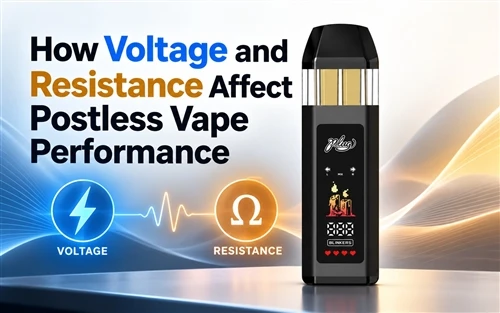
Battery Voltage and Resistance: Matching Power to the Oil
Battery output is another critical differentiator, and it is closely related to the oil's thermal behavior.
Nicotine e-liquids vaporize readily. PG boils at approximately 188°C and VG at approximately 290°C, so even moderate coil temperatures can produce dense vapor. Nicotine vapes can operate at 3.7V–4.2V or higher, with some sub-ohm coils drawing 20–80W.
Cannabis oils generally require a different approach. Cannabinoids and terpenes are sensitive to excessive heat, and many terpene compounds can degrade as temperatures rise. Cannabis vape batteries are therefore commonly tuned to lower and more controlled output, such as 2.4V–3.7V with higher-resistance atomizers in the 1.2Ω–2.0Ω range.
This helps the device warm viscous oil while reducing the likelihood of overheating and burnt flavor.
The exact configuration, however, should depend on the oil formulation and hardware architecture rather than a single universal voltage. Voltage, resistance, ceramic core design, and oil viscosity influence one another, which is why understanding how resistance affects cannabis vape hardware is important when specifying a device.
Different oil types may also require different hardware approaches. For example, hardware optimized for distillate oil may use a different operating profile from hardware intended for terpene-rich extracts.
Tank Capacity and Oil Chemistry
The capacity difference - 2–16 mL for nicotine tanks versus approximately 0.5–2.0 mL for many cannabis cartridges - is not arbitrary. It reflects the potency and dosing economics of the substances being vaporized.
A single milliliter of THC distillate at a typical concentration of 70–90% THC may contain 700–900 mg of THC. At a common per-inhalation dose of roughly 2–5 mg absorbed, one milliliter can provide well over a hundred doses. A 0.5 mL cartridge can therefore represent a substantial supply.
A 10 mL cannabis oil tank would be commercially impractical in many applications because of product cost, oil stability, and form-factor considerations.
Nicotine e-liquid, by contrast, typically contains 3–50 mg/mL of nicotine. A 2 mL pod may provide a day or two of use for a moderate user, while larger tanks and disposables primarily reduce refill frequency.
510 Thread Compatibility Does Not Mean Hardware Compatibility
Both categories can use the 510 thread, a standardized screw-type connection with a 7 mm diameter and 0.5 mm pitch. It originated in the e-cigarette industry and later became a widely used interface for interchangeable cannabis cartridges and batteries.
This is one of the few hardware elements that may genuinely be shared.
However, mechanical compatibility does not mean functional compatibility.
A 510-thread nicotine battery can physically connect to a 510-thread cannabis cartridge, but if the battery outputs around 4.0V by default, it may overheat a cannabis ceramic atomizer or scorch the oil.
Many cannabis-specific batteries therefore include functions such as adjustable voltage and preheat. A purpose-built 510 thread battery can provide a more appropriate power profile for cannabis cartridges, while brands evaluating the full system can review the key factors involved in selecting 510 cannabis vape cartridge hardware.
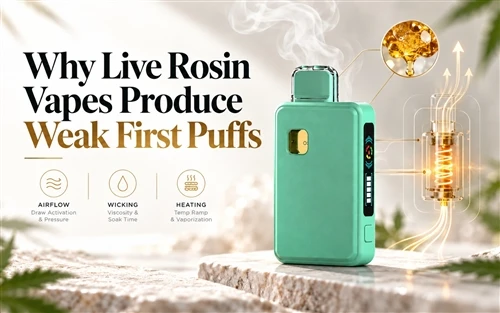
Preheat applies controlled power before the main draw to warm thick or cold cannabis oil and improve oil flow toward the atomizer.
Common Cannabis Vape Hardware Failure Modes and Their Causes
Understanding the hardware differences makes common cannabis vape problems easier to diagnose. Many failures can be traced back to a mismatch between the oil's physical properties and the hardware configuration.
Clogging is one of the most frequent complaints associated with cannabis cartridges. Thick oils - particularly oils containing waxes and lipids or products stored in cold environments - may become less fluid and restrict ceramic pores, oil intake channels, or the airway. A preheat function using a controlled low-voltage warm-up cycle can help return the oil to a more flowable state.
Leakage can occur when a cannabis cartridge is overfilled, stored horizontally, exposed to temperature swings, or paired with an oil that is too thin for the hardware's intake and sealing design. Ceramic atomizers can help control passive oil flow, but no cartridge architecture is completely immune to leakage.
Burnt taste usually indicates that the atomizer is running too dry or too hot. In cannabis oil vapes, this may happen when the oil is too thick to reach the ceramic core fast enough or when the battery voltage is too high. In nicotine hardware repurposed for cannabis oil, the cotton wick may be unable to replenish oil at the required rate.
Weak or no vapor can indicate a depleted battery, cannabis oil that is too cold or viscous to flow, or an atomizer whose pores or intake channels have become restricted by residue.
For especially viscous formulations, brands may need hardware specifically designed as a disposable vape for thick oil, rather than simply increasing voltage to compensate for slow oil flow.
The overall pattern is clear: many cannabis vape failures occur when oil viscosity, thermal behavior, ceramic core, airflow, intake design, voltage, and resistance are not properly matched.
Why Cannabis Vape Hardware Selection Matters for Cannabis Brands
For THC/CBD brand operators, oil processors, product developers, distributors, and wholesale buyers, hardware is not simply a commodity decision. It directly affects product consistency, flavor delivery, vapor output, consumer experience, and ultimately the reputation of the cannabis brand.
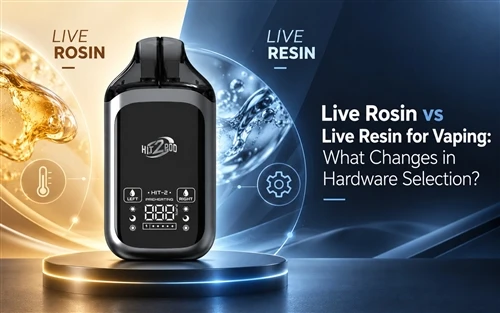
A premium live resin with a delicate terpene profile used in a high-voltage nicotine-style device with an unsuitable atomizer may taste burnt and perform inconsistently. The same oil paired with properly selected vape hardware for live resin, controlled voltage, suitable intake structure, and appropriate preheat functionality can provide much more stable vaporization.
The same principle applies to solventless formulations. Live rosin vape hardware needs to account for the oil's viscosity, terpene content, and temperature sensitivity rather than treating live rosin like a generic vape liquid.
Consumers typically attribute the experience - good or bad - to the brand on the package rather than to the unnamed hardware platform inside.
This is why professional cannabis vape hardware selection goes far beyond asking whether a cartridge fits a 510 battery. Important factors can include:
- Cannabis oil type and viscosity
- Ceramic core architecture
- Oil intake size and structure
- Airflow design
- Coil resistance
- Battery voltage
- Preheat functionality
- Tank material
- Seal integrity
- Cartridge or AIO capacity
- Activation method
- Compatibility with the specific formulation
Different oils - including distillate, live resin, live rosin, CBD oil, RSO, high-terpene full-spectrum extracts, and Delta-9 THC formulations - may require different ceramic structures or operating parameters.
Brands that treat hardware as an afterthought can end up with increased returns, complaints about clogged or burnt cartridges, and inconsistent consumer experiences. Brands that match cannabis oil vape hardware to their specific oil chemistry are in a better position to achieve stable vaporization, consistent output, and predictable product performance.
Final Thoughts
The core difference between a regular nicotine vape and cannabis oil vape hardware comes down largely to the liquid each device is designed to handle. Nicotine e-liquid is relatively thin and works effectively with cotton or mesh atomizers at higher power, while cannabis oil is much more viscous and generally requires purpose-built ceramic atomization, controlled voltage, specialized oil intake, and careful airflow design. Even when both products use a 510 connection, their atomizer architecture, voltage range, tank design, and operating requirements are fundamentally different.
ASM VAPE is a B2B cannabis vape hardware manufacturer focused on oil-matched hardware and OEM/ODM solutions for THC/CBD brands. If you are developing a cannabis oil product and need help matching ceramic core, voltage, resistance, airflow, capacity, or hardware architecture to your formulation, contact ASM VAPE to discuss your oil type, performance requirements, and project needs.
FAQ
Can You Put THC Oil in a Regular Nicotine Vape?
In most cases, regular nicotine vape hardware is not designed for thick THC oil. Cotton or mesh wicking systems optimized for PG/VG e-liquid may not move high-viscosity cannabis oil toward the heating element quickly enough, which can lead to weak vapor, dry hits, burnt taste, or clogging. Purpose-built THC oil vape hardware is generally a better choice.
Why Does Cannabis Oil Vape Hardware Usually Use Ceramic Coils?
Porous ceramic cores can transport viscous cannabis oil toward the heating zone through capillary action while providing relatively even heat distribution. This makes ceramic atomization well suited to high-viscosity cannabis oils such as distillate, live resin, live rosin, and other concentrates.
Can the Same Cannabis Vape Hardware Be Used for Distillate, Live Resin, and Live Rosin?
Not necessarily. Oil type, viscosity, terpene content, and formulation can affect the required ceramic core, oil intake, airflow, voltage, resistance, and tank structure. Different cannabis oils can therefore perform better with different hardware configurations.
What Voltage Is Best for Cannabis Oil Vape Hardware?
There is no single voltage that is ideal for every cannabis oil. Many cannabis vape devices operate at lower voltage than nicotine vapes, but the appropriate setting depends on the oil formulation, viscosity, ceramic core, resistance, and desired vapor performance. Professional hardware selection should match voltage and resistance to the actual oil rather than relying on a universal setting.
What Should Cannabis Brands Consider When Choosing Vape Hardware?
Cannabis brands should evaluate oil compatibility, ceramic technology, voltage and resistance, airflow, oil intake, capacity, tank material, activation method, leak resistance, clogging performance, and manufacturing consistency. For commercial projects, sample testing with the actual oil formulation before mass production is especially important.