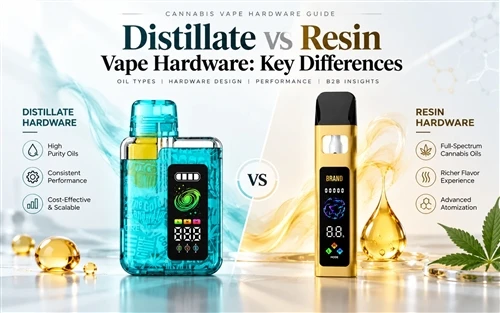
Distillate oil is the workhorse of the cannabis vape market. With cannabinoid concentrations commonly reaching 90% or higher, it delivers consistent potency, clean flavor profiles, and a viscosity that is relatively easy to work with across a wide range of cannabis vape hardware. But "relatively easy" does not mean "any cartridge will do." Choosing the right vape hardware for distillate oil directly affects whether a product hits smooth or harsh, whether it leaks in transit, whether it clogs after a week on the shelf, and whether the finished THC distillate cartridge delivers consistent vapor from the first draw to the last.
ASM VAPE is a B2B cannabis vape hardware manufacturer, engineering partner, and OEM/ODM supplier founded in 2019. Our documented industry experience spans 10+ years, and our work covers oil-matched hardware selection, product development, testing, filling support, troubleshooting, and scalable production for THC/CBD brands, distributors, and OEM/ODM partners. This guide explains the hardware decisions that matter for distillate oil-from ceramic core design and cartridge materials to voltage, airflow, clog resistance, and customization.
Understand Your Distillate First
Before selecting distillate vape hardware, you need to know exactly what you are filling. Distillate is produced through short-path or wiped-film distillation under vacuum and heat, which vaporizes and re-condenses individual cannabinoid compounds based on their unique boiling points, resulting in a highly refined, high-purity extract. The result is an oil that typically tests between 85% and 95% THC, with most native terpenes stripped away during processing.
Manufacturers commonly reintroduce terpenes-either cannabis-derived or botanical-to create specific flavor and aroma profiles. This step matters for hardware selection because terpene content directly affects oil viscosity. A plain distillate with minimal terpene reintroduction will be thicker and may require a wider-pore ceramic core or a stronger thermal profile. A distillate cut with a higher terpene percentage will flow more easily but may be more aggressive on certain seal materials over time.
Distillate's consistent composition and controlled viscosity make it relatively hardware-friendly - but the moment you reintroduce terpenes, you are changing the equation. Match your hardware to your final formulation, not just to "distillate" as a generic category.
ASM VAPE uses an oil-matched hardware approach: oil type and viscosity are evaluated together with ceramic core structure, intake design, airflow, voltage, resistance, and tank structure. In practice, "distillate" is only the starting label-the final formulation is what should drive hardware selection.
Key Distillate Properties That Affect Hardware Choice
|
Property |
Typical Range |
Hardware Implication |
|
THC/CBD concentration |
85% – 95%+ |
High potency means small volumes deliver strong effects; 0.5ml or 1ml tanks are standard |
|
Viscosity at room temp |
Medium-thick (varies with terpene %) |
Determines pore size of ceramic core and wicking channel design |
|
Terpene content |
0% (raw) to 8–12% (flavored) |
Higher terpene loads may require chemical-resistant seals and lower voltage |
|
Color |
Clear to light amber |
Glass tanks showcase clarity; opaque tanks hide impurities |
Choose the Right Atomizer Core Technology
The atomizer core is the heart of any vape cartridge. For distillate oil, ceramic-based heating elements are a common choice because they can provide broad, controlled oil contact and stable vaporization. The two primary options are:
A Ceramic Core (Recommended)
Porous ceramic absorbs oil through micron-scale pores and heats it across a broad surface area. This can produce smooth vapor, support consistent wicking, and preserve flavor integrity when the pore structure and power profile are matched to the distillate viscosity. For many THC distillate cartridges, a properly matched ceramic core is a practical balance of flavor, vapor output, and repeatable performance.
B Wick / Cotton Core
Traditional wick / cotton core atomizers use an organic cotton or silica wick wrapped with a heating wire. While cheaper to produce, wicks can burn, impart off-flavors, and struggle with consistent oil delivery at higher viscosities. For distillate, wick cores are generally treated as a budget option when flavor consistency and long-term stability are less critical.
Ceramic Core Subtypes for Distillate
Not all ceramic cores are the same. Within the ceramic category, there are meaningful differences in design that affect performance with distillate:
|
Ceramic Core Type |
Best For |
Key Characteristic |
|
Standard porous ceramic |
Classic distillate cartridges |
Proven architecture for high-volume distillate SKUs when pore size and power are matched to viscosity |
|
Full-ceramic (no metal post) |
Flavor-forward or lower-power formulations |
Reduces central metal contact and can support a cleaner oil path, but must still be matched to viscosity |
|
Postless ceramic |
Lower-power, terpene-forward formulations |
Full-ceramic bottom-coil architecture; not automatically suitable for very thick distillate |
For most distillate brands, a standard porous ceramic core remains a practical workhorse, but the word "ceramic" alone is not enough to specify performance. ASM VAPE engineering experience treats ceramic-core size and active oil-contact area as important variables: a low-resistance device with a small heating surface can still struggle to produce strong vapor, while a larger ceramic contact area can improve heat transfer and vapor output. Resistance, core geometry, intake, and power should be evaluated together.
ASM VAPE engineering reference: many center-post configurations used with distillate are designed around a stronger thermal profile, with internal reference ranges around 2.8–3.3V and 1.0–1.2Ω. Many postless configurations operate at lower power, commonly around 2.2–2.8V and 1.4–1.8Ω. These are reference ranges-not universal settings-and the final hardware should be validated with the actual oil formulation.
Select the Right Cartridge Format
The cartridge format determines compatibility, fill volume, and the consumer experience. The three formats most relevant to vape hardware for distillate oil are:
1. 510-Thread Cartridge
The most universal format. 510-threading is the industry-standard connection, so an empty 510 vape cartridge for distillate can pair with a wide range of compatible 510 batteries. This gives consumers flexibility and gives brands a broad hardware ecosystem. For a deeper compatibility checklist, see our guide on how to choose 510 cannabis vape cartridge hardware. Common capacities include 0.5ml, 1ml, and 1.2ml, with glass or thermoplastic tank options.
2. All-in-One (AIO) Disposable
A sealed unit combining battery, tank, and atomizer. No assembly is required by the consumer-fill, cap, and sell. AIO distillate vape hardware is useful for brands that want a controlled battery-to-atomizer pairing, with options such as inhale activation, USB-C charging, and preset or adjustable voltage.
3. Pod System
A proprietary battery + refillable or pre-filled pod. Pod systems offer a sleek form factor and strong brand lock-in but sacrifice the universal compatibility of 510. Best for brands building a dedicated device ecosystem rather than competing on cartridge-only SKUs.
Glass vs. Thermoplastic Tanks
For distillate, both materials work well, but the choice affects perception and performance:
|
Material |
Pros |
Cons |
|
Borosilicate glass |
Premium look, chemically inert, showcases oil clarity, heat-resistant |
Heavier, more fragile in transit, higher cost |
|
BPA-free thermoplastic |
Lightweight, shatter-resistant, lower cost, design flexibility |
Less premium feel, potential for minor chemical interaction over long shelf life |
For premium distillate brands targeting dispensary shelves, borosilicate glass tanks remain a strong option because it communicates quality and preserves oil visibility. For high-volume, price-sensitive SKUs or products that may face rough shipping conditions, BPA-free thermoplastic is a pragmatic choice.
ASM VAPE internal product experience also highlights a practical oil-utilization point: when only a small amount of thick THC oil remains, oil can cling to the tank wall instead of returning to the heating zone. Glass tanks can help reduce this wall-sticking tendency in some formulations, which is one reason tank material and internal geometry should be evaluated alongside the ceramic core.
Match Battery Voltage to Distillate Characteristics
The battery is not an afterthought-it is part of the distillate vape hardware system. Power output determines whether thick oil vaporizes cleanly or overheats, and voltage must be considered together with coil resistance, ceramic surface area, airflow, and oil viscosity.
For distillate cartridges, 3.2V to 3.8V is a common general reference range. Running too hot can scorch the oil and produce a harsh, burnt flavor; running too cool can result in weak vapor or slow oil movement. However, there is no universal "best voltage for distillate oil." A lower-resistance, larger-surface ceramic core can behave very differently from a higher-resistance postless core at the same voltage, so the actual formulation and atomizer design should be tested together.
|
Voltage Range |
Best For |
Effect on Distillate |
|
2.4 – 2.8V |
High-terpene distillate, flavor-forward |
Lower temp preserves terpenes, smoother vapor, smaller clouds |
|
3.2 – 3.8V |
Standard distillate (recommended) |
Balanced flavor and vapor production, optimal for most formulations |
|
3.8V+ |
Thick, low-terpene distillate |
Higher temp needed to move viscous oil, risk of harshness if oil is thin |
In ASM VAPE internal engineering notes, center-post hardware used for distillate is commonly referenced around 2.8–3.3V with approximately 1.0–1.2Ω resistance, while many postless designs use lower-voltage, higher-resistance configurations. These ranges complement-not replace-the general voltage guidance above; they show why voltage cannot be selected without considering the specific coil architecture and oil viscosity.
Treat the battery as part of the product, not a commodity. A consumer who pairs your premium distillate cartridge with a cheap, unregulated battery will blame your oil for the harsh hits - not their hardware.
Key Battery Features to Look For
A Preheat Function
A 3-to-5-second preheat cycle warms the oil before the first draw, which is especially valuable for thicker distillate formulations or when the cartridge has been stored in a cool environment. ASM VAPE product experience shows that high-viscosity THC oil can become harder to vaporize after sitting in low temperatures; a button-assisted preheat can improve the first-puff experience before normal inhale activation.
B Inhale Activation
Draw-activated firing eliminates the need for a button, creating a more intuitive consumer experience. This is standard on modern AIO disposables and increasingly common on 510 batteries designed for cannabis use.
C Adjustable Airflow
Airflow control lets consumers adjust draw resistance - tighter for a more cigarette-like mouth-to-lung hit, or more open for direct-lung draws. This is a meaningful differentiator for brands targeting different consumer preferences.
Prioritize Leak Prevention and Clog Resistance
Leaks and clogs are two of the most damaging hardware failures for a cannabis brand. With distillate vape hardware, both problems are strongly influenced by seal design, oil flow, airflow, viscosity, storage temperature, and the match between the ceramic core and the final formulation.
Leak Prevention
Leaks typically occur at three points: the bottom seal around the center post, the mouthpiece connection, and the airflow path. Quality hardware addresses each with purpose-designed components:
|
Leak Point |
Engineering Solution |
|
Bottom center post seal |
Upper and lower ceramic-core seals that block the oil exit path |
|
Mouthpiece / tank junction |
Press-fit or threaded connection with precision-toleranced O-rings |
|
Airflow path |
Integrated airway design that improves heat dissipation and reduces condensation leakage |
Leak prevention typically combines controlled sealing surfaces, optimized internal oil paths, and an airway layout that manages condensation. The goal is not only to stop visible leakage, but also to keep oil where it can feed the heater consistently throughout storage, shipping, and use.
Clog Resistance
Clogging happens when viscous oil cools and thickens inside the airway or the ceramic pores, restricting or blocking airflow. For distillate, clogs are most likely when:
1. Low ambient temperature
Cold storage or shipping thickens the oil and can make the first draw weak. A preheat function, a button-and-inhale activation design, or allowing the hardware to warm gradually can help restore oil flow before normal use.
2. Wrong pore size
If the ceramic pore size is too small for your distillate viscosity, oil cannot wick efficiently and the core runs dry - then the next pull pulls thickened oil into a narrow airway. Match pore size to viscosity.
3. Infrequent use
Oil left sitting in the airway or away from the heating zone between sessions can cool and thicken. Hardware with well-matched intake geometry, stable oil pathways, and sufficient ceramic contact area is more likely to maintain repeatable vapor output over time.
Consider the Full OEM/ODM Customization Path
For brands that want to differentiate beyond off-the-shelf distillate vape hardware, OEM/ODM customization should address both brand presentation and oil compatibility. ASM VAPE supports private-label customization on mature hardware platforms as well as deeper mold customization for exclusive product development.
|
Customization Layer |
Options |
Why It Matters |
|
Voltage / power |
Voltage presets, resistance adjustment, performance tuning |
Match power output to your specific distillate formulation |
|
Heating element |
Ceramic platform, heating core configuration, resistance |
Optimize wicking and vaporization for your oil viscosity |
|
Tank material & capacity |
Glass, plastic or other platform materials; capacity by hardware platform |
Align format with price tier and consumer use case |
|
Exterior design |
Logo printing/engraving, color, surface finish, UV/tactile processes |
Build brand recognition on the dispensary shelf |
|
Mouthpiece |
Material, shape, thread type, push-in vs. screw-on |
Affects draw feel, leak resistance, and consumer comfort |
|
Screen UI & functions |
UI customization, display features, vibration or other functions |
Build a differentiated user experience on supported platforms |
|
Mold customization |
Material, exterior design, structure, function, mold and packaging development |
Create an exclusive hardware platform instead of a simple private-label SKU |
A well-executed OEM/ODM program lets a brand control the consumer experience from the first draw to the last. ASM VAPE can also support 3D model previews and technical drawings during deeper product development, while oil-based customization focuses on matching capacity, heating core, voltage, and resistance to the formulation.
Validate with Testing Before You Scale
No matter how carefully you select vape hardware for distillate oil, real-world validation with the actual formulation is non-negotiable. Before committing to a production run, we recommend a structured cannabis hardware testing protocol:
1. Oil Compatibility Test
Fill sample cartridges with your actual distillate formulation and test for wicking speed, vapor production, and flavor at each voltage setting. Look for dry hits, flooding, or off-flavors.
2. Leak & Pressure Test
Subject filled cartridges to temperature cycling (cold to warm), pressure changes (simulating altitude during shipping), and physical orientation changes. Any leak is a disqualifier.
3. Shelf-Life Test
Store filled cartridges at various temperatures for 4–8 weeks and re-test performance. Oil can interact with seals and tank materials over time - what works on day one may not work on day thirty.
4. Consumer Draw Simulation
Use automated puffing machines to simulate real consumer usage patterns - varying draw length, frequency, and interval. This reveals clogging tendencies and battery life under realistic conditions.
Quick-Reference Decision Checklist
|
Decision Point |
For Distillate Oil |
|
Atomizer core |
Porous ceramic for many distillate formulations; evaluate core surface area, pore structure, and oil-contact geometry |
|
Cartridge format |
510-thread glass cartridge (0.5ml or 1ml) for universal compatibility |
|
Tank material |
Borosilicate glass for premium; BPA-free thermoplastic for value |
|
Battery voltage |
3.2–3.8V is a common general reference; final setting must be matched to resistance, coil architecture, and viscosity |
|
Leak prevention |
Upper/lower ceramic seals, integrated airway, precision O-rings |
|
Clog resistance |
Matched intake/pore structure, stable oil flow, sufficient ceramic contact area, and preheat where useful |
|
Testing |
Oil compatibility, leak/pressure, shelf-life, and draw simulation |
FAQ
What vape hardware is best for distillate oil?
The best vape hardware for distillate oil is the hardware that matches the final formulation. For many products, a ceramic-core 510 cartridge or a well-matched AIO works well, but viscosity, ceramic contact area, intake design, airflow, resistance, voltage, tank structure, and activation method should be evaluated together.
What voltage should I use for a distillate cartridge?
A 3.2–3.8V range is a common general reference for standard distillate cartridges, but it is not universal. ASM VAPE internal engineering notes also include center-post distillate configurations around 2.8–3.3V and 1.0–1.2Ω. Always test voltage together with coil resistance, ceramic design, and your actual oil viscosity.
Are ceramic coils better for THC distillate?
Ceramic cores are widely used for THC distillate because they can provide broad oil contact and controlled heat transfer. The important specification is not simply "ceramic"-core size, pore structure, active surface area, intake geometry, resistance, and power all influence vapor output and wicking.
How can I reduce clogging in a distillate vape cartridge?
Start by matching the oil viscosity to the ceramic pore or intake structure and airflow. For thick oil or cold storage conditions, a preheat function or button-assisted warming can improve the first draw. Stable oil pathways and proper testing after storage also help identify clogging risks before launch.
Should I choose a 510 cartridge or an AIO for distillate oil?
Choose a 510 cartridge when broad battery compatibility and a familiar format are priorities. Choose an AIO when you want tighter control over the battery, atomizer, activation, voltage, and overall user experience. Both formats can work with distillate when the hardware is matched and validated with the actual formulation.
Conclusion
Choosing vape hardware for distillate oil starts with the actual formulation, not a generic oil label. The most reliable approach is to match viscosity with ceramic core surface area, intake and airflow, tank structure, resistance, voltage, and activation method, then validate that combination with the real oil before scaling.
ASM VAPE is a cannabis-focused B2B hardware manufacturer and OEM/ODM engineering partner founded in 2019, with oil-matched hardware selection, customization, testing, and U.S. technical support. Contact us to discuss your distillate formulation and shortlist a 510 cartridge, AIO, pod, or custom hardware configuration for sampling.
Need Distillate Hardware Matched to Your Oil?
Share your formulation, target capacity, and performance goals with ASM VAPE to discuss an oil-matched cannabis vape hardware or OEM/ODM project.
- Industry editorial reference - Live Resin vs. Distillate: Why Device Matching Matters
- Distillate processing reference - Production Process Overview
- Industry hardware reference - Live Resin Overview
- Industry hardware reference - 510 Thread Cartridges for Oil
- Industry distribution reference - Cannabis Hardware Technology Overview
- Industry hardware reference - Cartridge Specifications
- Industry hardware reference - All-Oil-Capable Disposable Overview
- Cannabis hardware guide - Battery Compatibility & Voltage
- Cannabis vape maintenance guide - Common Hardware Issues
- General vape cartridge technology reference
- ASM VAPE - Wholesale Cannabis Vape Hardware Manufacturer & OEM/ODM