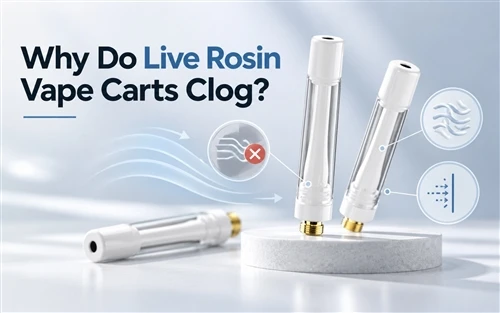
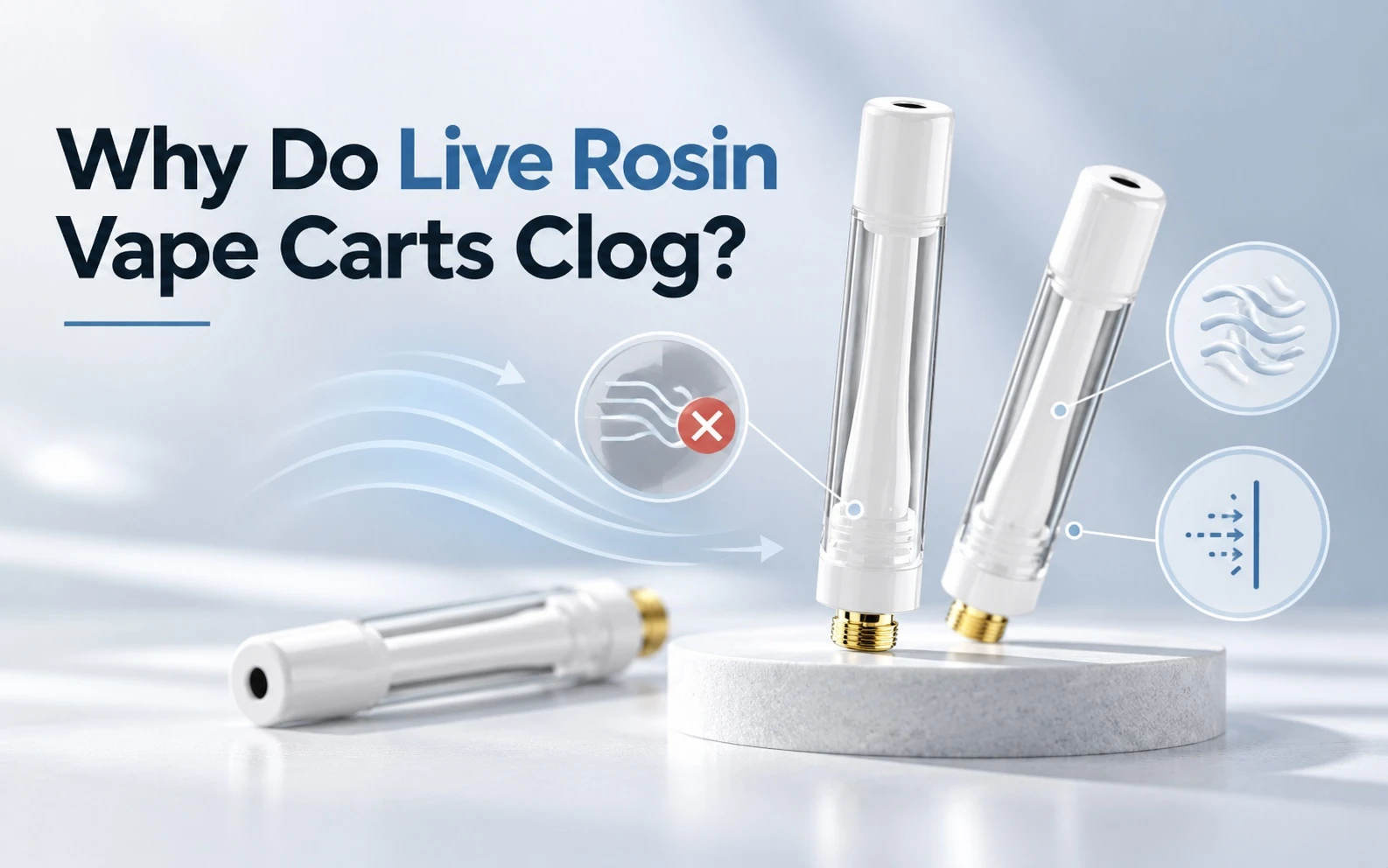
Live rosin is the crown jewel of solventless cannabis extracts - a full-spectrum concentrate that preserves the plant's native terpene profile with zero chemical solvents. But for brands and processors, live rosin vape cart clogging is a recurring headache: hard draws, blocked airflow, weak first puffs, and seized-up mouthpieces can all undermine the consumer experience. When a live rosin cart is clogged, the visible symptom may be the airway, but the root cause can begin much earlier in oil flow, ceramic wicking, or heating behavior.
ASM VAPE is a dedicated B2B cannabis vape hardware manufacturer and OEM/ODM engineering partner established in 2019. Our oil-matched hardware approach treats repeated live rosin clogging as a system problem: oil viscosity, oil flow, airflow, ceramic core behavior, voltage, resistance, tank structure, and environmental conditions must work together. That is why understanding both the oil and the hardware is the key to reducing clogging rather than only clearing it after it occurs.
What Makes Live Rosin Different
Before diving into live rosin vape clogging causes, it helps to understand what live rosin actually is - and why it behaves so differently from distillate inside a vape cartridge or all-in-one device.
Live rosin is produced by pressing ice-water hash (bubble hash) made from fresh-frozen cannabis flower. The result is a solventless, full-spectrum extract rich in THCA, native terpenes, lipids, waxes, and other plant compounds. Unlike distillate - which is a highly refined, homogeneous oil - live rosin is a complex, living matrix that continues to change over time.
Three properties of live rosin directly drive clogging:
High Viscosity
Live rosin is far thicker than distillate. At room temperature, it can be a semi-solid, buttery paste. This high viscosity means the oil resists flowing through narrow cartridge channels and ceramic pores, making it harder for the atomizer to wick efficiently.
THCA Crystallization
Live rosin naturally tends to separate over time, with THCA crystallizing into hard, gritty granules suspended in a liquid terpene fraction. These crystals can physically block the atomizer's oil intake holes and ceramic micro-pores.
Lipids & Waxes
Because live rosin is solventless and minimally processed, it retains plant lipids and waxes that distillate has stripped out. At cooler temperatures, these waxes solidify and congeal - especially at the mouthpiece and in the upper cartridge airway.
Distillate carts clog too, but live rosin carts clog on a completely different level. The oil itself is engineered by nature to solidify - your hardware has to be engineered to keep up.
The Five Root Causes of Live Rosin Cart Clogging
One useful diagnostic distinction is that not every symptom consumers call a "clog" is a true airway blockage. A poor oil-flow problem can cause weak or dry hits, an airflow problem can make the draw physically tight, and a heating mismatch can leave excess oil or condensate that later restricts the airway. For high-viscosity cannabis oil, these failure modes can overlap.
1. Oil Viscosity Exceeds Atomizer Wicking Capacity
The most fundamental cause: live rosin is simply too thick for many standard ceramic atomizers to wick at a sustainable rate. Ceramic coils rely on capillary action - the micro-pore structure of the ceramic draws oil from the reservoir to the heating surface. When oil viscosity is high, capillary flow slows dramatically. The atomizer heats faster than oil can arrive, leading to dry hits, carbonized residue buildup, and eventually a clogged or burned coil.
Standard ceramic atomizers designed for distillate typically have pore sizes and porosity tuned for low-viscosity oils (roughly 50–200 cP at room temperature). Live rosin can range from 10,000 to over 50,000 cP at the same temperature - orders of magnitude thicker. The atomizer literally cannot feed oil fast enough.
10x Live rosin viscosity vs. distillate at room temperature
2. THCA Crystal Blockage at Oil Intake Holes
Over days or weeks of storage, THCA in live rosin naturally nucleates and crystallizes. These crystals - which can range from fine sand to small pebbles - settle by gravity toward the bottom of the cartridge, right where the atomizer's oil intake holes are located. A crystal large enough to wedge into a 1.5–2 mm intake hole will choke off oil supply entirely.
This is why some carts work fine fresh but clog after two weeks on a dispensary shelf: the oil has had time to separate and crystallize. The problem is not the hardware failing - it is the oil's natural phase separation outpacing the hardware's tolerance.
3. Wax & Lipid Solidification in the Airway and Mouthpiece
While THCA crystals sink to the bottom, plant waxes and lipids tend to migrate upward with heat cycles. Each time a user takes a draw, the coil heats the oil, vapor travels up through the center airway tube, and some vapor condenses on the cooler inner walls of the mouthpiece. Over many sessions, this condensate - rich in waxes and heavy lipids - builds up and hardens into a plug.
This is the classic "hard to pull" clog: the mouthpiece feels blocked, and the user has to draw forcefully, which can create back-pressure that pushes oil back into the atomizer chamber rather than vapor out. The result is a feedback loop of worsening airflow.
4. Temperature Fluctuations During Shipping and Storage
Cannabis supply chains are not climate-controlled end to end. A cart manufactured in a 22°C facility may sit in a 40°C shipping container, then a 4°C dispensary storage room, then a consumer's car in winter. Each thermal cycle causes the oil to expand and contract, accelerate and decelerate crystallization, and shift viscosity dramatically.
Cold is especially damaging. When live rosin drops below about 15°C, it becomes nearly solid. The oil pulls away from the atomizer's ceramic surface as it contracts, breaking the capillary contact needed for wicking. When the cart warms back up, the oil may not re-wet the ceramic properly - leaving dry spots that scorch on the next draw.
5. Hardware Design Mismatch
Not all 510 cartridges - or all-in-one devices - are created equal. Many clogging problems begin when distillate-oriented hardware is paired with live rosin without validating oil compatibility. For live rosin vape hardware, the critical variables include ceramic wicking behavior, oil-contact area, intake geometry, airflow, center-post architecture, voltage, resistance, activation method, and tank structure. The goal is not simply "more heat"; it is to keep oil supply and vaporization in balance.
|
Hardware Factor |
Distillate-Oriented Hardware |
Live Rosin-Oriented Design Priority |
|
Ceramic core / wicking |
Usually tuned for a relatively fluid, homogeneous oil |
Prioritize high-viscosity wicking, effective oil-contact area, stable heat transfer, and flavor preservation |
|
Oil intake / oil path |
Standard intake geometry may be sufficient |
Match intake geometry and oil flow to the actual formulation; avoid narrow bottlenecks |
|
Airflow |
Standard airflow can work for lower-viscosity oil |
Balance draw resistance, vapor transport, and condensate management to reduce recurring restriction |
|
Center-post architecture |
Conventional center-post designs are common |
Postless / post-free architecture can reduce obstruction points, but it is not viscosity-independent |
|
Voltage & resistance |
Often configured around distillate performance |
Tune to the formulation; ASM VAPE postless product knowledge commonly uses about 1.4–1.8 Ω and 2.2–2.8 V, with some Resin/Rosin-oriented products operating even lower |
|
Activation / preheat |
Inhale-only activation may be sufficient |
Button + inhale or a controlled preheat can help when cold, high-viscosity oil needs time to regain mobility |
Engineering note: Exact specifications should be validated against the oil formulation. ASM VAPE's oil-matched framework evaluates ceramic core, intake, airflow, voltage, resistance, and tank structure together rather than treating any single parameter as a universal anti-clog setting.
Engineering Solutions: How ASM VAPE Prevents Live Rosin Clogs
Clogging is not inevitable, but there is no universal "anti-clog" cartridge for every live rosin formulation. ASM VAPE's engineering approach starts with oil-hardware compatibility: understand the formulation and viscosity first, then match the ceramic platform, oil path, airflow, voltage/resistance, capacity, and activation strategy.
1. Rosin-Optimized Ceramic Atomizers
For live rosin and other high-viscosity cannabis oils, ceramic performance should be evaluated by more than resistance alone. ASM VAPE's TMATE™ low-temperature ceramic vaping architecture is designed around faster wicking, low-temperature heat transfer, anti-clogging micro-structures, and stable terpene expression. Our 2026 Unicore platform is positioned specifically for Resin/Rosin oils, and its post-free products illustrate a lower-voltage strategy rather than relying on higher power as the default fix.
2. Postless / Post-Free Cartridge Architecture
A postless or post-free structure removes the conventional center post from the oil chamber and can reduce obstruction points while creating a cleaner oil path. ASM VAPE's internal product knowledge identifies postless hardware as a strong direction for live rosin and live resin, and many Unicore and Gemco products use POST-FREE architecture. However, postless does not mean clog-proof: an extremely thick formulation can still require changes to intake geometry, ceramic wicking, airflow, and heating parameters.
3. Preheat-Ready Battery Compatibility
Cold, high-viscosity oil may not reach or wet the ceramic fast enough during a short inhale-activated heating cycle. On compatible hardware, a controlled preheat or button activation can warm the ceramic and improve oil mobility before the first draw. Several ASM VAPE Resin/Rosin-oriented post-free products - including UNIVERSE Pro, UNICORN Pro, and UNIT Pro - combine button + inhale activation with adjustable low-voltage settings, giving brands more room to tune the user experience to the oil.
4. Airflow & Mouthpiece Design
Airflow and oil flow are related, but they are not the same system. A live rosin device needs enough airflow to carry vapor cleanly while limiting areas where condensate can accumulate and harden. Airway diameter, mouthpiece geometry, internal transitions, and draw resistance should therefore be evaluated together with the oil formulation instead of being specified by a single universal bore size.
5. Oil-Hardware Compatibility Testing
For B2B projects, repeated clogging is best addressed before mass production. ASM VAPE can evaluate the customer's oil against the target hardware and refine the combination of ceramic platform, intake, airflow, voltage, resistance, and activation. Depending on project needs, validation can include temperature-related behavior, aging, repeated-draw performance, filling behavior, and troubleshooting after fill. ASM VAPE's California product laboratory supports sample and product testing, filling support, troubleshooting, product refinement, and on-site technical assistance for U.S. partners.
Pro Tip for Brands
If a live rosin cart becomes hard to pull after sitting cold, start by warming it gently with your hands or using a compatible battery's preheat function. Do not immerse the cartridge or device in water. If performance improves after warming, low oil mobility or cold-start wicking may be part of the problem; if the draw remains physically blocked, inspect the airway and hardware. This distinction helps separate a true airflow clog from a viscosity, oil-flow, or heating issue.
Best Practices for Brands & Processors
Beyond hardware selection, brands and processors can take operational steps to reduce live rosin vape cart clogging and improve consistency:
Control Fill Temperature
Fill live rosin carts at 50–60°C to ensure the oil is fully liquid and homogeneous. Filling cold or partially-melted oil traps air pockets and uneven THCA distribution that will crystallize unpredictably later.
Store Upright & Climate-Controlled
Store filled carts upright at 15–25°C. Upright storage keeps THCA crystals settling toward the atomizer intake (where they can be re-melted by the coil) rather than blocking the mouthpiece airway.
Educate Consumers on Preheat
If the selected hardware supports preheat, include a clear instruction such as "Use the preheat function before the first draw when the cartridge is cold." Consumer behavior is the last mile of clog prevention, and a short warm-up can reduce cold-start restriction in high-viscosity live rosin.
Choose Rosin-Specific Hardware
Do not assume a distillate-optimized cartridge will work the same way with live rosin. The apparent savings from generic hardware can be outweighed by returns, weak vapor, repeated clogging, and negative consumer feedback. Choose rosin-specific or oil-matched vape hardware and validate it with the actual formulation before scaling.
FAQ
Why do live rosin vape carts clog more often than distillate carts?
Live rosin is generally thicker and more compositionally complex than distillate. Its viscosity, temperature sensitivity, THCA crystallization, waxes, and condensate can all interact with the oil path, ceramic core, and airway. That makes live rosin cart clogging an oil-to-hardware matching problem, not just a mouthpiece problem.
Can preheating fix a clogged live rosin cart?
Preheating can help when the main issue is cold, high-viscosity oil or poor initial wicking. It will not necessarily clear a mechanically blocked airway. If warming improves vapor but the draw is still physically restricted, the airway and hardware should be inspected separately.
Is postless vape hardware better for live rosin?
Postless or post-free hardware can be a strong option for live rosin because it removes the conventional center post and can simplify the oil path. However, postless hardware is not automatically clog-free; ceramic wicking, intake design, airflow, voltage, resistance, and the specific live rosin formulation still need to be matched.
What hardware parameters matter most for reducing live rosin clogging?
For B2B product development, the most important variables include ceramic core behavior, effective oil-contact area, oil intake geometry, airflow, tank structure, voltage, resistance, and activation or preheat strategy. These parameters should be tested as a system with the actual oil rather than optimized in isolation.
How can cannabis brands reduce clogging before mass production?
Test the live rosin formulation in the target hardware before launch, including filled-device behavior across realistic storage and use conditions. An oil-matched workflow - formulation review, hardware selection, parameter tuning, filling validation, troubleshooting, and refinement - is more effective than trying to solve recurring consumer clogs after release.
Conclusion
So, why do live rosin vape carts clog? Because thick, temperature-sensitive, compositionally complex oil can fall out of balance with oil delivery, airflow, ceramic wicking, and heating. High viscosity, crystallization, wax or condensate buildup, temperature swings, and hardware mismatch can all contribute - which is why repeated clogging is best treated as an oil-hardware compatibility issue rather than simply a blocked mouthpiece.
ASM VAPE is a B2B cannabis vape hardware manufacturer and OEM/ODM engineering partner established in 2019, serving 100+ cannabis brands with oil-matched hardware, ceramic atomization platforms, customization, testing, filling support, and U.S.-based technical assistance. If you are developing a live rosin cartridge, AIO, or post-free platform, contact ASM VAPE to discuss your oil formulation, target vapor experience, and hardware requirements before scaling production.
The best live rosin hardware is not defined by one "anti-clog" feature. Reliable performance comes from matching the oil path, airflow, ceramic core, and heating behavior to the actual formulation.
Discuss Your Live Rosin Hardware Project
Share your live rosin formulation and project requirements with ASM VAPE to evaluate oil-hardware compatibility, OEM/ODM customization, testing, and production options.
ASM VAPE - Professional Cannabis Vape Hardware Manufacturer & OEM/ODM Solutions Provider