Not all cannabis oils behave the same inside a vape cartridge - and the hardware you choose can make or break the consumer experience.
As the U.S. cannabis market matures, processors and brand owners face a deceptively simple question: should a single cartridge platform serve both distillate and resin oils, or does each extract demand its own engineered hardware? The answer, based on ceramic atomization engineering principles and oil-adaptation experience, is that distillate and resin differ fundamentally in viscosity, terpene load, thermal sensitivity, and wicking behavior - and each of those properties cascades into specific hardware decisions around coil pore geometry, inlet channel design, airflow calibration, and preheat logic.
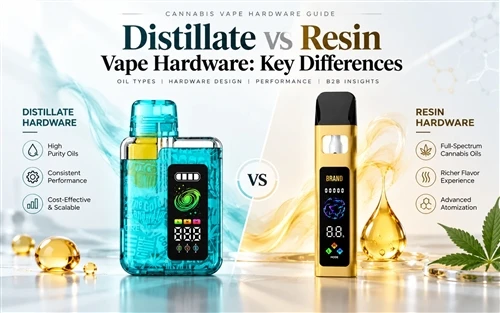
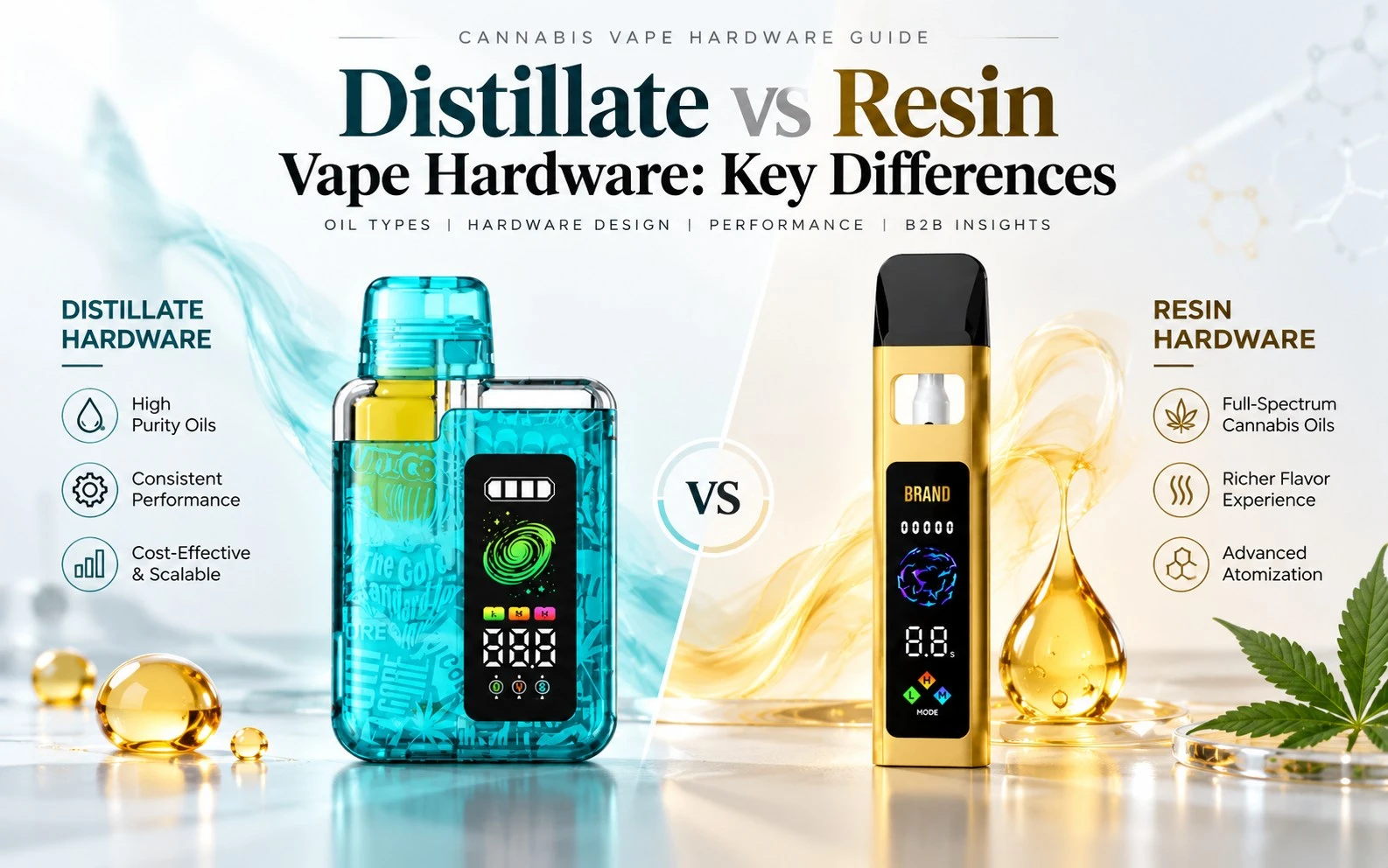
This distillate vs live resin vape hardware comparison breaks down the key differences between distillate-compatible and resin-compatible vape systems. For cannabis brands, processors, and wholesale buyers, the central principle is simple: the best cannabis vape hardware is not chosen by oil category alone, but by matching the actual formulation and viscosity to the ceramic core, intake, airflow, voltage, resistance, tank structure, and activation strategy.
Understanding the Two Oil Profiles
Before comparing hardware, it is essential to understand why these two oil categories place different demands on the atomizer in the first place.
Distillate: High Purity, High Viscosity
Distillate is a highly refined cannabis extract that has been processed through short-path or wiped-film distillation to isolate cannabinoids - predominantly THC (Δ9-tetrahydrocannabinol) or CBD - at concentrations typically reaching 80–95%. The refining process strips away most plant lipids, waxes, and the majority of native terpenes, producing a translucent, nearly flavorless oil that is exceptionally thick at room temperature. Because of its high cannabinoid concentration and low terpene content, distillate often requires the addition of botanical or cannabis-derived terpenes to restore flavor and adjust viscosity for vaping.
Key oil characteristics that affect hardware design:
|
Property |
Distillate Profile |
|
Cannabinoid concentration |
80–95% |
|
Native terpene content |
Low (often re-terpened) |
|
Room-temperature viscosity |
Very high (syrup-like) |
|
Heat sensitivity |
Moderate |
|
Primary hardware challenge |
Thick oil flow, cold-start clogging |
Live Resin and Rosin: Terpene-Rich, Heat-Sensitive
Live resin is extracted from fresh-frozen cannabis flower using hydrocarbon solvents (typically butane or propane), preserving a broad spectrum of volatile terpenes that give each strain its characteristic aroma and flavor. Live rosin, by contrast, is a solventless extract produced through low-temperature ice-water hash and mechanical pressing, yielding an even more delicate terpene profile. Both oils are prized for their "entourage effect" - the synergistic interaction of cannabinoids and terpenes - but this richness comes at a cost: the oils are more thermally fragile, and their terpene-heavy composition changes how they interact with heating elements and wicking materials.
Key oil characteristics that affect hardware design:
|
Property |
Resin / Rosin Profile |
|
Cannabinoid concentration |
60–85% |
|
Native terpene content |
High (strain-specific) |
|
Room-temperature viscosity |
Variable (often lower than distillate) |
|
Heat sensitivity |
High (terpene degradation risk) |
|
Primary hardware challenge |
Terpene preservation, flavor consistency, wax handling |
The Five Critical Hardware Differences
1. Ceramic Coil Pore Size and Wicking Architecture
The single most consequential hardware difference between distillate and resin platforms lies in the porous ceramic heating element - the core that simultaneously wicks and vaporizes the oil.
Porous ceramic atomizer cores operate on capillary action: the ceramic's micro-pore network draws oil from the reservoir to the heating surface through microscopic channels. The pore diameter - typically engineered in the range of 2–5 micrometers for standard ceramic cores - directly determines which oil viscosities the core can wick efficiently. This is not a one-size-fits-all parameter.
For distillate, the oil's high viscosity means it flows slowly through narrow pores. A standard small-pore ceramic may struggle to deliver oil fast enough to keep the heating surface saturated, leading to dry hits, burnt flavor, and premature coil degradation. Distillate-optimized hardware addresses this through:
- Larger pore ceramics (toward the upper end of the micropore range) that reduce capillary resistance for thick oils
- Multi-stage pore structures - an oil-uptake layer with larger pores (around 10–30 micrometers) paired with a surface locking layer with smaller pores, maximizing capillary pull while preventing flooding and leakage
- Quad or multi-inlet oil channels that provide multiple feed paths to the ceramic core, ensuring consistent supply even as the reservoir level drops
For live resin and rosin, the calculus flips. These oils are generally less viscous than distillate (especially at room temperature), but they carry a heavier load of terpenes, waxes, and plant particulates that can interact with the ceramic matrix differently. Resin-optimized hardware tends to favor:
- Finer pore ceramics that provide more controlled wicking and prevent the oil from flooding the heating surface
- Chemically inert ceramic formulations (such as alumina-silica or hydroxyapatite-based composites) that will not react with terpenes or introduce metallic ions into the flavor
- Smoother internal channel surfaces that minimize terpene adhesion and residue buildup over the cartridge's life
The practical takeaway: a cartridge designed for distillate may over-wick with resin, causing leakage and gurgling, while a resin-tuned cartridge may starve on distillate, producing dry, harsh hits. This is why leading cannabis hardware suppliers increasingly maintain distinct oil-specific platforms rather than treating every extract as interchangeable.
One additional engineering point is often overlooked: lower resistance alone does not guarantee better vapor performance. ASM VAPE's internal product experience indicates that when the ceramic core is too small, the oil-contact surface can be insufficient for fast vapor generation even if the electrical specification appears aggressive. Increasing ceramic heating surface area can improve heat transfer and vapor output without relying only on higher voltage.
2. Oil Inlet Design and Clog Prevention
Clogging is the number-one consumer complaint in cannabis vaping, and its root cause is almost always a mismatch between oil viscosity and inlet channel geometry.
Distillate clogs typically occur at cold temperatures - the oil thickens to the point where it cannot pass through the inlet holes to reach the ceramic core. When the device fires, the coil heats with little to no oil supply, producing a burnt taste or no vapor at all. Hardware solutions for distillate include:
- Larger inlet hole diameters - four large inlet holes are a common design in some distillate-optimized cartridges - that accommodate thick oil flow
- Preheat or "warm-up" functionality - a low-power pulse cycle that softens the oil for several seconds before the main firing sequence, a feature now considered essential for high-viscosity distillate platforms
- Dual air-vent systems that balance pressure across the oil reservoir, preventing vacuum-lock that can stall oil delivery
Resin clogs have a different etiology. Because resin and rosin contain plant waxes and lipids that distillate lacks, these compounds can accumulate and polymerize on the ceramic surface or in the inlet channels over repeated heating cycles, gradually restricting flow. Hardware solutions for resin include:
- Wider, shorter inlet paths that reduce the surface area where wax can deposit
- Lower operating temperatures that minimize thermal degradation and polymerization of terpenes and waxes
- Easier-to-clean or replaceable coil architectures in reusable platforms, since resin residue builds faster than distillate residue
Hardware engineering practice also shows that live rosin - with its high viscosity and thick consistency - can require preheating capability and wider wicking channels to prevent clogging, while live resin vape hardware should be tuned for controlled oil flow and terpene preservation.
3. Heating Temperature and Power Calibration
The optimal vaporization temperature for cannabis oils is not a single number - it is a range that depends on the oil's composition, and the hardware must be calibrated accordingly.
Distillate can tolerate a wider temperature range because its primary component (purified THC or CBD) is relatively thermally stable, and its terpene content is often added back in controlled amounts. Distillate cartridges commonly operate in the 3.2–3.8V range on standard 510-thread batteries, producing vaporization temperatures that efficiently aerosolize the high-potency oil without significant degradation risk.
Live resin and rosin require more careful thermal management. The volatile terpenes that define these extracts' flavor and aroma are heat-sensitive compounds that begin to degrade at lower temperatures than purified cannabinoids. If the coil runs too hot, the result is:
- Terpene oxidation and isomerization, producing off-flavors
- Acrolein and other thermal decomposition byproducts
- A flattened, one-dimensional taste that loses the strain's nuance
- Accelerated coil fouling from polymerized terpene residues
Resin-optimized hardware addresses this through voltage and resistance calibrated together for cooler operation, temperature-regulated output curves, and ceramic formulations with higher thermal mass that buffer temperature spikes. Advanced ceramic cores now incorporate multi-layer heating films that distribute heat more uniformly, with some next-generation designs reducing the heating film thickness from 80 micrometers to as thin as 2 micrometers for more precise thermal control.
ASM VAPE's internal hardware references provide an additional architecture-specific perspective. Certain central-post designs used for distillate commonly run around 2.8–3.3V with 1.0–1.2Ω resistance, while postless full-ceramic designs used for live resin, live rosin, and some Delta oils commonly sit around 2.2–2.8V with 1.4–1.8Ω resistance. These are engineering reference ranges for particular hardware structures, not universal prescriptions; the actual setting should be matched to the oil formulation, ceramic geometry, heating surface area, airflow, and device control strategy.
4. Cartridge Body and Sealing Materials
The non-heating components of the cartridge - the reservoir, mouthpiece, and sealing gaskets - also differ between distillate and resin platforms, though the distinctions are subtler than in the heating element.
Distillate platforms typically use standard borosilicate glass reservoirs and medical-grade stainless steel mouthpieces, as the chemically simple, low-terpene oil is relatively non-aggressive toward these materials. The primary sealing concern is preventing the thick oil from leaking at the base during temperature fluctuations.
Resin platforms face additional material compatibility challenges. The high terpene content in live resin and rosin can act as a solvent on certain polymers and elastomers over time, potentially degrading standard silicone seals or plastic reservoirs. Resin-optimized hardware tends to specify:
- Glass or quartz reservoirs exclusively, avoiding plastic that terpenes may extract or degrade
- Higher-grade, terpene-resistant seal materials (such as specialized fluoropolymer or high-durometer silicone formulations)
- Full-ceramic or ceramic-coated mouthpiece pathways to eliminate any plastic-oil contact in the vapor path
These material choices are not merely about safety - they directly affect flavor integrity. A cartridge that leaches plasticizers into terpene-rich resin will produce a chemical taste that destroys the product's value proposition.
Tank material also affects oil utilization. ASM VAPE's internal product experience notes that thick THC oil can adhere to reservoir walls as the tank empties, reducing contact with the bottom heating area and contributing to weak vapor or unused oil. Glass tanks can help reduce this wall-adhesion problem, making reservoir material a practical performance variable rather than a purely cosmetic choice.
5. Airflow Geometry and Vapor Density
The final hardware variable is airflow design - the channel geometry that determines how much air mixes with the vapor before it reaches the consumer's lips.
Distillate, being high-potency and relatively low in flavor compounds, benefits from a tighter, more restricted airflow that produces dense, potent hits with concentrated cannabinoid delivery. The tighter draw also slows vapor cooling, which helps maintain the thick oil's aerosolization in transit.
Resin and rosin, with their rich terpene profiles, benefit from a slightly more open airflow that cools the vapor and prevents the delicate terpenes from re-condensing before delivery. A more open draw also produces larger vapor clouds that better carry the complex aromatic compounds to the olfactory receptors, enhancing the perceived flavor experience.
The difference is measurable in the airway diameter: distillate-tuned cartridges often specify airways in the range of 0.6–1.8 millimeters, optimized for draw resistance and aerosol velocity, while resin platforms may open the airway slightly to accommodate cooler, more voluminous vapor.
Side-by-Side Hardware Specification Comparison
|
Hardware Parameter |
Distillate-Optimized |
Resin/Rosin-Optimized |
|
Ceramic pore size |
Larger (upper micropore range) |
Finer (controlled wicking) |
|
Pore structure |
Multi-stage (large uptake + fine surface) |
Uniform fine pores, chemically inert |
|
Oil inlet holes |
Larger diameter, quad-feed |
Wider, shorter paths |
|
Preheat function |
Essential (cold-start softening) |
Essential (viscosity + wax management) |
|
Operating voltage |
3.2–3.8V |
Lower range, temperature-regulated |
|
Coil resistance |
Standard to low |
Calibrated for cooler operation |
|
Reservoir material |
Borosilicate glass |
Glass or quartz (terpene-safe) |
|
Seal material |
Medical-grade silicone |
Terpene-resistant fluoropolymer |
|
Airflow geometry |
Tighter, restricted draw |
Slightly more open |
|
Primary failure mode |
Cold clogging, dry hits |
Wax buildup, terpene degradation |
Why a One-Platform-Fits-All Approach Falls Short
Many brand owners and wholesale buyers are tempted by the cost efficiency of a single cartridge SKU that claims to handle "all oil types." In practice, this compromise consistently underperforms on at least one oil category.
A distillate cartridge used with live resin will typically exhibit over-wicking, leakage from the base, and muted or chemical off-flavors from terpene-material interactions. A resin cartridge used with distillate will suffer from under-wicking, dry hits, and frequent cold-start clogs that frustrate consumers and drive returns.
The economics of returns, replacements, and damaged brand reputation far outweigh the SKU simplification savings. As the U.S. cannabis hardware market has matured, the trend has moved decisively toward oil-specific vape hardware, with major suppliers developing separate platforms for distillate, live resin, and solventless rosin around each oil's unique physical and chemical profile.
That does not mean every brand needs a completely different molded device for every formulation. It means the oil should drive the hardware configuration. A shared exterior platform can still use oil-matched ceramic cores, intake geometry, resistance, voltage, airflow, or activation settings where validation shows those changes are sufficient.
How ASM VAPE Approaches Oil-Specific Hardware
ASM VAPE is a dedicated B2B cannabis vape hardware manufacturer and OEM/ODM engineering partner founded in 2019. Our approach is built around a simple principle: not all oils work with the same vape hardware. Rather than treating the cartridge or disposable as a passive container, we match the hardware architecture to the oil type, viscosity, and performance goals.
Oil requirements first. Before finalizing a configuration, we evaluate the target oil or formulation, its viscosity and use conditions, and the performance priorities of the project. These inputs guide downstream choices including ceramic core, intake, airflow, voltage, resistance, capacity, tank structure, and activation method.
Ceramic platform and heating structure. ASM VAPE's 2026 portfolio includes Unicore, Gemco, and Verve™ ceramic platforms. Unicore is positioned specifically for Resin/Rosin oils and is widely used in POST-FREE products, while Gemco emphasizes terpene and flavor expression. Verve™ spans a broader range of full-ceramic, ceramic central-post, display, magnetic, and other product architectures.
Postless vs. central-post selection. Our internal product experience shows that central-post hardware can be effective for distillate when stronger heating and thorough oil utilization are priorities. Postless vape hardware, typically using a bottom full-ceramic coil and lower-power configuration, is often well suited to live resin, live rosin, and certain Delta oils. However, postless is not automatically the right answer for every formulation: extremely thick cannabis oil can still create wicking and vaporization challenges, so real-oil validation remains essential.
Platform-specific voltage and resistance. As noted above, ASM engineering references for certain central-post distillate designs are around 2.8–3.3V and 1.0–1.2Ω, while certain postless resin/rosin designs commonly use about 2.2–2.8V and 1.4–1.8Ω. The 2026 catalog reflects the same low-voltage direction on specific Resin/Rosin platforms: for example, the POST-FREE UNIVERSE uses a 1.8Ω Unicore configuration at 2.2V, while UNIVERSE Pro uses 1.8Ω with 1.8/2.0/2.2V options. These examples are platform references, not universal setpoints.
Heating surface area matters. One recurring lesson from oil matching is that resistance cannot be judged in isolation. If the ceramic heating element is too small, oil-contact area can limit instantaneous vapor production. A larger ceramic core can increase the oil-contact surface and improve heating efficiency, helping balance vapor volume with lower-temperature operation.
Testing and refinement. ASM VAPE supports product testing, filling support, troubleshooting, and product refinement through its California product laboratory for U.S. partners. The company has served 100+ cannabis brands, and its OEM/ODM workflow can move from oil-matched hardware selection and parameter adjustment to branding, mold development, testing, and scalable production.
This is the practical meaning of oil-matched cannabis vape hardware: start with the oil, configure the atomization system around it, and validate the combination before scaling. The goal is not to force every distillate, live resin, or live rosin formulation into a universal device, but to reduce clogging, leaking, burnt taste, weak vapor, poor airflow, oil waste, and avoidable after-sales issues.
Common Failure Modes and How the Right Hardware Prevents Them
Understanding the failure modes that plague mismatched hardware helps clarify why oil-specific engineering matters.
Cold-start clogging occurs when thick distillate solidifies in the inlet channels at low temperatures. The consumer draws air, the battery fires, but no oil reaches the coil - producing a burnt taste or nothing at all. Prevention: preheat functionality plus adequately sized inlet geometry matched to the oil's cold-temperature viscosity.
Leakage during transport occurs when low-viscosity resin floods through inlets designed for thicker oil, or when thermal expansion pushes oil past seals not rated for terpene exposure. Prevention: oil-matched inlet sizing and terpene-resistant seal specifications.
Burnt or chemical taste occurs when a coil runs too hot for terpene-rich oil, degrading the compounds that define the product's flavor, or when plastic components leach into the oil over time. Prevention: temperature-calibrated voltage/resistance and full glass or quartz reservoir specifications for resin platforms.
Inconsistent potency delivery occurs when wicking is uneven - the first few hits are potent, then the coil runs dry as oil supply can't keep up with consumption. Prevention: multi-stage pore architecture for distillate, or controlled fine-pore wicking for resin, ensuring steady-state oil delivery throughout the cartridge's life.
Weak first-hit vapor can also occur with high-viscosity THC oil after a device sits in a cold environment. ASM VAPE's internal experience shows that button-plus-inhale activation can be useful in these situations because the button can preheat thickened oil before the draw. When a button is not available, the broader hardware solution is still the same: optimize heating time, ceramic surface area, and oil delivery rather than relying on one electrical specification alone.
Making the Right Hardware Decision for Your Oil
For U.S. cannabis brand owners, oil processors, and wholesale buyers, the hardware selection process should follow a clear decision framework:
If your product is distillate-based (high potency, re-terpened, or flavored), prioritize hardware with: large-pore multi-stage ceramics, quad inlet feeds, robust preheat functionality, distillate-focused vape hardware with standard 3.2–3.8V battery compatibility, and glass reservoirs with medical-grade seals.
If your product is live resin-based (strain-specific terpene profiles, full-spectrum), prioritize hardware with: live resin vape hardware with fine-pore chemically inert ceramics, wider short-path inlets, temperature-regulated lower-voltage operation, glass or quartz reservoirs, and terpene-resistant seal materials.
If your product is live rosin or solventless (highest terpene sensitivity, thick consistency), prioritize hardware with: live rosin vape hardware with preheat capability specifically engineered for high-viscosity solventless oil, wider wicking channels, the gentlest thermal profiles available, and full-ceramic vapor pathways with zero plastic contact.
If you offer multiple oil types under one brand, resist the urge to assume one cartridge configuration will automatically suit all formulations. The modest tooling or SKU investment in oil-specific platforms can be recovered through reduced returns, stronger consumer reviews, and the brand equity that comes from a product that works exactly as promised.
Practical selection rule: oil type is only the starting point. Final cannabis vape hardware selection should consider formulation, actual viscosity, ceramic core, heating surface area, intake geometry, airflow, voltage, resistance, activation, tank material, and real-oil testing together.
FAQ
Can the same vape hardware be used for both distillate and live resin?
Sometimes, but it should not be assumed. Distillate and live resin can differ significantly in viscosity, terpene content, wicking behavior, and thermal sensitivity. A shared platform is most reliable when the ceramic core, intake, airflow, voltage/resistance, and activation settings have been validated with both actual formulations. In many projects, oil-specific configurations deliver more consistent results.
What voltage is best for distillate vs live resin vape hardware?
There is no universal voltage for every oil or device. The article's common 510 reference range for distillate is 3.2–3.8V, while ASM VAPE's architecture-specific internal references include roughly 2.8–3.3V for certain central-post distillate designs and 2.2–2.8V for certain postless live resin/rosin designs. Resistance, ceramic geometry, heating area, airflow, and formulation all affect the correct setting, so voltage should be validated as part of the complete hardware system.
Is postless vape hardware better for live resin?
Postless hardware can be a strong option for live resin because it can combine a bottom full-ceramic coil with lower-temperature operation and a cleaner oil path. However, it is not universally better. Extremely thick oil may still wick poorly in some postless structures, so viscosity, intake design, ceramic size, and real-oil testing should determine the final choice.
What matters more than voltage when choosing a ceramic coil for live resin?
Voltage is only one variable. Ceramic pore structure, heating surface area, oil-contact area, intake geometry, resistance, airflow, and thermal stability all influence vapor output and flavor. In ASM VAPE's product experience, increasing ceramic heating area can improve vaporization efficiency when a small core cannot deliver enough vapor, even if the resistance specification looks suitable on paper.
How can cannabis brands reduce clogging with thick THC oil?
Start by matching intake size and ceramic wicking behavior to the oil's viscosity, especially at lower storage temperatures. Preheat functionality can soften thick oil before the main draw, while adequate heating surface area and properly calibrated airflow help maintain oil delivery. Tank material also matters: glass can reduce oil wall adhesion as the reservoir empties, which may help limit oil waste and weak-vapor issues late in the product's life.
Conclusion
The distinction between distillate and resin vape hardware is not a marketing nuance - it is a matter of applied physics and materials science. Viscosity, terpene load, thermal sensitivity, and wicking behavior are intrinsic oil properties that demand specific engineering responses in ceramic structure, inlet design, temperature calibration, material selection, airflow, and activation. In practical terms, the answer to distillate vs live resin vape hardware is that neither oil should be forced into a generic configuration when performance, flavor, and reliability matter.
For cannabis brands and processors, the most reliable approach is to start with the oil and engineer the hardware around it. ASM VAPE is a dedicated cannabis vape hardware manufacturer and OEM/ODM partner focused on oil-matched solutions for distillate, live resin, live rosin, CBD, and Delta oils.
Contact ASM VAPE to discuss your formulation and hardware requirements. Our team can support oil-matched hardware selection, testing and refinement, private label or OEM/ODM customization, and scale-up for cartridge, POD, and all-in-one disposable projects.