A Hardware-First Guide for Cannabis Brands, Extractors, and Wholesale Buyers
Live rosin is the fastest-growing concentrate category in the U.S. cannabis market - and also one of the most demanding oils to put into a vape cannabis vape cartridges. Unlike distillate, which flows easily and tolerates a wide range of hardware, live rosin carries high terpene loads, variable viscosity, and naturally occurring particulates that stress every component of a cartridge. The wrong hardware does not just underperform - it can clog, leak, scorch delicate terpenes, and erode consumer trust in your brand.
ASM VAPE was founded in 2019 as a dedicated cannabis vape hardware manufacturer and OEM/ODM partner. Our team brings more than a decade of industry experience, and our engineering approach centers on matching hardware to the oil rather than treating every cannabis formulation the same. This guide summarizes the practical factors cannabis brands, extractors, and wholesale buyers should evaluate when choosing a live rosin vape hardware - including ceramic core design, resistance and voltage, tank materials, airflow, filling performance, and common failure modes.
What Makes Live Rosin Different
Live rosin is a solventless extract produced by applying heat and pressure to freshly frozen cannabis hash (ice-water hash). Because no hydrocarbon solvents are used, the resulting oil retains a fuller spectrum of cannabinoids and terpenes than most other cannabis concentrates. The trade-off is that live rosin is thicker, stickier, and less uniform than distillate. It can contain microscopic plant particulates, waxes, and lipids that settle over time.
These characteristics directly impact hardware selection. A cartridge designed for thin, homogeneous distillate can struggle with live rosin because the oil may not wick efficiently through narrow channels, can settle and restrict airflow, and may scorch if the heating element runs too hot.
The hardware must be engineered for the oil, not the other way around. In practice, there is no single universally "best cartridge for live rosin." The right choice depends on the specific formulation, viscosity, desired vapor output, flavor target, and operating conditions.
The Heating Element: Why Ceramic Core Matters Most
The heating element is one of the most important components in a live rosin cartridge. Three technologies dominate the market:
|
Heating Element Type |
How It Works |
Suitability for Live Rosin |
|
Cotton wick + wire coil |
Oil saturates a cotton fiber wrapped around a resistance wire. |
Poor - cotton cannot reliably wick thick rosin; risk of dry hits and scorching. |
|
Quartz rod + wire coil |
Wire wraps around a quartz rod; oil contacts the heated surface directly. |
Moderate - faster heat-up but uneven vaporization; terpene loss can occur at hot spots. |
|
Porous ceramic core |
Oil is drawn into micro-pores of a sintered ceramic body; the larger ceramic surface distributes heat more evenly. |
Excellent - steady oil delivery, even heat distribution, and better terpene preservation. |
Porous ceramic cores replace traditional wick-and-wire structures with a sintered ceramic body whose micro-pores draw oil through capillary action. For thick, terpene-rich extracts, this architecture can reduce uneven heating and scorching while supporting more consistent vaporization and flavor delivery.
But for live rosin vape hardware, it is not enough to ask whether a cartridge "uses ceramic." Ceramic pore structure, porosity, oil-contact area, and the effective heating surface all matter. ASM VAPE's internal product experience shows that a larger ceramic heating area can improve heat transfer and vapor output by increasing the contact area between the oil and the heating element. This is especially relevant when a low-power design still needs to produce satisfying vapor from a viscous cannabis oil.
Practical buying point: Do not ask only, "Is it ceramic?" Ask how the ceramic core is engineered for your oil viscosity, how large the effective heating surface is, and how the core balances wicking speed with heat delivery.
Coil Resistance and Voltage: Low and Slow
Live rosin generally benefits from live rosin vape temperature. High terpene content means excessive heat can destroy the compounds that make the extract premium. However, "lower is always better" is too simplistic. For a ceramic cartridge for live rosin, the goal is controlled heat: enough energy to vaporize the oil consistently without outpacing the core's ability to wick fresh oil.
The key parameters to evaluate include:
|
Parameter |
Recommended Range for Live Rosin |
Why It Matters |
|
Coil resistance |
1.2–1.5 ohm |
Higher resistance can support lower operating temperature and help protect terpenes. |
|
Operating voltage |
2.5–3.4 V |
Lower voltage helps reduce scorching and preserve flavor through the session. |
|
Wattage |
5–8 W |
Sufficient to vaporize thick rosin without excessive heat. |
|
Preheat function |
10–15 seconds at low voltage |
Warms viscous oil toward a more flowable condition before the first draw. |
Some modern cannabis vape hardware uses ultra-low-temperature ceramic heating or adjustable wattage so brands can fine-tune the vaporization profile across different oil types. For live rosin specifically, hardware that defaults to the lower end of the wattage range and includes a preheat cycle can be useful.
ASM VAPE's own product knowledge reinforces the need to match voltage and resistance to the oil rather than relying on a universal setting. Internal reference configurations for postless products commonly fall around 1.4–1.8 ohm and 2.2–2.8 V, while more traditional center-post structures can use higher-power configurations. These figures should be treated as hardware reference ranges, not universal live rosin specifications; final settings should be validated against the actual formulation.
If your hardware runs too hot, you are burning money - literally vaporizing the terpene premium your customers paid for.
Wickless and Postless Designs: Eliminating Failure Points
Traditional 510 cartridges often use a center post with relatively small oil intake holes - a design that can work adequately for distillate but create additional constraints with viscous live rosin. Narrow intake paths are more susceptible to restricted oil flow when rosin settles, while metal center-post structures also create a different thermal path than bottom-fed ceramic designs.
Wickless, postless vape cartridge designs remove the center post and instead feed oil directly toward a ceramic heating area at the bottom of the reservoir. This architecture can offer three advantages for live rosin:
- Wider oil intake: Postless chambers can provide a larger oil flow path, reducing the chance that viscous rosin is starved from the heating element.
- More direct ceramic heating: Removing a conventional metal center post can simplify the oil path and reduce localized thermal concentration.
- Production-friendly chamber access: A wider chamber geometry can support filling workflows and reduce trapped air when the design is properly validated.
ASM VAPE's internal product experience generally positions postless cartridge structures as a strong option for live rosin, live resin, and similar oils because they can combine lower-power operation with a full ceramic heating structure. At the same time, extremely thick formulations can still challenge any architecture, including postless designs. This is why viscosity testing matters more than choosing a structure by label alone.
In ASM VAPE's 2026 product platform, the Unicore ceramic platform is positioned for Resin/Rosin oils and is widely used in POST-FREE products. Several Unicore products also use relatively low-voltage configurations. This does not mean every live rosin formulation should use the same device; it means post-free live rosin vape architecture is one of the hardware directions worth validating when the oil calls for it.
Tank Material: Glass vs. Polycarbonate
The tank material affects chemical compatibility, oil behavior, durability, and consumer perception. For a premium live rosin vape cartridge, glass is often favored because of its inertness and clarity.
|
Tank Material |
Pros |
Cons |
Recommendation for Live Rosin |
|
Borosilicate glass |
Chemically inert; no leaching; premium feel; transparent. |
Heavier; higher breakage risk in transit. |
Recommended - live rosin's high terpene content can be demanding on polymer reservoirs. |
|
Polycarbonate (PC) |
Lightweight; shatter-resistant; lower cost. |
Potential interaction with high-terpene oils; clouding over time. |
Not recommended for terpene-rich oils when a more inert material is available. |
|
Tritan / PCTG |
Good clarity; BPA-free; better chemical resistance than PC. |
Still a polymer; long-term compatibility depends on formulation and exposure conditions. |
Acceptable for cost-sensitive SKUs when compatibility is validated. |
High-terpene cannabis extracts are known to interact with certain plastics. Borosilicate glass is a premium choice for a full ceramic cartridge or other live rosin-focused hardware because it is inert, transparent, and supports a high-end product presentation.
ASM VAPE's internal field experience also highlights another practical point: viscous THC oil can cling to reservoir walls when the tank is nearly empty, reducing the amount of oil that reaches the heating core. glass tanks in cannabis vape hardware can help reduce this "oil hang-up" behavior and make the remaining oil easier to observe. The ASM VAPE cartridge portfolio includes glass and ceramic material combinations; for example, the 1 mL full ceramic BULLET cartridge is a full-ceramic cartridge architecture with a glass tank, ceramic center post, and ceramic mouthpiece.
Airflow Design: Preventing Clogs and Leaks
Clogging and leaking are two of the most common consumer complaints with live rosin cartridges. Both are strongly influenced by hardware design, including oil flow, airflow, sealing geometry, and how the product reacts to temperature changes.
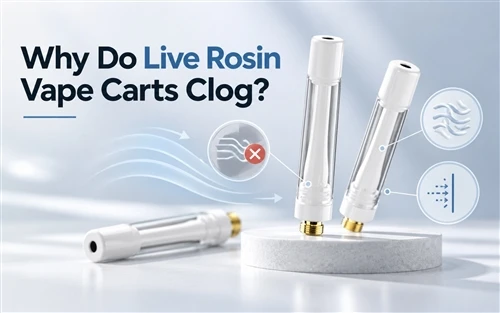
why live rosin vapes clog when thick rosin settles in narrow airflow channels or when oil movement becomes too slow to support the heating cycle. The solution is not simply "more airflow." A good live rosin cartridge needs an oil path and air path that work together so the core receives enough oil while vapor exits smoothly without pressure lock or oil backup.
Look for hardware with:
- Multi-point silicone gaskets at critical sealing locations.
- Oil-locking reservoir geometry designed to retain oil during storage and transport.
- A stable base assembly with repeatable production tolerances.
- Airflow channels sized for the target oil viscosity.
- Validated filling compatibility so gaskets and seals remain correctly seated during production.
This is also where first-puff performance matters. ASM VAPE's product experience shows that viscous THC oil can become less mobile in colder conditions or after long storage. With short inhale-activated heating cycles, the first draw may produce weak vapor until the oil warms. For brands developing live rosin vape hardware, cold-start and first-puff behavior should therefore be part of product validation, not an afterthought.
Cartridge Format: 510 Thread vs. All-in-One Disposable
Brands evaluating live rosin hardware face a fundamental format decision: a traditional 510 live rosin cartridge used with a separate battery, or an all-in-one (AIO) disposable device.
|
Factor |
510 Cartridge + Battery |
All-in-One Disposable |
|
Consumer familiarity |
High - the U.S. standard for years. |
Growing rapidly; now dominant in many state markets. |
|
Oil capacity |
Typically 0.5 mL–1.0 mL. |
0.5 mL–2.0 mL+. |
|
Brand customization |
Cartridge + battery can carry separate branding. |
Single device, unified branding opportunity. |
|
Battery control |
User controls voltage via their battery. |
Pre-set or variable voltage built in. |
|
Cost per unit |
Lower (cartridge only). |
Higher (includes battery). |
|
Best for |
Brands with established battery ecosystems. |
Premium live rosin brands wanting full hardware control. |
For live rosin specifically, the AIO format offers a significant advantage: the brand controls the entire thermal profile - voltage, preheat, activation, and airflow - rather than leaving performance to whatever 510 battery the consumer happens to own. Since live rosin is sensitive to over-voltage, this control is valuable.
However, a live rosin 510 cartridge remains the right choice for brands that want compatibility with an existing battery platform, lower hardware cost, or a familiar retail format. The key is to validate the cartridge and the intended battery settings as a complete system.
Filling and Production Considerations
Live rosin's viscosity makes filling more challenging than distillate. Hardware that works beautifully in a small lab test can still fail at production scale if the fill process, chamber geometry, or sealing sequence is not properly matched.
Key considerations include:
- Warm filling: Live rosin typically needs to be warmed to 40–60°C before filling to achieve flowable viscosity; gaskets and tank materials must tolerate the process temperature without deformation.
- Postless chamber geometry: Wider intake openings can allow faster filling and reduce the risk of air pockets that cause inconsistent fills.
- Centrifuge compatibility: Some producers use centrifuges to help remove air bubbles from filled cartridges; hardware must withstand centrifugal force without leaking.
- Filling-line validation: Hardware should be tested with the intended automated or semi-automated filling process before full-scale production.
ASM VAPE supports oil-based hardware matching as part of its OEM/ODM process. The company's California product laboratory provides sample/product testing, filling support, troubleshooting, product refinement, and on-site technical assistance for U.S. brand partners. This allows a project to move from a customer's actual oil formulation to hardware selection, parameter refinement, and scalable production with fewer assumptions.
ASM VAPE's recommended validation principle: Do not approve production hardware from a specification sheet alone. Test the actual live rosin formulation in the actual cartridge or AIO configuration that will go to market.
Common Failure Modes and How the Right Hardware Prevents Them
|
Failure |
Root Cause |
Hardware Solution |
|
Clogging after storage |
Rosin settles or becomes less mobile and restricts narrow oil/airflow channels. |
Postless or otherwise optimized oil path with wider intake and airflow geometry. |
|
Burnt taste mid-session |
Hot spots or heating rate exceeds oil delivery rate. |
Porous ceramic core with more even heat distribution and properly matched voltage/resistance. |
|
Leaking from base |
Inadequate gasket seal, assembly variation, or thermal expansion. |
Multi-point sealing, oil-locking geometry, and production validation. |
|
Weak vapor production |
Oil cannot wick to the heating element fast enough, or the effective heating area is too small. |
Ceramic core and heating surface matched to rosin viscosity and target vapor output. |
|
Oil darkening in tank |
Repeated high-temperature exposure degrades the oil near the heating zone. |
Lower-voltage operation, controlled preheat, and balanced oil delivery. |
|
Inconsistent fills |
Air pockets, narrow chamber geometry, or fill-process mismatch. |
Production-friendly chamber geometry and filling-line validation. |
The ASM VAPE Approach to Live Rosin Hardware
Different oils need different vape hardware. ASM VAPE's Oil-Matched Hardware approach starts with the customer's oil type, viscosity, and performance target, then matches or adjusts the ceramic core, intake, airflow, voltage, resistance, capacity, and tank structure.
For resin/rosin projects, ASM VAPE's 2026 product platform includes the Unicore ceramic system, positioned for Resin/Rosin oils and used across multiple POST-FREE products. ASM VAPE also offers cartridge architectures that include full-ceramic and glass-tank configurations. The 1 mL BULLET, for example, uses a glass tank, ceramic center post, ceramic mouthpiece, and a Verve™ ceramic core. Whether a specific cartridge is the right choice for a live rosin formulation should still be confirmed through oil-specific testing.
OEM/ODM customization can include:
- Capacity and heating-core configuration.
- Voltage and resistance adjustment based on oil formulation.
- Airflow and tank-structure refinement.
- Material selection, exterior design, colors, surface finishes, and branding.
- Screen UI or other supported device functions.
- Custom packaging and, for deeper programs, mold development.
ASM VAPE operates a GMP-certified 5,000+ m² factory with 25 professional assembly lines and a stated daily production capacity of 100,000 units. For U.S. projects, its California product laboratory can support sample testing, filling support, troubleshooting, product refinement, and on-site technical collaboration. The goal is not to force one cartridge onto every oil, but to build the hardware configuration around the oil that will actually be sold.
Checklist: What to Evaluate Before You Buy
Before committing to a live rosin cartridge or AIO for your brand, demand answers to these questions:
|
Evaluation Point |
What to Ask the Hardware Supplier |
|
Heating element |
Is it a porous ceramic core? How are pore structure, effective heating area, and oil-contact surface designed for viscous extracts? |
|
Oil compatibility |
Has this hardware been validated with live rosin, and can it be tested with our specific formulation? |
|
Wickless design |
Is the oil path wickless or postless, or does it use cotton or fiber? |
|
Airflow |
How are the intake and airflow paths designed to reduce clogging without increasing leakage risk? |
|
Voltage profile |
What is the default voltage? Is preheat included? Is voltage or wattage adjustable? |
|
Tank material |
Is it borosilicate glass or another validated material? What materials contact the oil? |
|
Leak prevention |
What sealing structure is used, and how is leak resistance validated? |
|
Filling line |
Has the hardware been validated with the intended automated or semi-automated filling process? |
|
OEM/ODM support |
Can the heating element, voltage/resistance, airflow, materials, branding, and packaging be customized? |
|
Production scale |
What is the minimum order quantity, lead time, and production capacity at scale? |
FAQ
What type of cartridge is best for live rosin?
The best live rosin vape cartridge is not defined by one feature alone. In most cases, buyers should prioritize a ceramic heating system, controlled low-temperature operation, an oil path sized for viscous extracts, reliable sealing, and materials that are compatible with terpene-rich oil. Postless or wickless architectures are often worth testing, but the final choice should be validated with the actual live rosin formulation.
Is a ceramic cartridge better for live rosin?
Porous ceramic is generally a strong choice because it can distribute heat more evenly and deliver viscous oil more consistently than traditional ceramic vs. cotton coil systems. However, ceramic quality and geometry matter. Pore structure, effective heating area, oil-contact surface, resistance, and operating voltage should all be matched to the formulation.
What voltage should I use for a live rosin cartridge?
The article's working reference range is 2.5–3.4 V, but there is no universal "best voltage" for every live rosin cart. ASM VAPE's own postless hardware references commonly use lower-power configurations, and the correct setting depends on the specific ceramic architecture, coil resistance, oil viscosity, and desired flavor/vapor profile. Oil-specific testing is more reliable than choosing a voltage from a generic chart.
Why do live rosin cartridges clog?
Live rosin is viscous and can become less mobile during storage or in colder conditions. Clogs may develop when narrow oil or airflow paths restrict movement, when oil collects in the air path, or when the heating cycle does not sufficiently warm the oil. Hardware with a properly sized intake, balanced airflow, controlled preheat, and oil-compatible ceramic core can reduce the risk.
Should I choose a 510 cartridge or an AIO for live rosin?
A 510 cartridge is attractive for compatibility, familiar consumer behavior, and lower hardware cost. An AIO gives the brand more control over voltage, preheat, activation, and airflow, which can be valuable for temperature-sensitive live rosin. The best format depends on your product strategy, battery ecosystem, target oil, and desired level of hardware control.
Conclusion
Live rosin is a premium product that commands premium pricing - but only if the hardware delivers the experience consumers expect. A cartridge that clogs after storage, scorches terpenes mid-session, or leaks during shipping does not just fail a single unit; it damages the brand behind it.
The right live rosin vape cartridge should be selected as a complete system. Ceramic core design, oil-contact area, voltage and resistance, preheat, tank material, intake geometry, airflow, sealing, and filling performance all need to work with the specific formulation. Postless and full-ceramic architectures can be strong options, but there is no one-size-fits-all answer. The most reliable decision is to test the actual rosin in the actual hardware under the conditions in which it will be filled, shipped, stored, and used.
ASM VAPE provides cannabis brands, extractors, and wholesale buyers with oil-matched cannabis vape hardware and OEM/ODM customization, supported by product testing, filling assistance, engineering refinement, and scalable manufacturing. If you are developing a live rosin vape cartridge or AIO for the U.S. market, contact ASM VAPE to discuss your oil formulation, performance targets, and hardware requirements.
- Live Rosin Vape Cart Guide - Canadian cannabis retail/business reference.
- Porous Ceramic Heating Element Technology - industry hardware reference (brand and URL anonymized).
- ASM VAPE - Wholesale Cannabis Vape Hardware Manufacturer & OEM - asmvape.com.
- Ceramic Hardware Technology for Licensed Brands - industry technology reference (brand and URL anonymized).
- Custom Disposable Vape / Rosin Filling and Hardware Reference - industry manufacturing reference (brand and URL anonymized).
- Disposable AIO vs. Cartridge + Battery - industry format comparison reference (brand and URL anonymized).
- Cannabis Vape Solution Provider - industry hardware reference (brand and URL anonymized).
- Smart All-in-One Vaporizer / Anti-Clog Technology - industry hardware reference (brand and URL anonymized).
- Brand Overview / Ceramic Cartridge Material Reference - industry cannabis hardware reference (brand and URL anonymized).
- Postless CBD Vape Pen / Nano Ceramic Coil - industry hardware reference (brand and URL anonymized).