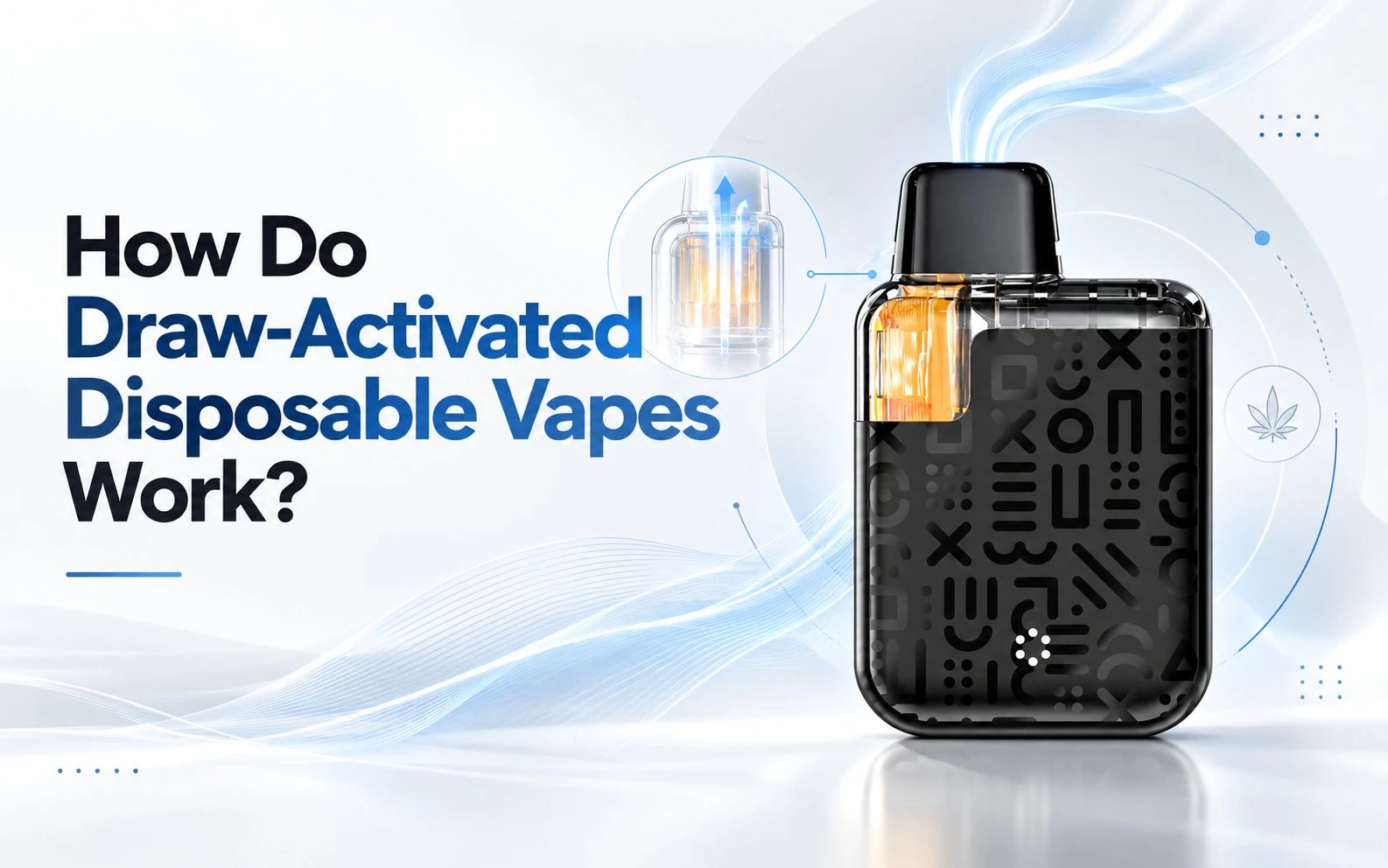
If you've ever unboxed a disposable vape and taken a puff without pressing a single button, you've already experienced draw-activation. A draw-activated disposable vape-also called an inhale-activated vape or auto-draw vape-uses a change in airflow or pressure to trigger heating automatically. No separate firing button is required, which helps create a simple, intuitive experience for cannabis vape users in legal markets.
In this article, we'll open up the technology behind draw-activated disposable vapes: what's inside the device, how a single breath triggers the sensor and heating circuit, and why airflow, ceramic heating, oil viscosity, voltage, resistance, and tank design all matter when selecting cannabis vape hardware.
The Five Core Components Inside Every Disposable Vape
Before we trace the puff-to-vapor sequence, it helps to know what's physically in the device. A typical draw-activated disposable cannabis vape contains several tightly integrated subsystems, although the exact architecture varies by hardware platform.
|
Component |
Core Function |
|
Oil reservoir / tank |
Chamber that stores cannabis oil and feeds it toward the heating area |
|
Atomizer (heating element) |
Ceramic heating element or ceramic coil that vaporizes oil into an inhalable aerosol |
|
Battery |
Lithium cell supplying power to the coil |
|
Airflow sensor (draw switch) |
Detects inhalation-related airflow or pressure change and triggers the firing circuit |
|
Control circuit (MCU / ASIC) |
Manages power delivery, activation logic, cutoff behavior, and device protection functions |
The defining trait of a draw-activated device is that an airflow or pressure sensor triggers the firing circuit when the user inhales. In a purely draw-activated disposable, there is no dedicated fire button; however, some cannabis vape hardware combines button and inhale activation so the user can also access functions such as preheating or voltage control.
The Draw-Activation Sequence: What Happens in a Single Puff
From the moment the user inhales, the device moves through a short sequence of sensing, power delivery, heating, and vapor flow. Here's how an auto-draw vape works step by step.
- You inhale, creating negative pressure. When you draw on the mouthpiece, air rushes through the device's internal airway. This creates a momentary pressure drop-a slight vacuum-inside the air channel. The pressure change is tiny, on the order of tens to a few hundred Pascals, but it's enough to be detected.
- The airflow sensor fires. Embedded in the airway is a small airflow or pressure sensor. The instant it registers the pressure drop, it converts that physical signal into an electrical one and sends a trigger signal to the control circuit.
- The control circuit closes the loop. The MCU or ASIC chip receives the trigger and instantly switches on the battery-to-coil circuit. Power flows from the lithium cell through the coil.
- The coil heats the oil. The ceramic heating element receives power and heats the cannabis oil in contact with or wicked into the ceramic structure. The oil is vaporized into an inhalable aerosol-not smoke, because the process is designed around vaporization rather than combustion.
- You stop inhaling, and everything resets. When the draw ends, the pressure differential disappears. The sensor stops sending its trigger signal, the control circuit cuts power to the coil, and the device returns to its ultra-low-power standby state-ready for the next puff.
This is the full cycle, and the control system repeats it with each draw. In practice, vapor consistency also depends on factors such as oil viscosity, ceramic-core design, airflow, intake geometry, voltage, and resistance.
The Airflow Sensor: The Heart of Draw-Activation
If the battery is the muscle and the coil is the heat source, the airflow sensor is the brain stem of a draw-activated vape. It's the component that makes "buttonless" possible, and its quality determines whether the device feels responsive or sluggish, reliable or finicky.

How the Sensor Detects a Puff
Inside the sensor is a micro-scale variable capacitor: a thin flexible membrane (diaphragm) suspended above a fixed back-plate, with a tiny air gap between them. One side of the sensor faces the device's internal airway; the other side is sealed against a reference pressure.
When you inhale, the negative pressure in the airway pulls the membrane slightly toward the low-pressure side. That microscopic deflection changes the distance between the membrane and the back-plate, which changes the capacitance. A companion ASIC chip samples this capacitance hundreds to thousands of times per second, and when the change crosses a trigger threshold, it outputs the "fire" signal.
The whole chain-pressure change → membrane deflection → capacitance shift → electrical trigger-happens in well under a tenth of a second.
Two Sensor Generations: ECM vs. MEMS
Not all airflow sensors are created equal. There are two main generations on the market today, and the difference matters for anyone sourcing vape hardware.
|
Comparison |
Traditional ECM (Electret Condenser Mic) |
Modern MEMS Sensor |
|
Structure |
Polymer electret diaphragm + discrete components |
Silicon-based micro-machined chip + integrated ASIC |
|
Detection principle |
Airflow-induced acoustic vibration |
Direct pressure differential |
|
Oil resistance |
Moderate-oil ingress can cause false triggers |
High-back-side intake and gel-fill designs resist oil |
|
Consistency |
Batch-to-batch variation, hand-soldered |
Semiconductor-grade uniformity, SMT-compatible |
|
Lifespan |
Subject to mechanical fatigue |
Billions of cycles, no macroscopic moving parts |
|
Standby power |
Higher |
Ultra-low (micro-amp range) |
MEMS-based draw sensors are increasingly used where manufacturers want compact integration and consistent trigger behavior. For hardware buyers, the important point is not the sensor label alone but whether the complete auto-draw system delivers a repeatable trigger threshold, stable airflow, suitable protection logic, and reliable performance with the intended oil and device architecture.
The Atomizer: Turning Oil Into Vapor
Once the sensor fires and power reaches the coil, the atomizer takes over. This is where the physics of the device shifts from sensing to heating.
In cannabis vape hardware, the atomizer is commonly built around a ceramic heating core. The ceramic structure provides the heated surface that interacts with the oil, while the surrounding oil path and intake design help keep the heating area supplied during use. The exact ceramic structure, surface area, resistance, and operating voltage should be matched to the oil rather than treated as a one-size-fits-all specification.
This matching becomes especially important because cannabis oils can differ significantly in viscosity and formulation. Distillate, Live Resin, Live Rosin, CBD, and Delta oils may require different combinations of ceramic core, intake hole, airflow, voltage, resistance, and tank structure to support stable vaporization, flavor, and oil flow. Lower-temperature ceramic configurations are often used where preserving terpene expression is a priority.
The key point for hardware buyers is that ceramic heating and oil compatibility work together. A well-matched atomization system should be evaluated with the intended oil formulation so vapor output, flavor, airflow, and oil utilization remain as consistent as possible across the usable oil volume.
Built-In Safety: What Happens When Things Go Wrong
A well-designed draw-activated disposable isn't just about responsiveness-it's also about knowing when not to fire. Modern control circuits, especially those built around MEMS sensors with integrated ASIC logic, can include several layers of protection that operate without any user input.
Timeout Protection
If a draw continues beyond the device's programmed firing window, the control circuit can cut power according to the supplier's configured timeout. This helps limit prolonged coil heating and unnecessary battery stress; the exact cutoff duration varies by hardware platform and firmware design.
01
Blow-Back (Anti-Blow) Protection
If a user blows into the mouthpiece instead of drawing, the sensor detects a pressure increase rather than a decrease. The ASIC recognizes this reversed signal and refuses to fire, preventing oil from being pushed back into the airway and protecting the sensor from contamination.
02
Auto-Shutoff
When the battery voltage drops below a safe threshold, the control circuit stops firing entirely. The device simply goes quiet-no weak, sputtering hits-signaling that the unit's useful life is over.
03
Short-Circuit & Overcurrent Protection
If the coil or wiring develops a fault, the circuit breaks before the battery can discharge dangerously.
04
These protection functions should be evaluated as part of the complete hardware design, especially for regulated cannabis products where reliability, battery behavior, and consistent activation can affect both user experience and after-sales performance.
Why Draw-Activation Is Popular in Cannabis Vape Hardware
You might wonder: if button-activated devices can offer more direct control, why are draw-activated vapes so common in THC and CBD disposable hardware? The answer is largely about simplicity, familiar operation, and a streamlined user experience.
Zero Learning Curve
Cannabis consumers include many first-time or occasional users. A device that works the moment you inhale removes every barrier to entry. There's no "how do I turn this on?" moment in the dispensary parking lot.
01
Familiarity
The inhale-to-activate motion mimics the natural act of smoking, which makes the transition to vaporized cannabis feel intuitive rather than technical.
02
Discretion and Simplicity
Removing a dedicated fire button reduces button-related accidental activation and keeps the interaction simple. The sensor and control circuit still need to be designed to avoid false triggering, while low standby power helps preserve battery capacity between uses.
03
Brand Consistency
For a cannabis brand, a well-tuned draw-activated format can help standardize the activation experience across users. The device responds to inhalation rather than relying on a separate button press, while airflow, trigger threshold, and heating configuration determine how consistent that experience feels.
04
What to Look for When Sourcing Draw-Activated Hardware
For cannabis brands, distributors, and OEM/ODM partners evaluating disposable vape hardware, the draw-activation system should be considered together with oil compatibility and atomization design. Here's a practical checklist:
|
What to Evaluate |
Why It Matters |
|
Sensor responsiveness / trigger threshold |
Should activate reliably on a normal draw without becoming so sensitive that false triggering becomes more likely |
|
Affects draw resistance, oil supply to the heating area, and the device's ability to work with thicker oils |
|
|
Protection logic / cutoff settings |
The supplier should document the firing cutoff and relevant battery or circuit protection behavior for the platform |
|
Activation architecture |
Choose inhale-activated, button-activated, or button + inhale activation according to the oil, feature set, and target user experience |
|
Ceramic core and oil compatibility |
Match the ceramic core, voltage/resistance, intake, and airflow to the intended oil formulation and viscosity |
|
Battery capacity vs. oil volume |
They should be matched so neither outlasts the other wastefully |
|
Tank structure and materials |
Tank architecture and material choice can affect oil contact, flow, visibility, chemical stability, and overall product positioning |
At ASM VAPE, our cannabis vape hardware program is built around oil-matched hardware: ceramic core, intake, airflow, voltage, resistance, tank structure, capacity, and activation mode can be selected or adjusted around the customer's oil type, viscosity, and performance goals. Our current product portfolio includes inhale-activated, button-activated, and button & inhale-activated platforms across multiple ceramic systems for different cannabis-oil applications.
FAQ: Draw-Activated Disposable Vapes
Q: What is a draw-activated disposable vape?
A: A draw-activated disposable vape is a device that begins its firing sequence when the user inhales through the mouthpiece. It may also be described as an inhale-activated vape or auto-draw vape; the key difference from a button-fired device is that inhalation triggers the sensor and control circuit.
Q: How does an auto-draw vape know when I inhale?
A: An airflow or pressure sensor detects the change created by the user's draw. The sensor sends a signal to the control circuit, which supplies power to the heating element for the programmed firing period.
Q: Why can a draw-activated cannabis vape produce little vapor on the first puff?
A: With thick THC oil, low temperature or long periods of non-use can reduce oil flow toward the heating area. Because a draw-activated firing cycle is brief, the first draw may produce less vapor until the oil and ceramic heating area reach a more suitable operating condition. Hardware matching-including ceramic-core size, intake design, voltage, resistance, and airflow-can reduce this issue.
Q: Draw-activated vs. button-activated vape: which is better for cannabis oil?
A: Neither activation method is universally better. Draw activation prioritizes a simple inhale-to-fire experience, while button activation can provide more direct control or preheating functions; hybrid button & inhale-activated hardware can combine both approaches. The right choice depends on oil viscosity, heating strategy, target features, and the intended user experience.
Q: Does oil viscosity affect draw-activated disposable vape performance?
A: Yes. Cannabis oils vary in viscosity and formulation, so the same hardware configuration does not suit every oil. For stable vaporization, the ceramic core, intake hole, airflow, voltage, resistance, and tank structure should be evaluated together with the intended oil.
The Takeaway
Draw-activated disposable vapes work through a compact chain of events: inhalation creates an airflow or pressure change, a sensor converts that change into an electrical trigger, the control circuit delivers power, and the ceramic heating element vaporizes the oil into aerosol. The activation technology is almost invisible to the user, but sensor response, airflow, oil compatibility, and heating design all influence whether the device feels smooth and consistent.
For cannabis brands operating in legal markets, understanding this mechanism is more than a technical detail-it supports better sourcing decisions around flavor, vapor output, reliability, and user experience. The strongest hardware programs treat activation as one part of a complete oil-matched cannabis vape hardware system rather than evaluating the sensor, ceramic core, voltage, or airflow in isolation.
ASM VAPE is a cannabis vape hardware manufacturer and OEM/ODM partner focused on oil-matched solutions for THC/CBD brands in legal markets. Contact us to discuss your oil type, target capacity, activation method, ceramic platform, or custom hardware project, and our team can help evaluate a suitable configuration.
![How to Choose Vape Hardware for Delta 9 Oil [2026 Guide]](/uploads/43868/info/n20260923113103fe52e.jpg)