Choosing vape hardware for Delta 9 oil starts with the formulation itself. Viscosity, terpene content, oil flow, and heat sensitivity all influence how a cartridge or all-in-one device performs. The right combination of ceramic core, intake design, airflow, voltage, resistance, and activation can improve flavor consistency, reduce clogging and leakage, and use more of the oil in the tank.
For product development, the most reliable approach is simple: characterize the oil first, then configure and test the Delta 9 THC vape hardware around it.
![How to Choose Vape Hardware for Delta 9 Oil [2026 Guide]](/uploads/43868/info/p202609231128082b00c.jpg?size=1586x0 "How to Choose Vape Hardware for Delta 9 Oil [2026 Guide]")
1. Start With Your Delta 9 Oil, Not the Hardware
"Delta 9 oil" describes a broad category of vape formulations containing delta-9 THC. It does not describe one fixed viscosity or vaporization behavior.
A Delta 9 distillate, a terpene-rich formulation, a full-spectrum extract, and a live resin-based product can behave very differently inside the same device. The properties that matter most for hardware selection include:
- viscosity and oil flow;
- terpene concentration;
- sensitivity to heat;
- desired vapor density;
- intended flavor profile;
- storage and operating conditions.
This is why two Delta 9 products can require different ceramic cores, intake structures, airflow settings, and operating voltages.
Distillate, for example, generally has more predictable flow characteristics than many terpene-rich or less refined extracts. Brands working primarily with distillate can compare platforms developed specifically as vape hardware for distillate oil, while formulations containing more sensitive aromatic compounds may need a different heating strategy.
The hardware should also be tested with the final formulation, not an oil that is merely "similar." Small differences in viscosity can change wicking, startup performance, and leakage behavior. The actual filled oil should be used during compatibility testing before mass production.
2. Match Oil Viscosity With Intake, Wicking, and Airflow
Viscosity is one of the most important variables when choosing Delta 9 vape hardware.
The oil intake is the path that allows oil to reach the heating core. Its size and geometry determine how quickly the formulation feeds the ceramic. Airflow then controls how vapor moves through the device and how the draw feels.
Thick or High-Viscosity Delta 9 Oil
High-viscosity oil moves slowly. If the intake and ceramic wicking system cannot feed the heater fast enough, common symptoms include:
- weak vapor on the first draw;
- inconsistent vapor production;
- dry or harsh hits;
- restricted airflow;
- clogging.
Thicker oil generally needs a more capable oil-delivery system, which may include larger or optimized intake openings, a ceramic structure designed for high-viscosity formulations, and enough effective heating area to vaporize the oil efficiently.
This is also where coil construction becomes important. A deeper comparison of ceramic vs. cotton coils for thick cannabis oil helps explain why the heating material, pore structure, and oil-contact area can change wicking behavior.
Preheat can also be useful. When viscous THC oil sits for a long period in a cold environment, its mobility can decrease enough that the first draw produces little vapor. Heating the core briefly before inhalation can help restore oil flow around the heating area.
Thin or Fast-Flowing Delta 9 Oil
Low-viscosity oil creates a different engineering problem.
If oil reaches the heating chamber faster than the ceramic can manage it, the device may flood. That can lead to:
- spitback;
- gurgling;
- leakage;
- inconsistent airflow.
So the goal is not to maximize oil flow. The goal is to control oil flow at the rate the heating system can use it.
Airflow must also be considered together with the oil path. Changes in draw resistance, inlet size, vapor channel diameter, and condensation behavior can alter how the device performs over time. For a deeper look at this relationship, see what causes poor airflow in cannabis vape hardware.
In practical terms, clogging and leaking can be two opposite signs of the same problem: the oil-delivery system is poorly matched to the formulation.

3. Choose the Right Heating Architecture
The heating core determines how oil is absorbed, heated, and converted into vapor. For Delta 9 vape hardware, ceramic has become the main engineering platform because its porosity, geometry, heating area, and thermal behavior can be tuned for different oils.
Ceramic Heating Cores
A well-designed ceramic coil for Delta 9 oil can provide:
- more even heat distribution;
- controlled oil absorption;
- a larger effective oil-to-heater contact area;
- stable vapor production;
- consistent flavor over the life of the tank.
Heating area matters more than many buyers realize.
A larger ceramic surface can expose more oil to the heater at the same time. This can improve vapor production without depending entirely on higher temperature. It can also make the system more forgiving when the oil feeds slowly, provided the intake and ceramic porosity are correctly matched.
Ceramic should still be evaluated as a complete system. Core size, resistance, porosity, inlet structure, and operating voltage all affect the final result.
Postless Ceramic Hardware
A postless or post-free vape removes the traditional central metal post from the oil tank and places the ceramic heating architecture toward the bottom of the reservoir.
This structure is increasingly useful for Delta 9, live resin, live rosin, and terpene-sensitive formulations because it can create a more direct oil-to-heating path and is commonly paired with lower-temperature ceramic systems.
Brands that want a deeper technical explanation can review how postless vape hardware works, including the relationship between the oil reservoir, ceramic core, airflow, and central-post-free architecture.
Postless hardware still has to be matched to the oil. Extremely thick formulations can overwhelm an under-sized intake or slow-wicking ceramic even when the tank is postless.
Typical postless configurations may operate around 1.4–1.8Ω and 2.2–2.8V, although the correct window depends on the specific core and formulation.
For brands that prefer a cartridge format, a postless vape cartridge provides a practical example of how the same architecture can be implemented outside an AIO device.
Quartz and Wick-Based Alternatives
Quartz atomizers heat quickly and can work well in specialized extract applications where rapid response is important.
Traditional cotton- or wick-based systems are still used in some lower-cost or easier-flowing formulations. They are generally less attractive for premium, terpene-sensitive products where oil delivery and controlled heating are higher priorities.
For most modern Delta 9 hardware programs, ceramic remains the strongest starting point.
4. Match Voltage, Resistance, and Heating Area
The best voltage for Delta 9 oil cannot be separated from resistance and heater design.
Voltage controls the electrical potential supplied to the heating system. Resistance, measured in ohms, affects how that electrical energy is converted into heat. The ceramic's size, mass, porosity, and surface area then determine how that heat reaches the oil.
A useful reference range for many Delta 9 configurations is 2.4–3.2V.
That range is a starting point, not a universal setting.
Postless and terpene-sensitive systems may operate lower. Some central-post or higher-output designs may operate higher.
Typical resistance ranges include:
|
Resistance |
Typical Use Direction |
|
1.0–1.2Ω |
Lower-voltage configurations, smooth vapor, smaller clouds |
|
1.4–1.8Ω |
Controlled or variable-voltage systems, moderate output |
|
Below 1.0Ω |
Requires careful thermal control for terpene-rich Delta 9 formulations |
A key engineering point is that the same voltage can behave very differently on two ceramic platforms.
For example, a small heater with limited oil contact may need a different power profile from a larger ceramic core that spreads heat across a broader surface.
Too much heat can create harsh vapor, burnt taste, and faster terpene degradation. Too little heat can produce slow startup, weak vapor, and poor oil utilization.
For a more detailed technical explanation of this relationship, see how resistance affects cannabis vape hardware.
The target is enough heat to vaporize the formulation efficiently, with enough control to keep flavor and output stable.
5. Choose the Device Format and Activation Style
Once the heating system is matched to the oil, the next decision is how the user will interact with it.
AIO vs. 510 Cartridge
An all-in-one, or AIO, integrates the tank, heater, battery, and electronics into one device. A 510 cartridge uses a standardized threaded connection and operates with a separate battery.
|
Factor |
AIO Vape |
510 Cartridge |
|
Battery and heater matching |
Controlled as one system |
Depends on external battery |
|
User convenience |
High |
Moderate |
|
Voltage control |
Set by device design |
Battery-dependent |
|
Branding area |
Larger |
More limited |
|
Hardware optimization |
Easier to tune as a complete system |
Cartridge and battery must work together |
|
Reuse |
Usually single-device lifecycle |
Battery can be reused |
AIO hardware gives the manufacturer more control over the complete electrical and airflow system. A 510 cartridge gives the consumer more flexibility and works well when compatibility with reusable batteries is part of the product strategy.
For cartridge-based projects, how to choose 510 cannabis vape cartridge hardware covers thread compatibility, battery matching, voltage considerations, and cartridge selection in more detail.
Draw Activation vs. Button and Preheat
Draw-activated hardware starts heating when the user inhales. It is simple and familiar.
Button activation gives more control. A device can also include preheat, variable voltage, or both.
For thick Delta 9 oil or products used in colder conditions, preheat is particularly useful because it can warm the ceramic and nearby oil before the main draw.
Variable-voltage hardware can also make formulation testing easier because developers can compare performance at several output levels. An adjustable-voltage AIO vape is one example of this type of platform.
The activation method should support the formulation. Additional controls are useful when they solve a specific heating or oil-flow requirement.

6. Check Tank, Airpath, and Oil-Contact Materials
Material selection affects compatibility, reliability, flavor, and compliance testing.
A Delta 9 vape device may include:
- glass;
- PCTG or other engineered plastics;
- ceramic;
- stainless steel;
- aluminum;
- seals and elastomers;
- adhesives;
- plated or machined metal components.
The most important areas are the oil path and airpath-the surfaces that directly contact the formulation or the vapor moving toward the mouthpiece.
Good procurement practice includes verifying:
- ceramic composition;
- metal grades;
- plastic compatibility;
- adhesive location;
- heavy-metal test documentation;
- plasticizer or material test reports;
- batch traceability.
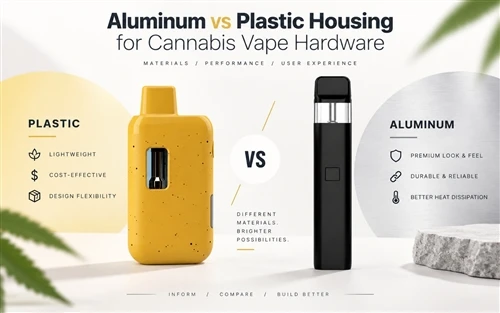
Material choice also depends on product positioning. Glass offers strong oil visibility and chemical compatibility, while engineered plastics can reduce weight and give designers more freedom in AIO structures.
The best material combination depends on the formulation, tank geometry, target cost, and final device architecture.
7. Test the Actual Filled Hardware Before Mass Production
A device that performs well for ten draws is not yet a validated Delta 9 hardware platform.
The useful test is the full tank lifecycle.
Test From the First Puff to the Last
Evaluate:
- startup speed;
- vapor volume;
- flavor consistency;
- draw resistance;
- mid-tank performance;
- low-oil performance;
- residual oil at the end.
Good Delta 9 hardware should maintain reasonably consistent performance across the entire oil volume.
The end of the tank deserves particular attention. Oil can remain on tank walls, collect in areas away from the intake, or become increasingly difficult to feed as the remaining volume decreases. That affects both consumer experience and usable oil yield.
Test Clogging, Leakage, and Storage Conditions
Hardware should also be tested after storage and environmental exposure.
Useful scenarios include:
- room-temperature storage;
- cold storage or cold-use conditions;
- warm storage;
- horizontal storage;
- transportation;
- repeated heating cycles.
A leakage rate around 2% is sometimes used as an industry comparison benchmark, while rates above 5% generally indicate a reliability problem worth investigating.
The exact result depends on the formulation, fill process, storage time, temperature, and device structure, so internal testing conditions should remain consistent.
Test Batch-to-Batch Consistency
A strong sample is useful. A repeatable production batch is more important.
Check:
- resistance distribution;
- vapor output;
- airflow;
- filling compatibility;
- leakage;
- activation response.
Keeping resistance variation within roughly 0.1Ω can be a useful quality-control target for many cartridge programs.
8. Compare True Cost per Usable Unit
The cheapest hardware quote does not always produce the lowest finished-product cost.
A better comparison is:
Hardware price + fill loss + leakage + failed units + returns = effective cost per usable unit
One sourcing example illustrates the difference:
|
Cartridge Type |
Unit Price |
Fill Loss |
Leakage |
Failure Rate |
Effective Cost |
|
Budget cotton-wick |
$1.20 |
3% |
5% |
4% |
~$1.35 |
|
Mid-range ceramic |
$1.80 |
1% |
2% |
2% |
~$1.88 |
|
Premium ceramic |
$2.40 |
0.5% |
1% |
1% |
~$2.46 |
These figures are useful because they force procurement teams to look beyond the purchase price. A small reduction in leakage or failure can matter more than a modest difference in hardware cost once the cartridge is filled with valuable Delta 9 oil.
The same principle applies to oil waste. Hardware that leaves a meaningful amount of usable oil trapped away from the heating area creates a cost that never appears on the hardware invoice.
9. Questions to Ask a Delta 9 Vape Hardware Manufacturer
A hardware supplier should be able to discuss the oil before recommending a device.
Useful questions include:
- Can you test the hardware with our final Delta 9 formulation?
- Which ceramic core is best suited to this viscosity?
- Can voltage and resistance be adjusted?
- How is oil intake sized for this formulation?
- What clogging and leakage tests are performed?
- How do you verify resistance consistency across production batches?
- Can airflow and activation be customized?
- What materials are used in the oil path and airpath?
- Can you provide heavy-metal and material test documentation?
- Can you support sample filling, troubleshooting, and refinement before production?
The strongest suppliers treat oil matching, hardware configuration, testing, and manufacturing as one development process.
A purpose-built product can also provide a useful starting point during sampling. For example, the PACE Delta-9 oil disposable vape is positioned specifically around Delta-9 oil applications and can be evaluated alongside other ceramic configurations depending on the formulation.
FAQ
What vape hardware is best for Delta 9 oil?
There is no single best platform for every formulation. A strong starting point is usually ceramic hardware matched to the oil's viscosity, terpene content, oil-flow behavior, desired vapor output, and product format.
What voltage is best for Delta 9 oil?
A useful reference range is 2.4–3.2V for many Delta 9 configurations. Lower-voltage postless or terpene-sensitive systems are also common. Voltage should always be evaluated together with resistance and ceramic design.
Are ceramic coils better for Delta 9 oil?
For most premium Delta 9 hardware programs, ceramic is a strong choice because the heating geometry and porosity can be designed for controlled oil delivery and even heat transfer. Wick-based and quartz systems still have valid use cases.
Is postless vape hardware good for Delta 9 oil?
Yes, especially when the formulation benefits from a low-temperature ceramic architecture and a direct oil-to-heater path. Compatibility still depends on viscosity, intake size, ceramic porosity, airflow, voltage, and resistance.
Why does a Delta 9 vape clog?
Common causes include slow oil flow, high viscosity, cold storage, restricted airflow, poorly matched intake openings, and residue forming in the vapor path. The most effective solution is usually to correct the oil-to-hardware match and then validate the revised configuration under real storage and use conditions.
Choosing the Right Delta 9 Vape Hardware
The right vape hardware for Delta 9 oil keeps the formulation flowing correctly, heats it efficiently, preserves the intended flavor, and performs consistently from the first puff to the end of the tank.
A practical selection process is:
Oil formulation → viscosity → intake and ceramic core → heating architecture → voltage and resistance → airflow → activation → filled-oil testing.
ASM VAPE develops oil-matched cannabis vape hardware around this process, with configurable ceramic platforms, voltage, resistance, airflow, capacity, and product architecture. If you are developing or upgrading a Delta 9 product, contact us to discuss your formulation and identify a hardware configuration to test before mass production.
![How to Choose Vape Hardware for Delta 9 Oil [2026 Guide]](/uploads/43868/info/n20260923113103fe52e.jpg)