Choosing a cannabis vape hardware manufacturer is not simply a matter of comparing catalogs, prices, or minimum order quantities. The hardware has to work with your oil, remain consistent in mass production, meet the requirements of your target market, and perform reliably after weeks of storage and consumer use.
A useful selection process starts with the formulation and works outward: oil compatibility first, hardware engineering second, validation and manufacturing consistency third.
1. Start With Your Cannabis Oil, Not the Device
Oil compatibility is the ability of a vape device to wick, heat, and vaporize a specific cannabis formulation consistently without excessive clogging, leaking, weak vapor, or burnt taste.
This matters because cannabis oils are not interchangeable. Distillate, live resin, live rosin, CBD oil, and other concentrates can differ substantially in viscosity, terpene content, flow behavior, and preferred operating temperature.
A manufacturer that starts by asking about your oil is generally more useful than one that immediately sends its best-selling device.
Distillate vs. Live Resin and Live Rosin
Different formulations place different demands on the atomization system.
|
Oil Type |
Typical Hardware Priorities |
|
Reliable wicking, sufficient heating power, consistent vapor output |
|
|
Controlled temperature, flavor preservation, stable oil flow |
|
|
Lower-temperature vaporization, terpene preservation, careful clogging control |
|
|
High-viscosity concentrates |
Strong wicking, suitable intake design, preheat or other oil-flow support where needed |
These are starting points, not fixed formulas. Two live resin formulations can behave differently because of terpene content, viscosity, additives, and storage temperature.
The manufacturer should therefore consider several variables together: ceramic core, intake geometry, airflow, voltage, resistance, tank structure, and activation method.
What Information Should You Give the Manufacturer?
Before requesting samples, provide enough information for meaningful hardware selection:
- Oil type and approximate viscosity
- Fill volume
- Desired vapor output
- Flavor priority
- Intended storage conditions
- Target market
- Existing problems such as clogging, leaking, burnt taste, or weak vapor
Be cautious when a supplier claims that one device works equally well with every formulation.
A capable manufacturer should be able to explain why a particular configuration fits your oil.
2. Evaluate the Manufacturer's Atomization and Hardware Engineering
The atomization system is the combination of the heating element, oil intake, airflow path, electrical parameters, and surrounding structure that turns cannabis oil into vapor.
Its design usually matters more to performance than the shape of the outer shell.
Ceramic Core, Intake, and Oil Flow
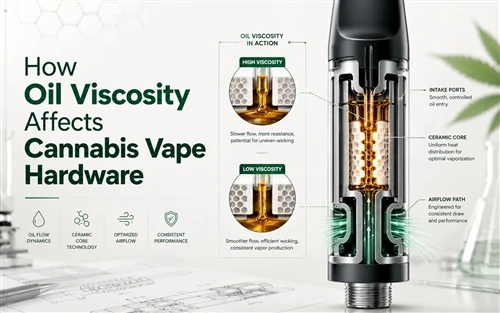
A ceramic heating element has to receive oil fast enough to remain saturated during use. If oil moves too slowly toward the heating surface, the result may be weak vapor or a dry, burnt hit. If the oil-flow system is poorly matched in the other direction, leakage can become more likely.
The effective heating area also matters. A larger contact area can improve heat transfer and vapor production, but it still has to be balanced with resistance, voltage, oil flow, and the intended draw style.
Intake-hole diameter is therefore only one variable. It should not be treated as a universal rule such as "larger is always better."
For high-viscosity formulations, the broader hardware architecture becomes especially important. A postless live rosin vape hardware platform, for example, removes the traditional metal center post from the oil chamber and can create a different oil-flow and heating environment from a conventional central-post design.
Resistance, Voltage, and Airflow
Resistance and voltage determine how the heating system behaves. Higher heat is not automatically better.
Too much heat can compromise flavor or increase the risk of burnt taste. Too little energy may struggle to vaporize a viscous formulation quickly enough. For a deeper explanation of the relationship between electrical parameters and vapor performance, see this guide on how resistance affects cannabis vape hardware.
Airflow changes the experience again. It affects draw resistance, vapor density, cooling, and how condensation behaves inside the airway.
The same logic applies when comparing central-post, postless, or full-ceramic structures. Each architecture changes the relationship between the oil path, heating surface, materials, and airflow. A full ceramic vape cartridge, for example, may be selected when reducing metal contact in the oil path and preserving flavor are important design priorities.
Variable-voltage hardware can add another layer of control. An adjustable voltage AIO vape allows the operating temperature to be tuned more closely to different formulations or flavor targets.
When reviewing a recommendation, ask the manufacturer to explain the engineering decisions. "This is our most popular model" is not a technical answer.
3. Test Production-Quality Samples With Your Actual Oil
A polished empty sample can confirm appearance and basic construction. It cannot prove oil compatibility.
A production-quality sample should be built as close as practical to the intended mass-production specification, including the relevant heating system, electrical configuration, materials, and activation method.
Appearance Samples vs. Functional Samples
An appearance sample is useful for checking:
- Dimensions
- Color
- Surface finish
- Logo placement
- Mouthpiece shape
- General ergonomics
A functional sample should be evaluated with the actual oil whenever possible.
That test should look at more than whether the device produces vapor on the first draw. Important observations include clogging, leakage, first-puff performance, vapor consistency, flavor, burnt taste, oil consumption, charging behavior, and performance after storage.
A practical validation path is:
Fill → store/age → vape → evaluate → adjust → retest → approve
The exact storage period, puff protocol, temperature conditions, and acceptance criteria should be agreed before testing rather than invented after a problem appears.
Check the Filling Process Too
A device may vape well and still create problems on the production line.
Confirm compatibility with the filling and capping process, including filling opening, tray design, filling temperature, oil viscosity during filling, and capping sequence. Large orders amplify small production inefficiencies quickly.
If you are still comparing hardware structures for terpene-rich formulations, this guide to vape hardware for live rosin provides additional context on the types of hardware characteristics that matter during evaluation.
The safest approval is not "the sample looks good." It is the production configuration performs well with the actual formulation and fits the intended filling process.
4. Check Manufacturing Quality, Batch Consistency, and Change Control
Mass-production capability means more than having enough assembly lines.
The harder question is whether a factory can reproduce the approved sample across thousands of units and repeat that performance on the next order.
Ask how the manufacturer controls:
- Incoming materials
- Ceramic-core consistency
- Resistance
- Battery cells
- Airflow tolerances
- Sealing
- Assembly
- Finished-product inspection
- Failure tracking
- Batch traceability
A useful failure-rate number should also come with a method. Ask what counts as a failure, where the data comes from, how many units it covers, and whether it refers to factory inspection or field returns.
Do Not Ignore Change Control
Change control is the process used to review, document, test, and communicate changes to a product after its specification has been approved.
It becomes important when a manufacturer changes a ceramic core, battery cell, seal, plastic material, PCB, metal component, or component supplier.
The finished device may look identical while its performance has changed.
Ask two direct questions:
Will we be notified if a material, component, or supplier changes?
What testing is repeated after that change?
This is one of the clearest ways to separate a mature manufacturing process from a factory that manages every order as an isolated production run.
If you are comparing manufacturing partners before requesting samples, a broader overview of vape hardware manufacturers in China can also help identify the differences between suppliers that focus on engineering, production scale, customization, or private-label fulfillment.
Quality should be repeatable, not dependent on one unusually good sample.
5. Review Materials, Testing, and Compliance Documentation
Cannabis oil remains in direct contact with vape hardware for extended periods. Material selection therefore deserves more attention than a generic claim such as "premium materials."
Start by identifying the oil-contact path: every component the formulation can contact between filling and vaporization.
Know What Materials Contact Your Oil
Depending on the architecture, that may include:
- Tank material
- Heating element
- Ceramic structure
- Central post or internal metal parts
- Seals
- Soldered or assembled components
- Parts of the airflow structure
Material documentation becomes especially important when evaluating heavy metals, chemical compatibility, and possible extractables or leachables.
The goal is not to assume that glass is always good, plastic is always bad, or ceramic is automatically safer than another heating technology. The better approach is to identify the exact material and review the evidence that applies to it.
Make Sure Reports Match the Exact Model
A certification logo on a supplier's website tells you much less than a report tied to the actual SKU you intend to purchase.
Check:
- Model number
- Hardware configuration
- Materials tested
- Test date
- Test method or standard
- Laboratory information
- Applicable market
This is particularly important for heavy-metal documentation, battery and electrical safety records, and material-compliance reports.
Requirements also vary by market. A product developed for California may face different testing or documentation expectations from one sold elsewhere in the United States, Canada, or Europe. Your target market should therefore be part of the hardware specification from the beginning.
The strongest supplier is not necessarily the one displaying the largest number of certification logos. It is the one that can provide the relevant documentation for the product you are actually buying.
6. Choose the Right Level of Customization: Private Label, OEM, or ODM
"Custom vape hardware" can describe very different projects.
Private label usually means branding an existing hardware platform. OEM customization modifies an existing platform to meet specified product or performance requirements. ODM development goes further by creating a more distinctive product involving new structure, appearance, functions, materials, or tooling.
|
Customization Level |
Typical Scope |
Best Fit |
|
Private Label |
Logo, colors, finish, packaging, UI |
Faster market launch |
|
Performance / OEM Customization |
Capacity, heating configuration, voltage, resistance, selected functional parameters |
Oil-specific performance |
|
ODM / Mold Customization |
Exterior, structure, materials, functions, tooling |
Exclusive product development |
This distinction affects price, MOQ, development time, and the type of manufacturer you need.
A brand that only needs a logo and custom color may not require deep engineering involvement. A brand developing hardware around a specific live rosin formulation does.
Define the scope before comparing quotations. Two suppliers may quote completely different prices because they are not quoting the same level of work.
7. Compare MOQ, Lead Time, Supply Chain, and Total Cost
MOQ and unit price matter, but neither tells you whether a supplier is economically competitive over the full project.
First, break the lead time into stages.
Break Lead Time Into Stages
Ask separately about:
Sample development → oil tuning → approval → production → shipping → reorder
A supplier may offer a short production cycle but require weeks for sampling and approval. International freight then adds another layer.
Private-label projects will generally move faster than new tooling or full ODM development. MOQ tends to rise with customization depth for the same reason: exclusive materials, tooling, engineering, and setup have to be spread across a larger order.
That is a more useful way to plan a launch than relying on a single quoted production lead time.
Compare Total Cost, Not Only Unit Price
Total landed cost is the cost of getting usable hardware into your operation, not merely the factory unit price.
Consider:
Unit price + customization + tooling + freight + duties + warehousing
Then add the cost of poor performance:
Defects + oil waste + returns + replacements + delayed production
Saving a few cents on an empty cartridge loses its appeal quickly if the finished product produces more leaking, clogging, or customer complaints.
Also review production capacity, component availability, reorder reliability, and local support. U.S. inventory or technical resources can be valuable for North American programs, particularly when troubleshooting or urgent replenishment is required, but they should be evaluated as supply-chain advantages rather than universal requirements.
8. Questions and Red Flags Before You Choose a Manufacturer
A good supplier evaluation should end with specific questions that force specific answers.
12 Questions to Ask a Cannabis Vape Hardware Manufacturer
- Have you worked with my type of cannabis oil before?
- Can you test the hardware with my actual formulation?
- Why do you recommend this ceramic core or atomization system?
- How were the voltage, resistance, intake, and airflow selected?
- How do you test for clogging, leaking, and burnt taste?
- How do you measure and track product failures?
- How do you maintain batch-to-batch consistency?
- What happens if a material, component, or supplier changes?
- Do your test reports apply to this exact hardware model?
- Is the device compatible with my filling and capping process?
- What are the sample, production, and reorder lead times?
- What is your process if a quality issue appears after delivery?
The answers should become more technical as the project becomes more technical.
Red Flags to Watch For
Several warning signs deserve extra scrutiny:
- "One device works with every oil."
- No clear explanation of resistance, voltage, airflow, or heating configuration
- Refusal or inability to provide production-quality samples
- Unclear oil-contact materials
- Test documentation for a different model
- Component changes without a defined notification process
- No traceable process for handling failed batches
- Sales staff can discuss price and branding but cannot get engineering questions answered
A reseller can still be useful for a straightforward private-label project with local stock and low order requirements. Once the project requires oil-specific engineering, performance adjustment, or exclusive development, direct access to the manufacturer and its engineering team becomes much more important.
9. Final Thoughts: Choose the Manufacturer From the Oil Outward
Choosing the right cannabis vape hardware manufacturer comes down to four capabilities: the supplier must understand your oil, engineer suitable hardware around it, validate the configuration before mass production, and reproduce that performance consistently at scale.
Price, MOQ, certification, and production capacity still matter. They should come after the product fundamentals have been proven.
ASM VAPE develops cannabis vape hardware around this oil-matched approach, with products covering all-in-one devices, pods, cartridges, and 510 batteries, plus private-label, oil-based, and ODM customization. Its manufacturing and support system also includes product testing, filling support, scalable production, and a California product laboratory for U.S. projects.
If you are developing hardware for Distillate, Live Resin, Live Rosin, CBD, or another cannabis formulation, contact ASM VAPE with your oil and project requirements. The right place to start is the formulation-not a generic device catalog.

![What Vape Hardware Is Best for Live Rosin? [ 2026 Guide]](/uploads/43868/info/n20260901180936686c1.jpg)