
Aluminum and plastic are both proven housing materials for cannabis vape hardware, but they suit different product goals. Aluminum offers higher rigidity, a natural metallic feel, and premium finishing options. Plastic provides lower weight, greater molding freedom, and strong economics at scale. For most projects, the best choice comes down to device architecture, expected production volume, target weight, surface design, and how long the hardware is intended to stay in use.
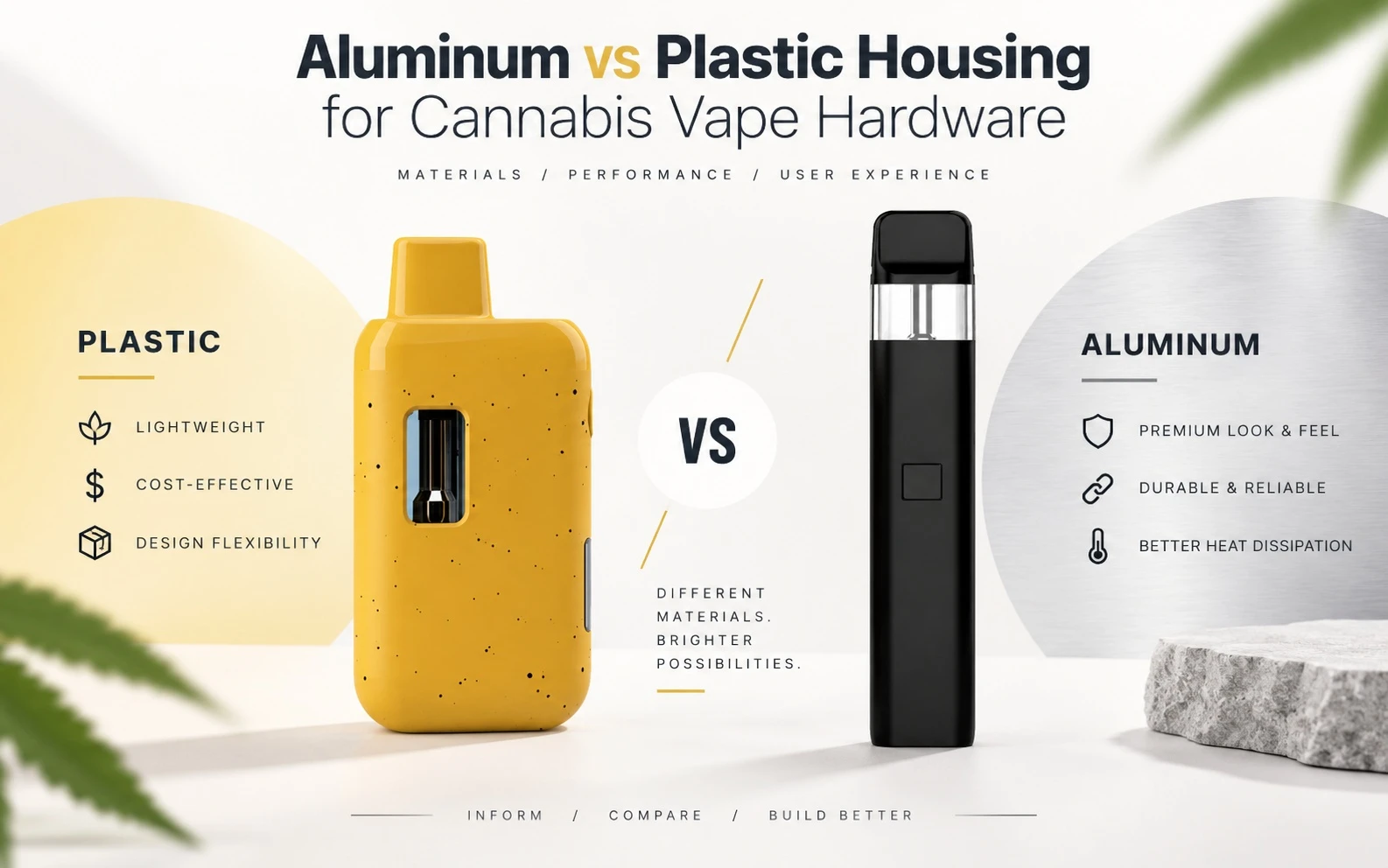
Aluminum vs Plastic Vape Housing: Quick Comparison
For cannabis vape hardware, housing refers to the exterior body that protects and supports components such as the battery, PCB, reservoir, and activation system. It should be evaluated separately from the materials that directly contact the cannabis oil.
This distinction is especially useful with AIO vape hardware, where the battery, tank, heating system, and exterior housing are integrated into one compact device.
The main differences look like this:
|
Factor |
Aluminum Housing |
Plastic Housing |
|
Weight |
Heavier than most plastics |
Generally lighter |
|
Rigidity |
Usually higher |
Depends strongly on polymer and structure |
|
Impact behavior |
Strong dimensional stability |
Can provide very good toughness |
|
Heat transfer |
High |
Low; acts more as an insulator |
|
Complex geometry |
More constrained by manufacturing process |
Excellent with injection molding |
|
Surface finish |
Anodizing, brushing, sandblasting, coating, laser engraving |
Molded color, texture, coating, printing, translucent effects |
|
High-volume unit cost |
Often higher |
Often lower after tooling is amortized |
|
Metallic feel |
Natural advantage |
Can imitate the appearance, not the exact tactile feel |
|
Transparent designs |
Limited |
PC and PCTG can support transparent or translucent structures |
|
Typical fit |
Reusable, rigid, metallic or premium-looking hardware |
Lightweight, complex, high-volume hardware |
One reason plastic usually wins on weight is simple material density. Common plastics are typically around 0.90–1.50 g/cm³, while aluminum alloys are roughly 2.5–2.9 g/cm³.
That does not mean every plastic vape is lighter than every aluminum vape. Battery size, oil capacity, wall thickness, internal frame design, and overall dimensions can easily outweigh the housing difference.
The more useful conclusion is that aluminum gives engineers more rigidity per unit of geometry, while plastic gives them more freedom to reduce mass and integrate shapes.
What Do "Aluminum" and "Plastic" Actually Mean in Vape Hardware?
Neither term describes a single material.
Aluminum Alloys and Manufacturing Methods
Vape housings generally use aluminum alloys selected according to the manufacturing process. Die-cast structures may use casting alloys such as ADC12, while extruded or machined components may use 6000-series alloys. The exact alloy affects strength, surface finish, machining behavior, and cost.
Common aluminum housing processes include:
- Die casting
- Extrusion
- CNC machining
- Anodizing
- Sandblasting
- Brushing
- Powder coating
- Laser engraving
Anodizing is particularly useful for consumer hardware because it creates a colored oxide layer that is integrated with the aluminum surface. It can produce a clean metallic finish without relying on a simple painted layer.
For brands that want a matte metal body, brushed finish, engraved logo, or serialized housing, aluminum is an efficient design platform.
ABS, PC, and PCTG Are Not the Same Plastic
"Plastic housing" can mean very different things depending on the polymer.
ABS is widely used where moldability, cost control, and adequate structural strength are priorities.
Polycarbonate, or PC, offers higher impact resistance and can be used for clear or translucent structures.
PCTG is commonly selected where clarity, toughness, and chemical resistance are important. For components that may contact cannabis extracts, PCTG compatibility with cannabis oil should be considered separately from the exterior housing material.
This distinction matters. A thin, low-grade molded shell and a well-engineered PC or PCTG housing should not be treated as equivalent simply because both are called plastic.
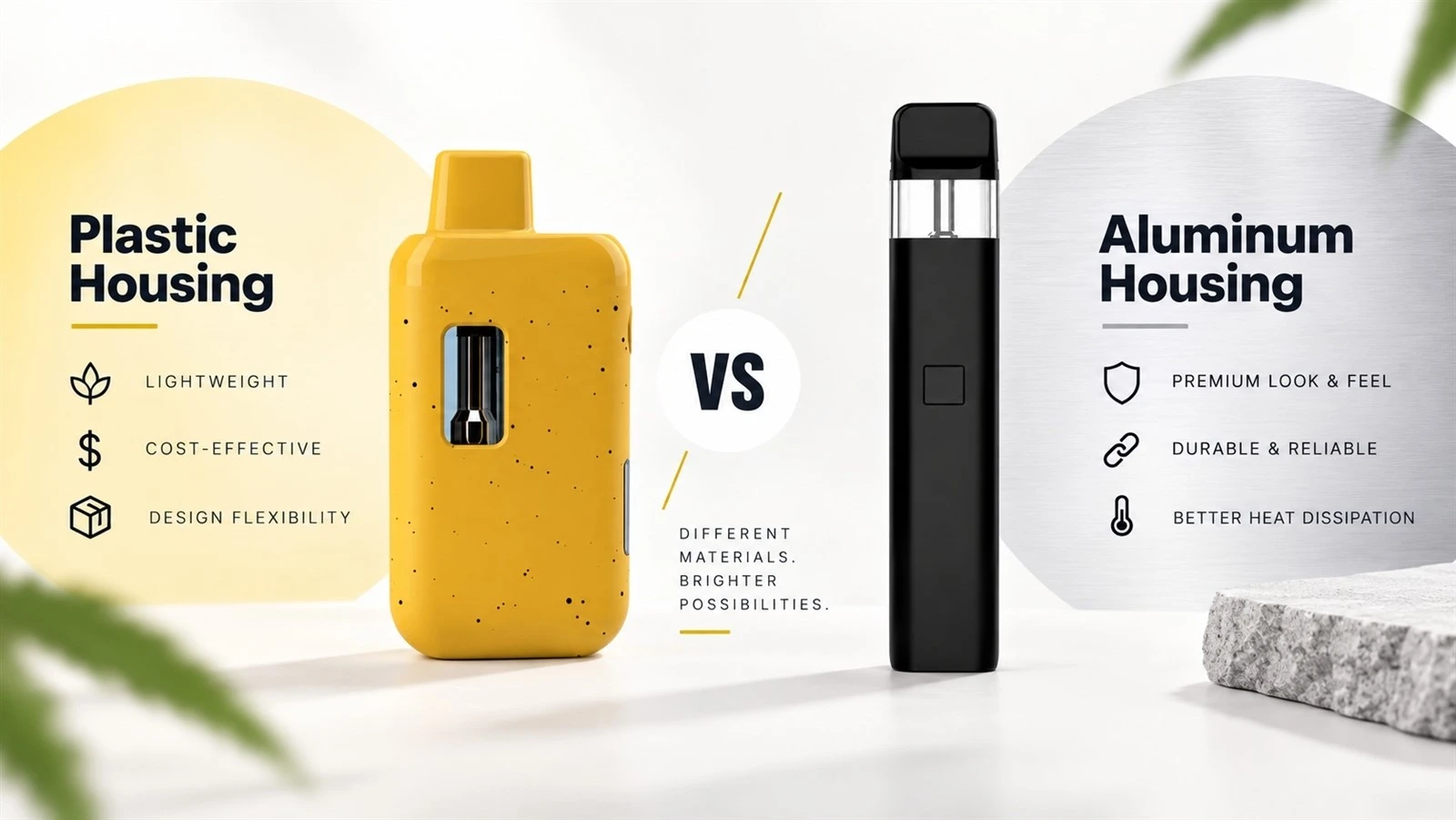
Weight, Durability, and Heat: The Engineering Trade-Offs
These three factors usually have the biggest effect on how the device feels and performs in everyday use.
Weight and Portability
Plastic has a clear density advantage.
For ultra-slim disposables, compact AIO devices, and pocket-focused designs, saving several grams can materially change the feel of the product. The difference becomes even more relevant when a brand is shipping tens of thousands of units, because housing weight contributes to packaging and freight weight as well.
Aluminum remains relatively light compared with steel or zinc alloys, so it still works well in portable devices. It simply gives engineers less room to minimize weight than most engineering plastics.
For reusable 510 batteries, a little extra weight may even be desirable because it creates a more substantial hand feel. For a high-volume disposable, the same weight may add cost without creating equal value.
Durability and Impact Resistance
Aluminum usually offers higher rigidity and better resistance to permanent deformation. It holds its shape well under compression and repeated handling.
Plastic behaves differently. Good engineering plastics can absorb impact very effectively because they offer more toughness and elasticity. That is why the statement "metal is always more durable" is too broad.
Actual drop performance depends on:
- Material grade
- Wall thickness
- Housing geometry
- Internal ribs and supports
- Stress concentration around charging ports or joints
- Assembly method
In practice, aluminum is a strong choice when dimensional stability and repeated-use durability matter. Plastic works very well when the structure is designed correctly and weight is a higher priority.
Heat Transfer and Thermal Behavior
Aluminum conducts heat far more readily than common plastics. Plastic behaves more like a thermal insulator.
That difference affects device design in both directions.
An aluminum body can spread localized heat away from a battery or heating area more quickly. It can also transfer that heat toward the outer housing, making warmth more noticeable in the user's hand.
Plastic slows that transfer. This can make the outside of the device feel cooler, but it may also retain more internally generated heat if the device has limited thermal pathways.
So thermal conductivity should be treated as a design variable, not a quality score.
Good thermal management comes from the complete device architecture: heating core position, battery layout, airflow, power output, internal spacing, and housing geometry all matter.
Design Freedom, Surface Finish, and Cost at Scale
Aluminum and plastic create very different development paths.
Aluminum: Metallic Finishes and Premium Tactile Design
Aluminum has a natural advantage when the product concept depends on a metallic feel.
Finishing options can include:
- Anodized colors
- Brushed textures
- Sandblasted matte surfaces
- Polished finishes
- Powder coating
- Laser-engraved logos or serial numbers
These finishes are especially useful for reusable batteries, slim metallic devices, and premium AIO platforms where the housing itself is part of the brand identity.
The trade-off is processing complexity. Machining, extrusion, anodizing, and secondary finishing generally involve more individual steps than molding a finished plastic part.
That usually increases unit cost.
Plastic: Complex Geometry and High-Volume Molding
Plastic becomes particularly strong when industrial design is more complex.
Injection molding can integrate features such as:
- Curved or ergonomic shells
- Snap-fit assemblies
- Internal ribs
- Oil-viewing windows
- Integrated mouthpieces
- Molded logos
- Transparent or translucent sections
- Multiple textures
These features can often be produced directly in the molded part rather than being added through separate machining or assembly operations.
This is one reason plastic remains attractive for high-volume All-in-One Disposable vape hardware.
The economics are especially favorable once mold cost is spread over a large production run. Tooling can be expensive at the beginning, but the per-unit cost drops quickly as production volume increases.
For a high-volume disposable project, this matters more than the raw material price alone.
A fair cost comparison should include:
- Tooling
- Raw material
- Machining or molding
- Surface finishing
- Assembly
- Scrap rate
- Packaging
- Freight
- Quality control
Plastic usually wins on unit economics at scale. Aluminum can make more sense when the product justifies a higher housing cost through reusable construction, metallic positioning, or simpler low-volume development.
Does Housing Material Affect Cannabis Oil, Flavor, or Safety?
This is where housing material can be confused with oil-contact material.
They are not the same thing.
The housing is the outer structural body. It mainly influences:
- Weight
- Rigidity
- Heat transfer
- Surface feel
- Appearance
- Manufacturing method
The parts that actually contact the cannabis oil can include:
- Reservoir or tank
- Seals
- Intake structure
- Central post
- Ceramic heating core
- Other wetted surfaces
Those are the components that need the closest attention for chemical compatibility, terpene resistance, migration, and oil stability.
An aluminum outer body may contain a PCTG or glass reservoir with a ceramic heating system. A plastic housing can use exactly the same type of oil-contact structure. If tank material is part of the project decision, the trade-offs of glass tanks in cannabis vape hardware should be evaluated separately from the outer shell.
This is especially important with cannabis formulations because distillate, Live Resin, Live Rosin, CBD, and Delta oils do not all behave the same way.
Hardware should be matched to oil viscosity and formulation through factors such as ceramic core, intake design, airflow, voltage, resistance, and tank structure. Housing still matters indirectly because it influences structural and thermal behavior, but it should not be used as a shortcut for judging oil compatibility.
Aluminum vs Plastic vs Hybrid: Which Fits Your Vape Product?
For practical product development, there are three useful paths.
Choose Aluminum When...
Aluminum is usually the stronger option when:
- Metallic tactile feel is part of the product concept
- High rigidity is important
- The device is reusable
- Anodizing, brushing, or engraving is central to the visual design
- A slightly higher housing weight is acceptable
Reusable 510 batteries are an obvious example. A metal housing has time to deliver value because the device is charged, carried, dropped, and handled repeatedly.
Premium disposable hardware can also justify aluminum when the exterior finish is part of the brand presentation. A product such as an aluminum disposable vape shows how a slim disposable format can still use a metal exterior when tactile feel and visual positioning are part of the design brief.
Choose Plastic When...
Plastic usually makes more sense when:
- Low weight is important
- The design has complex geometry
- Transparent or translucent elements are required
- Production volume is high
- Unit cost must be tightly controlled
- The hardware has a relatively short intended use cycle
This fits many disposable AIO formats, especially when the design depends on molded curves, integrated structures, or oil windows.
A plastic disposable vape is a straightforward example of how molded housing can support a compact box format while keeping manufacturing and weight under control.
Plastic is not inherently a low-end choice. Material grade, molding quality, finish, and structural design determine how the final product feels.
Choose a Hybrid Housing When...
A hybrid structure is often the best answer when the device needs some characteristics from both materials.
Examples include:
- Plastic body with an anodized aluminum accent
- Aluminum outer sleeve with a molded plastic internal frame
- Aluminum exterior with a PCTG or glass reservoir
- Plastic structural housing with metallic decorative components
Hybrid construction lets each material do the job it handles best.
For many projects, this is more useful than trying to force every part of the device into a single material system.
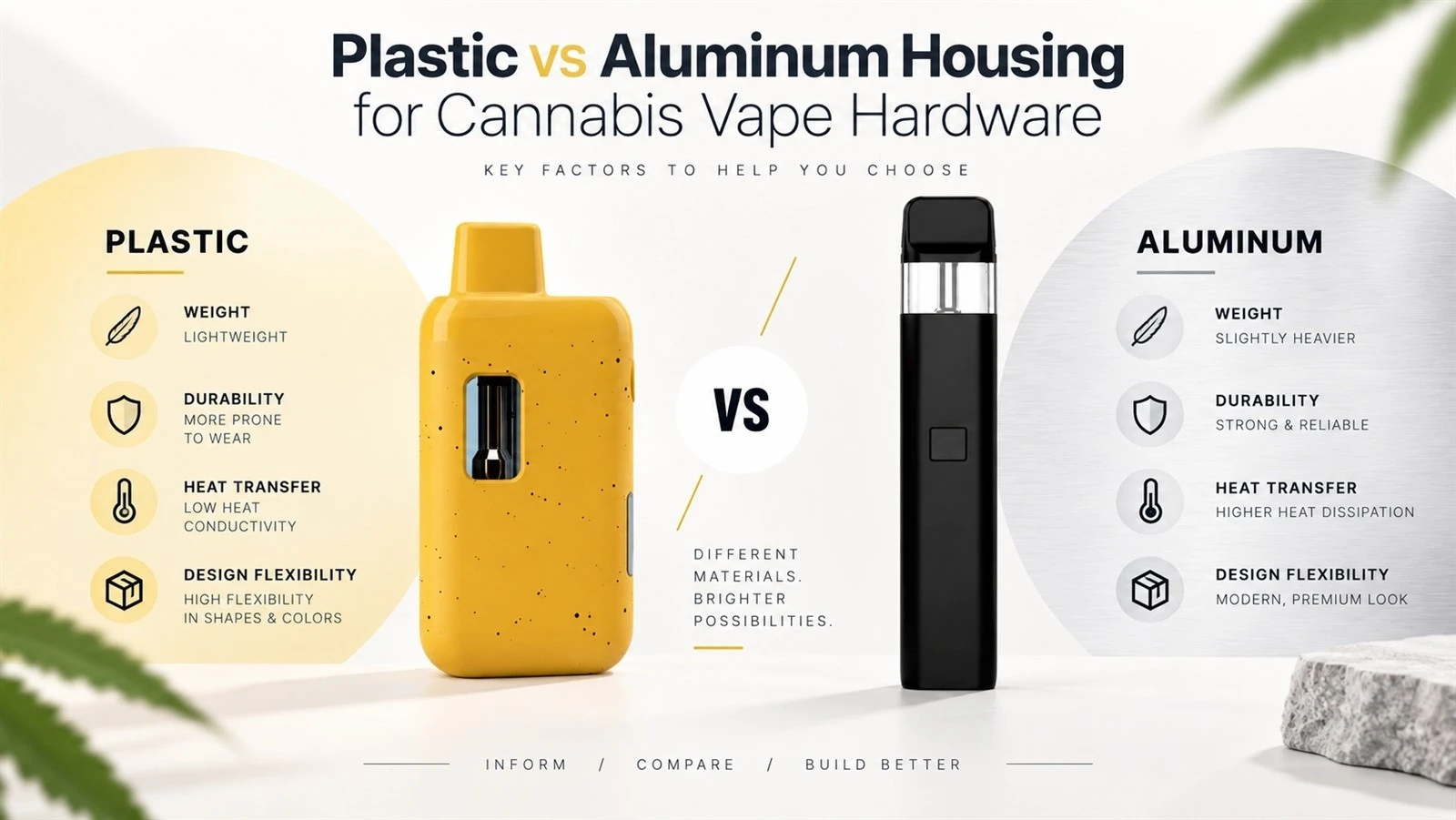
How Should Cannabis Brands Choose a Housing Material?
The most effective selection process starts with the device requirements.
|
Question |
Why It Matters |
|
Is the device disposable or reusable? |
Determines how much long-term housing durability is worth |
|
What is the target weight? |
Plastic provides more lightweighting flexibility |
|
Is metallic feel part of the brand design? |
Aluminum may fit better |
|
Does the product need complex geometry? |
Injection-molded plastic usually has the advantage |
|
Is transparency required? |
PC, PCTG, or hybrid structures can simplify this |
|
What is the expected production volume? |
Volume changes tooling economics |
|
What surface finish is required? |
Aluminum and plastic support different finishing methods |
|
Where are the main heat sources? |
Housing material affects heat transfer |
|
Which materials actually touch the oil? |
Oil-contact compatibility must be assessed separately |
|
What is the tooling budget? |
Important for injection molding |
|
Are sustainability goals defined? |
Requires whole-device analysis, not just housing material |
For high-volume projects, plastic often becomes the practical choice because molding efficiency and part integration can outweigh the advantages of metal.
For reusable or design-led hardware, aluminum can justify its higher cost through rigidity, surface finish, and tactile quality.
Sustainability goals need a wider view as well. The fact that a housing material is recyclable does not automatically make the complete vape easy to recycle; battery removal, material separation, electronics, and collection infrastructure still matter. Products designed specifically around those constraints, such as recyclable disposable vape hardware, require decisions at the complete-device level.
The housing decision should follow the product architecture.
FAQ
Is Aluminum Better Than Plastic for Cannabis Vape Hardware?
No single material is better in every application.
Aluminum generally offers higher rigidity, strong dimensional stability, and metallic finishing options. Plastic offers lower weight, complex molding, and better high-volume economics.
The right choice depends on the device format and project priorities.
Is Plastic Housing Safe for Cannabis Vape Hardware?
Plastic safety depends on the polymer grade, part design, and whether that material is in direct contact with oil or vapor.
Housing material should be evaluated separately from reservoir and vapor-path materials.
Does Aluminum Housing Make a Vape Run Cooler?
Not automatically.
Aluminum transfers heat more quickly than plastic, which can help spread localized heat. Whether the full device operates at a lower temperature depends on battery placement, heating power, internal spacing, airflow, and housing design.
Which Housing Material Is Better for Disposable Vapes?
Plastic is often the more efficient choice for high-volume disposable hardware because it is lightweight, easy to mold into complex shapes, and economical once tooling is amortized.
Aluminum still makes sense for disposable products where metallic appearance or rigidity is part of the product positioning.
Can Aluminum and Plastic Be Combined in One Vape Device?
Yes. Hybrid vape housing is common and technically useful.
A device can use aluminum for the exterior or decorative sections and plastic for internal structure, complex molded components, or transparent sections.
Conclusion
Aluminum is the stronger choice when rigidity, metallic feel, and premium finishing are central to the device. Plastic is usually better for lightweight construction, complex geometry, and high-volume production. Hybrid designs can combine both without forcing the entire device into one material strategy.
For cannabis vape hardware, housing should also be evaluated separately from the reservoir, ceramic core, seals, and other oil-contact components.
As a cannabis vape hardware manufacturer, ASM VAPE develops aluminum, plastic, glass, ceramic, and hybrid hardware around the oil, device architecture, target cost, and brand requirements. If you are evaluating housing materials for a new AIO, cartridge, pod, or 510 battery project, contact our team to discuss the product structure and material options.



![What Vape Hardware Is Best for Live Rosin? [ 2026 Guide]](/uploads/43868/info/n20260901180936686c1.jpg)