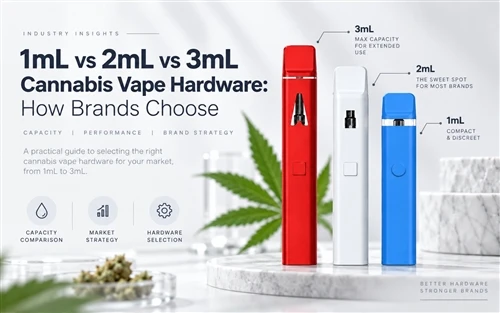
Choosing between 1mL, 2mL, and 3mL cannabis vape hardware affects far more than fill volume. Capacity changes the product's use cycle, device size, oil inventory, battery requirements, and the engineering needed to keep vapor output consistent from the first draw to the last. In practice, 1mL tends to fit compact and premium products, 2mL works well as a balanced mainstream format, and 3mL serves extended-use and value-focused products. The right choice still depends on the oil, hardware architecture, and commercial model.

1mL vs 2mL vs 3mL Cannabis Vape Hardware: Quick Comparison
The fastest way to compare cannabis vape capacity is to look at how each format changes the finished product. Brands evaluating several sizes on the same platform can also compare dedicated 1mL, 2mL, and 3mL disposable vape hardware before moving into formulation-specific testing.
|
Factor |
1mL |
2mL |
3mL |
|
Typical positioning |
Premium, compact, trial |
Mainstream, value, balanced |
Extended-capacity, specialty |
|
Consumer use cycle |
Shorter |
Medium |
Longer |
|
Portability |
Highest |
Good |
Lower |
|
Oil inventory per device |
Lowest |
Medium |
Highest |
|
Common oil strategy |
Premium extracts, strain-specific oils, distillate |
Broad formulation range |
Often value-oriented or distillate-based |
|
Hardware engineering demand |
Moderate |
Higher |
Highest |
|
Battery-to-oil matching |
Important |
More important |
Critical |
|
Long-term performance validation |
Important |
Higher priority |
Highest priority |
For consumers, capacity also changes how long a device may last. A useful working estimate is roughly 150–450 puffs from 1mL, 350–850 from 2mL, and 550–1,200+ from 3mL. Draw length, device efficiency, power, and usage style can move those numbers considerably.
For a more consumer-oriented comparison, see our guide to 1mL vs 2mL vs 3mL THC disposable vape capacities.
Puff counts are useful for estimating the use cycle, but they should not be treated as fixed hardware specifications. A low-voltage ceramic device and a hotter, higher-output device can consume the same volume of oil very differently.
What Actually Changes When Vape Capacity Increases?
A larger reservoir affects the whole device. More oil has to reach the ceramic core, vaporize consistently, and remain stable through a longer consumption cycle. Oil delivery, power configuration, sealing, and end-of-life performance all become more important as capacity increases.
Oil Delivery and Wicking
Oil delivery describes how the formulation moves from the reservoir to the heating element. Its performance depends on viscosity, intake geometry, ceramic porosity, tank structure, temperature, and the position of the heating core.
Larger capacity increases the amount of oil the system must manage over its lifetime. It does not automatically mean a longer wicking path. A bottom-mounted postless heating structure, for example, can keep oil close to the ceramic even inside a larger reservoir.
That distinction matters with thick cannabis oils. A large chamber can perform very well when the intake and ceramic architecture are designed around the formulation.
Battery, Voltage, and Resistance
Capacity also changes how much usable energy a device must deliver before the oil is depleted.
Battery size matters, but mAh is only one part of the calculation. Voltage, resistance, ceramic efficiency, activation mode, rechargeability, and average puff duration all influence how long the device can operate.
This is why two 3mL devices with the same battery capacity can perform very differently. A well-matched heating system may use the available energy far more efficiently than a poorly matched one.
Brands developing larger-capacity products should evaluate how resistance affects cannabis vape hardware together with voltage and ceramic design instead of choosing battery capacity in isolation.
The practical engineering target is straightforward: the battery and atomization system should remain functional until the usable oil is finished.
Full-Lifecycle Performance
Initial performance is only part of the test.
A device may produce excellent vapor after filling and still develop problems later in its life. As the oil level falls, brands should monitor:
- vapor output
- flavor consistency
- clogging
- burnt taste
- leakage
- condensation
- residual oil
- battery behavior
The larger the capacity, the more important this full-lifecycle validation becomes.
A 3mL reservoir only creates value if the hardware can use those 3mL reliably.

1mL vs 2mL vs 3mL: Which Product Strategy Fits Your Brand?
Capacity also shapes how a product is positioned on the shelf.
1mL: Compact, Premium, and Trial-Oriented
The 1mL format remains highly practical for premium extracts, strain-specific products, smaller AIO devices, cartridges, and new product launches.
Live resin and live rosin brands often work well with shorter use cycles. These oils can carry significant value through terpene profile, extraction method, cultivar, and flavor, so the brand does not need maximum fill volume to establish a premium position.
Consumers buying these products may also rotate strains more frequently and place greater value on portability and flavor than on keeping one device for the longest possible time.
There is a commercial reason to favor 1mL for new launches as well. A limited cultivar, unfamiliar cannabinoid blend, or new terpene profile ties up less oil inventory in each finished unit. If demand is uncertain, that reduces the financial exposure of an initial production run.
A smaller format also leaves more freedom for slim industrial design and compact packaging.
2mL: Capacity, Value, and Portability in Balance
The 2mL format has become a strong middle ground for cannabis vape hardware.
It extends use time substantially beyond 1mL while still fitting into relatively compact AIO designs. That makes it useful for everyday products and value-oriented SKUs that need more oil without moving into the largest device formats.
From a product-development perspective, 2mL is also attractive because many platforms can support both 1mL and 2mL configurations without redesigning the entire device. A brand can therefore create different fill-volume SKUs while keeping a recognizable exterior platform.
For postless formats, 1mL and 2mL postless AIO vape hardware offers a practical example of how two capacities can share the same basic product architecture.
The added volume still changes the validation workload. Thick oils need enough intake area and ceramic saturation, while longer use cycles make stable battery output and rechargeability more valuable.
For many products, 2mL works because it offers more capacity without pushing device size, oil inventory, or engineering demands as far as a 3mL format.
3mL: Extended Capacity With Higher Engineering Demands
A 3mL cannabis vape serves a longer use cycle and usually targets heavy-use consumers, value-focused formulations, or products where fewer device replacements are part of the value proposition.
The engineering burden is higher.
A 3mL device goes through more heating cycles and keeps oil inside the hardware for longer. Oil pooling, uneven feeding, condensation, flooding, battery endurance, and flavor drift deserve more attention during development.
Multi-core structures can also become useful at this capacity. For example, 2mL and 3mL triple-channel cannabis vape hardware shows how a larger total capacity can be paired with a more complex ceramic architecture instead of relying on a single conventional oil path.
Holding 3mL and vaporizing 3mL consistently are two different engineering tasks.
Three milliliters is also not an absolute upper limit. Larger 3.5mL, 4mL, and other high-capacity cannabis vape formats exist. For this reason, 3mL is better understood as a common large-capacity tier.
How Oil Type and Viscosity Affect Capacity Selection
Oil type should be evaluated before the final capacity is locked in.
Different formulations move and heat differently because viscosity, terpene content, cannabinoid composition, and temperature affect how oil reaches the ceramic core.
|
Oil Type |
1mL |
2mL |
3mL |
Main Hardware Focus |
|
Distillate |
Widely applicable |
Often suitable |
Often easier to scale |
Intake and power matching |
|
Live Resin |
Common |
Viable with matching |
More demanding |
Flavor and oil flow |
|
Live Rosin |
Common premium use |
Requires careful testing |
Highest validation burden |
Ceramic, intake, low-temp heating |
|
CBD / Delta oils |
Formulation dependent |
Formulation dependent |
Formulation dependent |
Actual viscosity and oil behavior |
Many distillate formulations are easier to scale into larger capacities because they can flow consistently across a broad range of hardware configurations. Brands developing these products can evaluate hardware specifically designed for distillate oil.
Terpene-rich extracts usually need more careful tuning. Live resin vape hardware should maintain stable oil delivery while controlling heat, while hardware for live rosin often requires even closer attention to viscosity, ceramic saturation, and lower-temperature vaporization.
Postless designs are particularly relevant here. By removing the conventional center post and bringing the ceramic heating structure closer to the oil reservoir, postless vape hardware can shorten the oil path and provide more direct contact between oil and ceramic.
The oil category is still only a starting point.
Two live resin formulations may behave differently. Two distillates can have different viscosities. Final hardware selection should therefore be based on the actual oil being filled.
Capacity, COGS, and Sales Velocity
Capacity also changes the economics of a cannabis vape SKU.
Cannabis extract can represent a significant portion of the finished product cost. Depending on quality, cannabinoid profile, production method, and market conditions, wholesale cannabis oil may range around $15–$40+ per gram.
Putting more oil into each device therefore increases the amount of inventory value tied up in every finished unit.
A realistic COGS calculation should include:
- oil
- hardware
- filling
- packaging
- testing
- freight
- distribution
- expected defect or leakage loss
On the same hardware platform, moving from 1mL to 2mL may create only a modest increase in hardware BOM. The economics change when the larger version also needs a different battery, screen, more complex ceramic system, heavier housing, or more demanding sealing structure.
Sales velocity matters for the same reason.
A slow-moving premium strain in a 3mL device ties up more extract per unit and may spend considerably longer in the supply chain before the consumer finishes it. A fast-moving mainstream SKU can support a larger fill volume more comfortably.
For high-value formulations and unproven launches, smaller capacity often gives the brand more flexibility.

Single Tank vs Dual-Chamber: Capacity Is Also an Architecture Decision
Total capacity does not always mean one reservoir.
A 2mL device may contain one 2mL tank, or it may use two separate 1mL chambers. Likewise, a 3mL product can use a single 3mL reservoir or two 1.5mL chambers.
That difference creates new product possibilities. Separate chambers can hold two strains, two cannabinoid formulas, or different flavor profiles while keeping them isolated until vaporization.
Brands considering these formats should also look at how dual-chamber cannabis vape hardware manages airflow, activation, oil separation, and switching between chambers.
So total oil volume and chamber architecture should be treated as separate decisions.
A larger number on the capacity specification does not tell you how the oil is actually stored or vaporized.
Don't Confuse mL With Grams: Capacity and Compliance Are Different Questions
In cannabis vape hardware, mL measures reservoir volume. Grams measure mass.
A 1mL tank therefore does not automatically contain exactly 1 gram of cannabis oil. Actual fill weight depends on formulation density and the filling specification used by the brand.
That distinction becomes important in markets where cannabis quantity limits are expressed by weight while the hardware itself is specified by volume.
For example, California adult-use rules allow up to 8 grams of cannabis concentrate in a daily purchase. That does not create an 8mL vape-hardware limit. Capacity, filled mass, potency, packaging, labeling, and testing requirements need to be evaluated separately.
Brands working across the U.S. and Canada should therefore review three questions for each target market:
- How much volume does the hardware hold?
- What mass and cannabinoid content are being filled?
- What testing, packaging, labeling, and product-format requirements apply?
This is especially important for multi-state product lines. A hardware configuration that works commercially in one market may need a different fill or packaging strategy elsewhere.
A 6-Step Framework for Choosing 1mL, 2mL, or 3mL Vape Hardware
A practical hardware-selection process starts with the formulation and works outward.
1. Start with the oil.
Define oil type, viscosity, terpene profile, cannabinoid formulation, and oil value.
2. Define the consumer use cycle.
Decide whether the product is intended for occasional use, everyday use, or longer high-frequency use.
3. Define the product economics.
Evaluate oil cost, target retail price, expected sales velocity, and how much inventory value will sit in each device.
4. Choose the capacity.
Once the first three factors are clear, the 1mL, 2mL, or 3mL decision becomes much easier.
5. Match the hardware.
Select the ceramic core, intake size, airflow, voltage, resistance, battery, activation method, and tank architecture around the formulation.
6. Validate the full oil volume.
Testing should cover initial draws, mid-life performance, and the final portion of oil. Track clogging, leakage, flavor, vapor output, battery performance, and residual oil.
Full oil utilization deserves particular attention.
A 3mL device offers poor value if a meaningful portion of the oil remains on the tank wall or cannot reach the ceramic core. Tank material, reservoir geometry, ceramic position, and intake design all influence how much filled oil is actually usable.
The practical capacity of a vape is the amount of oil the device can deliver reliably throughout its life.
FAQ
Is 2mL better than 1mL for cannabis vapes?
Not universally. A 2mL vape provides more oil and a longer use cycle, while 1mL remains well suited to compact devices, premium extracts, new-product trials, and faster SKU turnover. The better format depends on formulation and product positioning.
Is 3mL too large for live resin or live rosin?
No, but the validation requirements are higher. Terpene-rich and high-viscosity oils need careful testing for ceramic saturation, oil flow, flavor consistency, clogging, and performance across the entire use cycle.
Does a 3mL vape need a larger battery?
Not necessarily. The device needs enough usable energy to finish the oil, but battery mAh is only one variable. Voltage, resistance, ceramic efficiency, rechargeability, and power management also affect performance.
How many puffs are in 1mL, 2mL, and 3mL?
A useful estimate is approximately 150–450 puffs for 1mL, 350–850 for 2mL, and 550–1,200+ for 3mL. Draw duration, voltage, oil viscosity, vapor output, and hardware efficiency can shift those numbers considerably.
Is 1mL the same as 1 gram?
No. Milliliters measure volume, while grams measure mass. The actual filled mass depends on oil density and formulation.
Choosing the Right Capacity
1mL, 2mL, and 3mL cannabis vape hardware support different product strategies. One milliliter works especially well for compact, premium, and trial-oriented products. Two milliliters offers a strong balance of capacity, portability, and perceived value. Three milliliters extends the use cycle, but it demands more rigorous validation of oil delivery, power, sealing, flavor, and full-volume performance.
The right capacity is the one that fits the formulation, expected use cycle, product economics, and hardware architecture together.
ASM VAPE develops oil-matched hardware across 1mL, 2mL, 3mL, and multi-chamber platforms. If you are planning a new product line, contact our cannabis vape hardware manufacturer team to discuss your oil, target capacity, ceramic system, voltage, resistance, and customization requirements.