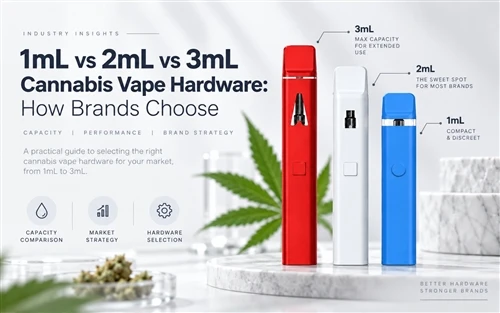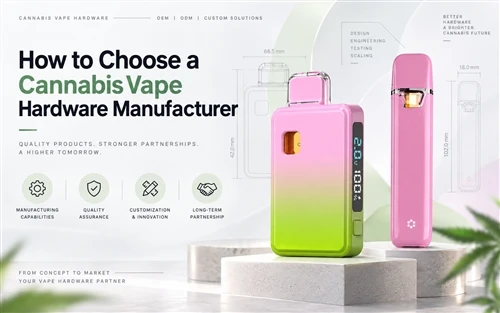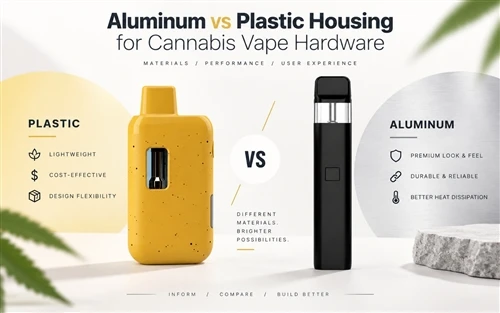
An AIO vape, short for all-in-one vape, combines the battery, oil reservoir, heating element, airflow system, and mouthpiece in one complete device. In the prefilled cannabis market, most AIO vapes are closed-system products designed to be used until the oil is depleted.
They require no separate 510 battery, cartridge installation, or complicated setup. This guide explains what an AIO vape is, how it works, the main device types, and what cannabis brands should evaluate before choosing AIO hardware.
What Is an AIO Vape?
AIO stands for "all-in-one." The term describes a vape architecture in which the main operating components are integrated into a single finished device.
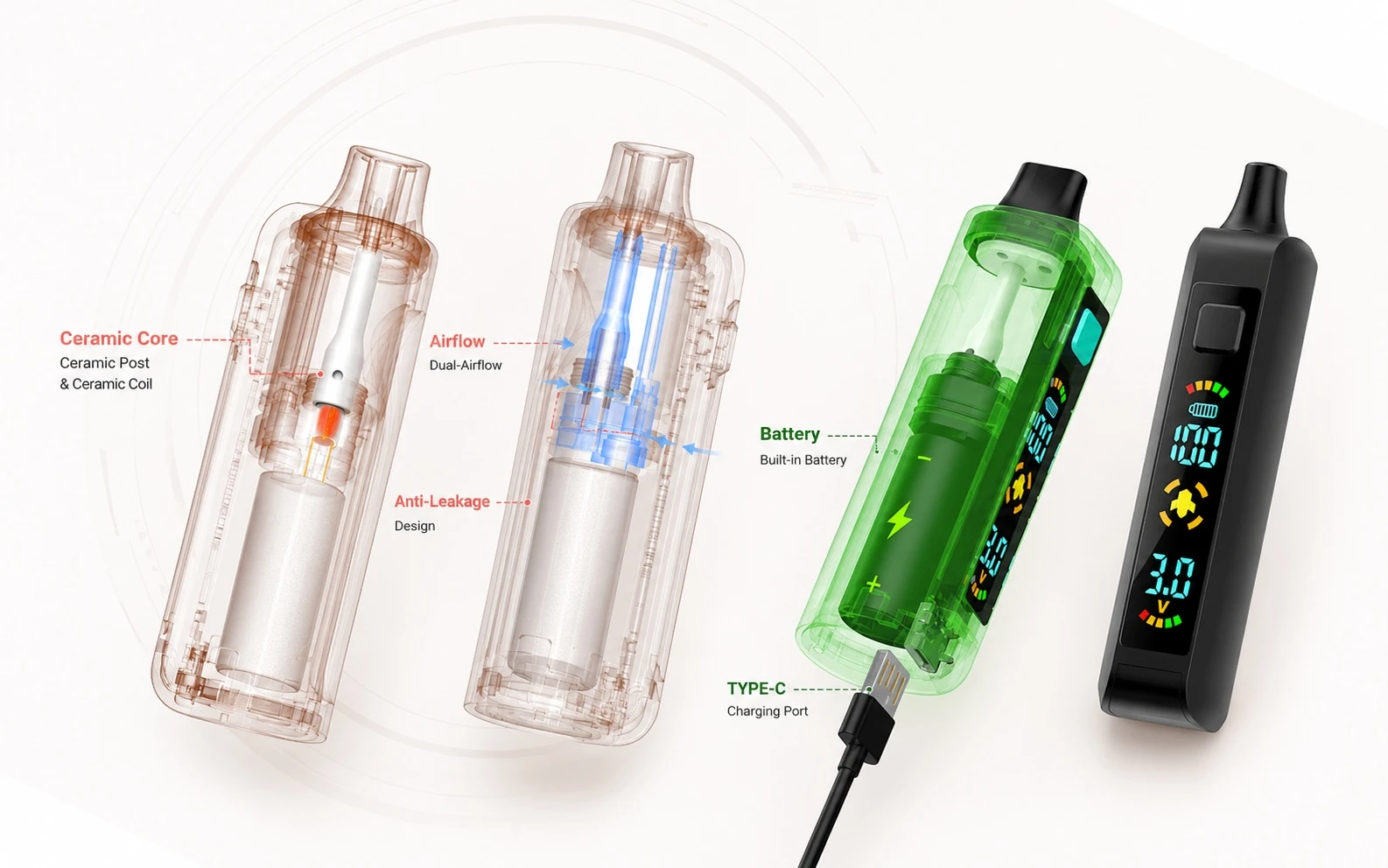
A typical cannabis AIO vape includes:
- A built-in battery
- A prefilled oil reservoir
- A ceramic heating core
- An internal airflow path
- An activation sensor or button
- A mouthpiece
- A control circuit
- A charging port on rechargeable models
Unlike a 510 cartridge system, an AIO does not require the consumer to connect a separate cartridge to a reusable battery. The oil reservoir, atomizer, and power source are already matched inside the device.
In the cannabis market, most AIO vapes are prefilled and non-refillable. The consumer uses the device until the oil is depleted, then replaces the entire unit.
However, "AIO" and "disposable" do not mean exactly the same thing.
AIO describes the device structure. Disposable describes the product lifecycle. A rechargeable AIO can still be disposable if the battery can be recharged but the oil reservoir cannot be refilled.
The term "vape pen" is also broader than AIO. Vape pen usually refers to a slim device shape. An AIO can have a pen-style body, but it can also be square, flat, curved, or custom-molded. A 510 battery with a cartridge may also be called a vape pen.
There is another important distinction. In nicotine vaping, AIO can refer to refillable systems with replaceable coils or pods. This article focuses on prefilled cannabis AIO vape hardware.
The defining feature is not the shape or charging port. It is the integration of the battery, oil tank, atomizer, airflow, and mouthpiece into one controlled system.
How Does an AIO Vape Work?
An AIO vape turns cannabis oil into an inhalable aerosol by using battery power to heat oil held inside the atomizer.
The process looks simple from the outside. Inside the device, several components must work together at the correct rate.
Main Components Inside an AIO Vape
The battery supplies power to the heating element. Depending on the design, the device may use direct battery output, regulated voltage, multiple voltage levels, or a preheat program.
The oil reservoir stores the cannabis extract. Common fills include distillate, live resin, live rosin, and some CBD formulations. Reservoir size varies by product design and market positioning.
The ceramic heating core draws oil toward the heating area through capillary action. Its pore structure, heating surface, resistance, and intake design all affect how quickly oil reaches the coil.
Intake holes control oil flow from the reservoir to the ceramic core. They must be large enough to feed the oil but not so large that the heating chamber floods.
The airflow sensor detects pressure changes when the consumer inhales. In a draw-activated device, this signal tells the control circuit to power the atomizer.
The internal airway carries the aerosol from the heating chamber to the mouthpiece. Its diameter and shape influence draw resistance, condensation, and vapor density.
Rechargeable AIO devices also include a charging port and charging protection circuit. USB-C is common, but the port alone does not make the device refillable.
What Happens When You Take a Puff?
In a draw-activated AIO vape, the operating sequence is straightforward:
- The consumer inhales through the mouthpiece.
- The airflow sensor detects the pressure change.
- The control circuit activates the battery.
- The battery sends power to the heating element.
- Oil held in the ceramic core is heated.
- The resulting aerosol travels through the airway and mouthpiece.
Some devices use a button instead of automatic draw activation. Others add preheat, which applies lower power for a short period before the main puff. Preheat can help thick oil move toward the heating area, especially in cool conditions.
Consumers usually call the output "vapor," although "aerosol" is technically more accurate because the output can contain suspended droplets and other compounds.
Stable performance depends on balance. The ceramic core must receive oil at roughly the same rate that the heating element vaporizes it.
If oil feeding is too slow, the core can run partially dry. This may cause weak output, harshness, burnt taste, or localized overheating.
If oil feeding is too fast, the heating chamber can flood. The result may be gurgling, spitback, airway condensation, or leakage.
A good AIO is therefore not simply a battery attached to a tank. It is a matched oil-feeding, heating, airflow, and power system.
What Are the Main Types of AIO Vapes?
AIO vapes are commonly classified by charging method, refillability, activation style, and output control. For prefilled cannabis products, the most important distinction is whether the device can be recharged.
Non-Rechargeable Disposable AIO Vapes
A non-rechargeable AIO does not include a charging port. The battery is intended to last through the planned oil volume and device lifecycle.
This format is simple and compact. It is often used for smaller fill capacities or products designed for shorter use periods.
Battery matching is critical. If the battery is undersized, the device may stop working while usable oil remains in the reservoir. This creates waste and usually leads to consumer complaints.
A well-designed non-rechargeable AIO should have enough usable battery capacity to support the intended fill volume, output level, and draw pattern without excessive unused oil.
Rechargeable Disposable AIO Vapes
A rechargeable disposable AIO includes a charging port, allowing the consumer to recharge the battery before the oil is depleted.
The oil reservoir is still usually sealed and non-refillable. Once the oil is gone, the entire device is replaced.
Rechargeable designs are often more suitable for:
- Larger oil capacities
- High-viscosity extracts
- Devices with preheat functions
- Products expected to remain in use for longer periods
- Higher-output configurations
Rechargeable does not mean reusable in the traditional sense. A device that can be charged several times but cannot be refilled is still a disposable vape.
Refillable or Reusable AIO Systems
Some AIO systems can be refilled, recharged, or fitted with replaceable coils. These designs are more common in nicotine vaping than in regulated prefilled cannabis markets.
They offer greater flexibility but introduce more user-controlled variables, including oil selection, filling technique, coil condition, and power settings.
For cannabis brands selling a finished, prefilled product, a sealed AIO usually provides tighter control over how the device is used.
AIO devices can also be classified as draw-activated or button-activated, fixed-voltage or multi-voltage, and preheat-enabled or non-preheat. These features should be selected according to the oil and intended user experience, not added simply for marketing.
What Are the Pros and Cons of AIO Vapes?
AIO vapes solve several practical problems, but their integrated construction also creates clear trade-offs.
Advantages of AIO Vapes
The main consumer benefit is ease of use. The device is usually ready immediately after opening the package.
There is no separate battery to buy, no cartridge to install, and no voltage setting to learn. This reduces setup errors and makes the format accessible to new consumers.
AIO devices are also compact. Because the tank and battery are designed together, the body can be smaller and more visually distinctive than a standard cartridge-and-battery combination.
For brands, the stronger advantage is control.
The hardware supplier can match the oil reservoir, ceramic core, resistance, battery output, airflow, and charging system as one package. This reduces the risk that a premium cartridge will later be connected to an unsuitable battery.
AIO devices can also provide:
- More consistent hardware configuration
- Fewer user-controlled variables
- Greater freedom in device shape and branding
- Better control over draw resistance
- Easier integration of preheat or custom output
- A more complete branded product experience
This is especially important for live resin and live rosin products, where excessive heat or poor oil feeding can quickly damage flavor.
Disadvantages of AIO Vapes
The main limitation is that the major components cannot usually be replaced separately.
If the battery, sensor, atomizer, or charging circuit fails early, the consumer may lose access to the remaining oil. A problem in one component can make the entire product unusable.
AIO devices also offer less flexibility than 510 systems. The consumer cannot move the oil reservoir to another battery, change cartridges on the same device, or adjust power unless the hardware includes those functions.
Long-term cost is not always lower. An AIO may reduce the first-purchase barrier because no separate battery is required, but the entire electronic device is replaced each time the oil is depleted.
Waste is another concern. A disposable AIO contains a battery, circuit board, heating element, plastics, metals, and residual oil in one small product. These materials can be difficult to separate and recycle.
Most importantly, an AIO structure does not automatically prevent clogging, leaking, weak vapor, or burnt taste. Poorly matched hardware can fail regardless of how convenient the format appears.
How Should Cannabis Brands Choose AIO Vapes?
The right AIO should be selected around the oil formulation first. Appearance, battery size, and price matter, but they should not lead the decision.
Match the Hardware to the Oil Formulation
Oil categories are useful, but they do not tell the full story. Two products both labeled "distillate" can have different viscosities because of terpene content, cannabinoid composition, formulation method, and storage temperature.
The same is true for live resin and live rosin.
Distillate
Distillate is highly refined, but its final flow behavior depends on the complete formulation. Added terpenes may lower viscosity and improve flavor, but they may also increase leakage risk if the intake and sealing system are too open.
A distillate AIO should be evaluated for:
- Terpene percentage
- Room-temperature viscosity
- Intake-hole size
- Ceramic-core saturation rate
- Voltage and resistance
- Long-term seal compatibility
Distillate is often easier to vaporize than thick rosin, but it should not be treated as one standard oil.
Live Resin
Live resin often contains a richer volatile terpene profile. Preserving that profile requires controlled heating and stable oil delivery.
Higher terpene content can improve flow, yet it may also increase the risk of leakage, flooding, or condensation. Airway and seal design become especially important.
A live resin AIO should avoid excessive output. High voltage may produce a stronger initial puff, but it can flatten flavor, increase harshness, and accelerate residue buildup.
Live Rosin
Live rosin is usually more demanding.
It may be thick at room temperature and may contain more natural plant compounds than highly refined oils. These properties can slow oil feeding and increase deposits around the heating area.
A live rosin AIO often benefits from:
- A ceramic core designed for high-viscosity oil
- Optimized intake holes
- Gentle preheat
- Stable low-voltage output
- Strong condensation control
- Careful storage and filling validation
Increasing power is not the correct fix for poor oil feeding. If the ceramic core cannot receive oil fast enough, higher power will make the problem worse.
Hardware compatibility should be tested with the actual formulation, not assumed from the oil category alone.
Evaluate the Ceramic Core and Oil-Feeding Design
The ceramic heating system is one of the most important parts of an AIO vape.
Key variables include:
- Ceramic composition
- Pore size and distribution
- Heating-element layout
- Surface area
- Resistance consistency
- Intake-hole dimensions
- Oil-contact materials
- Production tolerances
The goal is controlled oil movement.
When oil feeding is too slow, the device may produce dry hits, burnt taste, darkened oil near the core, or weak output after repeated puffs.
When oil feeding is too fast, the atomizer may flood. This can cause spitback, gurgling, leakage, and liquid accumulation in the airway.
The correct ceramic core is not simply the most porous option. It is the one that stays properly saturated under the intended oil viscosity, voltage, draw duration, and storage condition.
Match Battery Capacity, Voltage, and Oil Volume
Battery capacity should be matched to the usable oil volume and expected power demand.
A larger battery is not automatically better. Oversized batteries add cost and device volume. Undersized batteries may leave oil unused.
Brands should consider:
- Fill volume
- Coil resistance
- Output voltage
- Expected puff duration
- Preheat frequency
- Standby power consumption
- Charging efficiency
- Low-temperature performance
A large-capacity device or thick-oil formulation may need a rechargeable design. This is especially true when the device uses preheat or requires longer draw times.
Voltage also needs careful control.
If voltage is too high, the device may produce harsh aerosol, burnt flavor, faster oil darkening, and increased terpene loss. If voltage is too low, vapor production may be weak and condensation may increase because the oil is not fully aerosolized.
Regulated output can reduce performance changes as the battery drains, but it is a design feature, not an automatic characteristic of every AIO.
Consider Airflow and User Experience
Airflow affects much more than draw resistance.
A tighter draw can create a more concentrated, slower inhalation. A more open draw can produce larger aerosol volume and stronger coil cooling.
Airflow influences:
- Activation sensitivity
- Aerosol density
- Ceramic-core temperature
- Flavor intensity
- Condensation
- Perceived harshness
- Oil consumption
Because most AIO airflow systems are fixed, the target experience must be chosen before production.
Factory-set airflow reduces user adjustment, but it does not make every puff identical. Draw strength, puff duration, oil temperature, and device orientation still influence performance.
Verify Reliability Before Mass Production
Sample approval should involve more than checking appearance and taking a few puffs.
Brands should test the device with the real production oil under realistic conditions.
Recommended validation includes:
- Oil compatibility testing
- Leakage testing
- Clogging testing
- Puff-cycle testing
- Battery-runtime testing
- Draw-activation testing
- Charging testing
- High- and low-temperature storage
- Transport simulation
- Device-orientation testing
- Long-term aging
- Filling and capping validation
Filling technique matters as much as hardware selection. Filling temperature, filling speed, headspace, capping time, post-fill rest time, and storage orientation can all change device performance.
A vape that works with laboratory test oil may not perform the same way with a terpene-rich live resin or thick live rosin formulation.
Review Capacity, Customization, and Market Positioning
After oil compatibility is established, brands can evaluate product features and appearance.
Common customization options include:
- Oil capacity
- Battery capacity
- Rechargeable or non-rechargeable design
- Draw activation
- Preheat
- Voltage settings
- Mouthpiece shape
- Oil-viewing window
- Shell material
- Color and surface finish
- Logo printing
- LED behavior
- Packaging
Premium oil should not be placed in generic hardware without validation. The device is part of the formulation experience, not just a container.
Frequently Asked Questions About AIO Vapes
Is an AIO Vape the Same as a Disposable Vape?
Most prefilled cannabis AIO vapes are disposable, but the terms are not identical.
AIO describes the integrated structure of the device. Disposable describes what happens at the end of its use cycle. A rechargeable AIO can still be disposable if the oil reservoir cannot be refilled.
Can You Recharge an AIO Vape?
Some AIO vapes can be recharged. These devices normally include a USB-C or similar charging port.
Charging allows the consumer to continue using the device until the oil is depleted. It does not necessarily mean the oil reservoir can be refilled.
A device without a charging port should not be modified or connected to an external power source.
Can You Refill an AIO Vape?
Most prefilled cannabis AIO devices are sealed and are not designed for refilling.
Opening the device may damage the tank seal, airflow path, sensor, or electrical components. It can also create oil leakage and contamination risk.
Refillable AIO systems exist, but they are a separate product category.
How Long Does an AIO Vape Last?
An AIO vape may last from several days to several weeks, but there is no universal lifespan.
Actual use time depends on:
- Oil capacity
- Frequency of use
- Puff duration
- Output power
- Oil viscosity
- Battery capacity
- Preheat use
Fixed puff-count claims should be treated cautiously because user behavior can change the result significantly.
Why Does an AIO Vape Clog or Leak?
Clogging often develops when condensed aerosol or thick oil residue accumulates in the airway. Low storage temperatures can also make oil move more slowly and increase draw resistance.
Leakage may result from excessive oil feeding, damaged seals, high temperatures, poor filling technique, incorrect capping, or prolonged storage in an unsuitable position.
The oil formulation, hardware design, and filling process must be evaluated together.
Why Does an AIO Vape Taste Burnt?
Burnt taste usually indicates that the heating area is not receiving enough oil or is operating at excessive power.
Common causes include:
- Oil feeding that is too slow
- Voltage that is too high
- Repeated puffs without enough recovery time
- Very cold or thick oil
- Heavy residue on the ceramic core
- An almost empty reservoir
Continuing to use a device after a persistent burnt taste may further degrade the oil and heating core.
Are AIO Vapes Better Than 510 Cartridges?
AIO vapes are better suited to brands that want to control the complete device experience. They reduce battery-matching problems and are easier for consumers to use.
510 cartridge systems offer more flexibility. The battery can be reused, cartridges can be changed, and some users can adjust voltage.
Neither format is automatically better. The correct choice depends on oil type, product positioning, desired user control, and environmental priorities.
What Oils Can Be Used in an AIO Vape?
AIO devices can be designed for distillate, live resin, live rosin, CBD oil, and other cannabis formulations.
However, one device should not be assumed to work equally well with every oil. Viscosity, terpene content, storage temperature, and natural plant compounds all affect hardware performance.
The safest approach is to test the actual production formulation in the intended AIO hardware before mass production.
Conclusion
An AIO vape is an integrated device that combines the battery, oil reservoir, heating core, airflow system, and mouthpiece in one finished product. Its main consumer advantage is simplicity. Its main value for cannabis brands is control over how the oil and hardware perform together.
That control only works when the ceramic core, intake design, voltage, airflow, battery, and filling process are matched to the real oil formulation.
ASM VAPE develops customizable cannabis AIO hardware for distillate, live resin, live rosin, and CBD formulations. Contact our team to discuss oil compatibility, sample testing, device configuration, and custom branding for your next product.
![How to Choose Vape Hardware for Delta 9 Oil [2026 Guide]](/uploads/43868/info/n20260923113103fe52e.jpg)