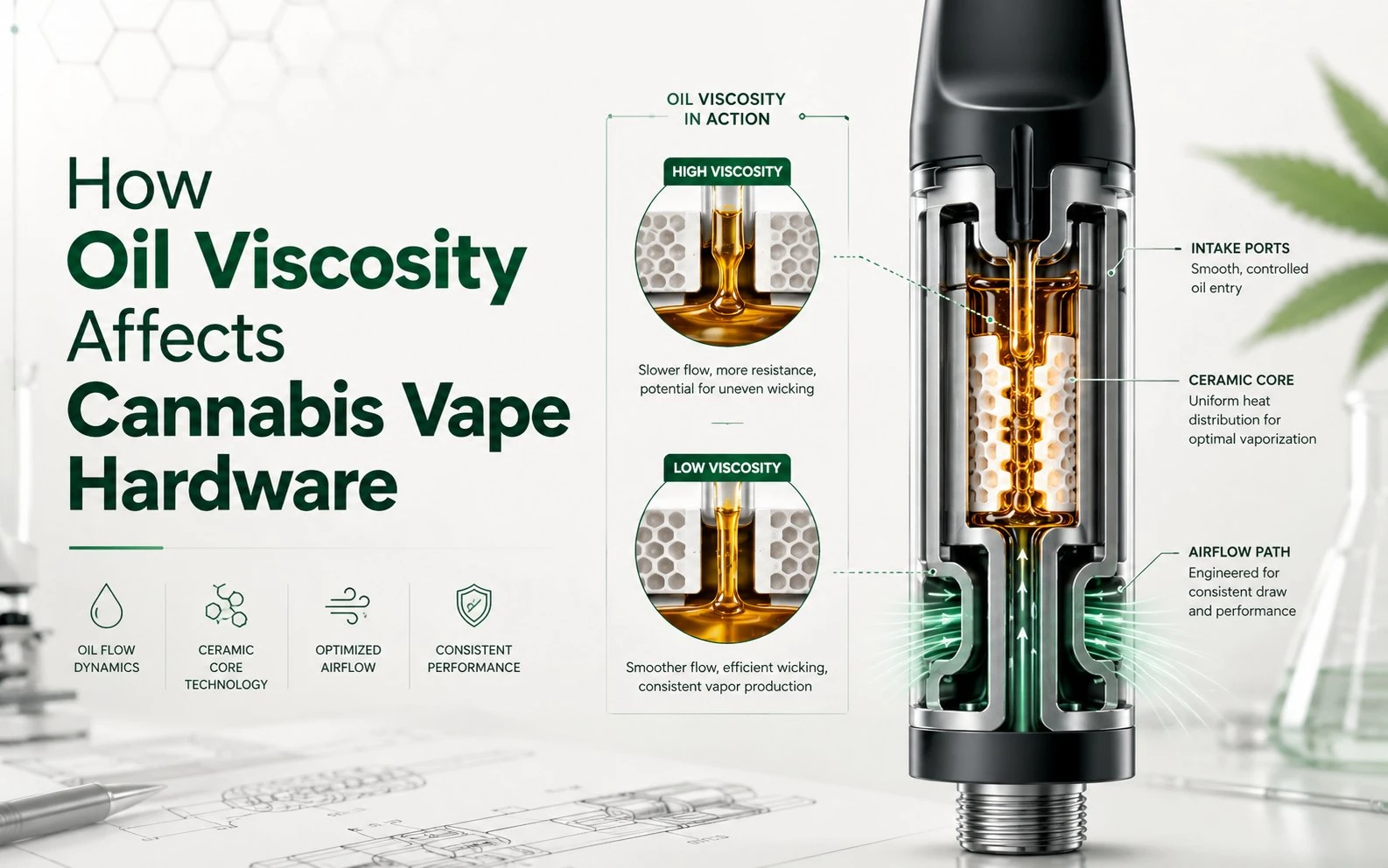
Cannabis oil viscosity directly affects how oil moves through a vape device, reaches the ceramic heating area, and turns into vapor. When oil flows too slowly, the heater can outrun the supply and produce weak vapor or burnt taste. When it flows too quickly, the heating chamber can flood and leak.
Good cannabis vape hardware therefore does more than heat oil. Its intake geometry, ceramic structure, airflow, resistance, and power output must work together around the behavior of the actual formulation.
What Is Cannabis Oil Viscosity-and Why Does It Matter for Vape Hardware?
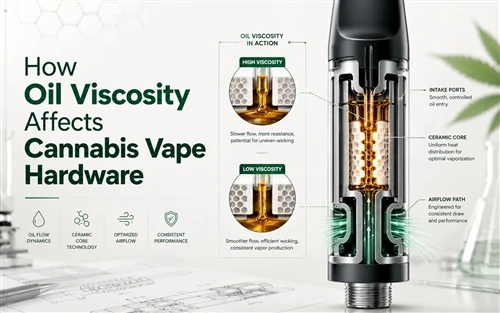
Viscosity is a fluid's resistance to flow. A high-viscosity cannabis oil moves more slowly, while a lower-viscosity formulation flows more easily.
For vape hardware, that difference matters because oil must travel from the reservoir through the intake system and into the porous heating structure before it can be vaporized.
Viscosity therefore affects much more than whether an oil looks "thick." It influences:
- oil feeding and wicking speed
- ceramic saturation
- first-puff performance
- vapor consistency
- clogging and flooding risk
- heating requirements
- leakage risk
Oil type alone does not define viscosity. Two live resin formulations can behave differently because their terpene content, cannabinoid concentration, processing method, and formulation are different. The same principle applies when selecting vape hardware for distillate oil or hardware for live rosin.
For cannabis vape hardware selection, viscosity is best treated as an engineering input, not simply a formulation characteristic.
How Viscosity Changes Oil Flow, Wicking, and Vaporization
A vape device needs a controlled supply of oil at the heating surface.
The basic process is:
Oil viscosity → intake flow → ceramic wicking → ceramic saturation → heating → vaporization
The intake openings first control how easily oil can leave the reservoir. The porous ceramic structure then draws that oil toward the heating surface through capillary action. Once heated, part of the supplied oil is converted into aerosol and must be replaced.
This creates one of the most important relationships in cannabis vape hardware:
Oil replenishment rate vs. vaporization demand
When both stay reasonably balanced, the ceramic remains properly saturated and vapor production stays consistent.
If the heater vaporizes oil faster than the hardware can replenish it, the heating area becomes under-supplied. If oil enters faster than the heater can process it, the system becomes oversaturated.
This is why simply increasing intake size, ceramic porosity, or voltage is not a complete solution. Each change affects the balance of the entire oil path and heating system.
The goal is controlled oil flow, not maximum oil flow.
What Happens When Cannabis Oil Is Too Thick or Too Thin?
High- and low-viscosity oils tend to create opposite hardware problems.
High-Viscosity Oil: Slow Wicking and Under-Saturation
High-viscosity cannabis oil moves through small intake passages and porous structures more slowly. If the ceramic cannot replenish the heating area quickly enough, repeated heating can leave parts of the atomizer temporarily under-saturated.
Common symptoms include:
- weak or inconsistent vapor
- delayed first-puff performance
- dry or harsh hits
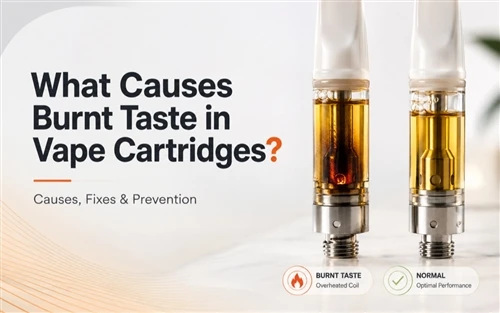
- burnt taste
- residue accumulation
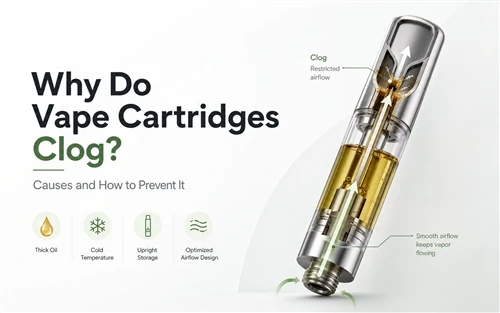
- increased clogging risk in some designs
This problem can become more obvious after the device has been sitting for a long time or exposed to low temperatures. Rosin formulations can be especially sensitive to oil-flow and residue issues, which is why understanding why live rosin vapes clog requires looking beyond the airpath alone.
The oil itself is not simply "too thick to vape." The problem is that its flow behavior does not match the feeding and heating rate of that specific hardware.
Preheat can help in some cold-start or high-viscosity applications because warming temporarily reduces local viscosity and improves oil movement. It is an adjustment tool, not a substitute for correct intake and ceramic design.
Low-Viscosity Oil: Flooding and Leakage
Low-viscosity formulations present the opposite problem. Oil can move through the intake system faster than the ceramic and heater can control it.
Excessive feeding may lead to:
- ceramic oversaturation
- chamber flooding
- gurgling
- spitback
- oil entering the airflow path
- cannabis vape leakage
Lower viscosity does not automatically make an oil easier to use. A cartridge optimized for thick distillate may feed a thinner, terpene-rich formulation too aggressively.
The correct hardware sits between these two failure conditions: enough oil supply to prevent dry heating, but enough flow control to prevent flooding.
Which Vape Hardware Parameters Must Be Matched to Oil Viscosity?
Viscosity should never be matched to one specification in isolation. Intake geometry, ceramic properties, heating output, and airflow operate as one system.
Oil Intake Size and Geometry
More viscous oils generally require higher oil-flow capacity. Lower-viscosity formulations usually need tighter control.
The following figures can be useful as engineering reference points rather than universal specifications:
|
Oil-flow profile |
Example intake diameter |
Main design concern |
|
Lower viscosity |
1.0–1.4 mm |
Control flooding and leakage |
|
Mid-range |
1.4–2.0 mm |
Balance feeding and vaporization |
|
Very thick oil |
2.0 mm+ in some designs |
Maintain sufficient oil supply |
Diameter is only one variable. Hole count, shape, position, ceramic permeability, reservoir structure, and operating temperature can change the result significantly.
A 2.0 mm intake in one atomizer does not necessarily perform like a 2.0 mm intake in another. For this reason, a disposable vape designed for thick oil should be evaluated as a complete oil-flow system rather than judged by intake diameter alone.
Ceramic Porosity and Heating Surface
Calling a product "ceramic" tells you very little about its actual oil compatibility.
Ceramic heating structures differ in:
- pore size and distribution
- overall porosity
- density
- permeability
- heating surface area
- oil contact area
- heat distribution
A more open ceramic structure may improve feeding for some high-viscosity oils. A tighter structure can help control faster-flowing formulations.
This is also why comparing ceramic vs. cotton coils for thick cannabis oil involves more than simply choosing one material over another. The way the structure feeds oil and transfers heat is what ultimately matters.
The best ceramic core is not the one with the highest porosity. It is the one that can replenish oil at a rate compatible with the heater.
Voltage, Resistance, and Heating Output
A common mistake is to assume that thicker oil always requires higher voltage.
It does not.
If a thick oil is already feeding too slowly, increasing heater output can make the imbalance worse. The heating surface consumes oil faster while the ceramic is still struggling to replenish it, increasing the risk of dry heating and burnt flavor.
Oil feeding should be stable before power is increased.
Typical voltage ranges sometimes used as starting references include:
|
Extract type |
Illustrative voltage range |
|
Distillate |
2.8–3.4 V |
|
Live resin |
2.4–3.0 V |
|
Live rosin / solventless |
2.2–2.8 V |
|
High-terpene blends |
2.2–2.7 V |
These are not universal settings. Resistance, ceramic design, heater surface area, airflow, and the actual formulation all affect the correct operating range. For a deeper look at the electrical side, see how resistance affects cannabis vape hardware.
An adjustable-voltage AIO disposable can provide a wider tuning window during hardware evaluation, but variable voltage still cannot correct poor oil feeding.
Airflow and Preheat
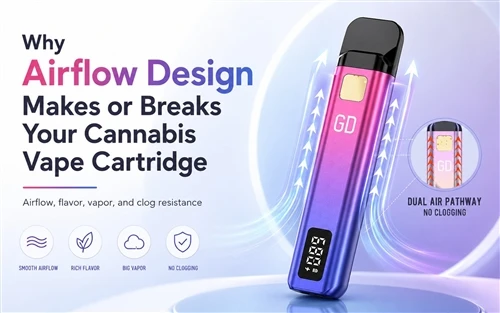
Airflow affects draw resistance, pressure balance, vapor transport, and condensation. It should be validated together with the oil path rather than treated as a separate cosmetic feature.
Preheat and variable voltage can widen the usable operating window, especially for cold or viscous oils. Neither can compensate for fundamentally mismatched oil-flow architecture.
Why Temperature and Formulation Changes Matter
Cannabis oil viscosity is temperature-dependent.
As temperature falls, viscosity generally rises and oil moves more slowly. As temperature increases, the same formulation becomes more fluid.
That means a cartridge that works well during a room-temperature bench test can behave differently after cold transportation, winter storage, or extended time in a warm environment.
A viscosity number without its measurement temperature is incomplete.
Formulation also matters. The following ranges illustrate how widely cannabis oils may vary at room temperature:
|
Formulation |
Reference viscosity range |
|
Pure THC distillate without terpenes |
50,000–200,000 cP |
|
Distillate with reintroduced terpenes |
5,000–30,000 cP |
|
Live resin / live rosin |
2,000–25,000 cP |
|
CO₂ oil |
30,000–100,000 cP |
|
Lower-viscosity / thinned formulations |
1,000–5,000 cP |
These ranges should be treated as reference points. Actual cannabis oil viscosity varies with terpene concentration, cannabinoid profile, processing, storage condition, temperature, and measurement method.
This is also why "distillate hardware" or "live resin hardware" should not be treated as precise engineering specifications. Extract type narrows the field; the actual formulation determines compatibility.
How Should Cannabis Brands Measure and Match Oil Viscosity?
Visual inspection is not a reliable viscosity test.
For more controlled product development, viscosity can be measured with equipment such as a cone-and-plate viscometer or a rotational viscometer, including common Brookfield-type instruments. Samples should be measured under documented temperature conditions so results can be compared across batches.
Hardware selection can then follow a practical sequence:
- Characterize the actual formulation. Record extract type, terpene content, cannabinoid profile, and other relevant formulation changes.
- Measure or evaluate viscosity under relevant temperature conditions.
- Select intake and ceramic structures that can maintain controlled oil feeding.
- Confirm stable saturation before tuning voltage, resistance, or preheat behavior.
- Validate airflow and final vapor performance in the complete device.
This order matters. Choosing an attractive cartridge first and trying to force the oil to work afterward creates avoidable development problems.
Oil type can guide the initial hardware shortlist. Actual oil behavior should determine the final configuration.
Why Real-Oil Hardware Validation Matters Before Mass Production
A successful fresh-fill test does not prove that a cannabis vape will perform consistently in real retail use.
Compatibility should be tested with the actual production formulation in the actual cartridge, disposable, or pod platform being considered.
Useful validation points include:
- filling behavior
- cold-start and first-puff performance
- repeated-puff consistency
- clogging
- leakage
- vapor output
- flavor consistency
- vertical and inverted storage
- temperature variation
- aging and shelf-life performance
Temperature cycling, such as testing across approximately 5°C to 40°C, can expose behavior that never appears during a single room-temperature test.
Formulation changes also deserve attention. A new terpene profile, cannabinoid ratio, extraction process, or raw-material batch can alter viscosity enough to change hardware performance.
Revalidation is especially important before large production runs. Hardware that performs well only during an initial bench test has not yet demonstrated reliable oil-hardware compatibility.
FAQs About Cannabis Oil Viscosity and Vape Hardware
Does thicker cannabis oil need larger intake holes?
Often, but not automatically. More viscous oils generally benefit from greater oil-flow capacity, which can include larger or additional intake openings. Ceramic permeability, intake position, temperature, and heating rate must also be considered.
Can high-viscosity oil cause vape clogging?
Yes, viscosity mismatch can contribute to clogging. Slow feeding and incomplete vaporization may encourage residue buildup, while low temperature can make the problem worse. Condensation, airflow design, and internal geometry can also contribute.
Can low-viscosity cannabis oil cause leaking?
Yes. If oil enters the ceramic and heating chamber faster than the device can control it, flooding and leakage risk increase. Seal design and manufacturing tolerances still matter, so viscosity is a risk factor rather than the only cause.
Is higher voltage better for thicker cannabis oil?
No. Higher voltage increases heating demand. If the ceramic cannot replenish thick oil quickly enough, extra power can increase dry heating and burnt taste instead of improving vapor output.
Does temperature change cannabis oil viscosity?
Yes. Cannabis oils generally become more viscous when cold and more fluid when warm. Hardware compatibility should therefore be evaluated under realistic storage and use temperatures.
Should vape hardware be selected by oil type or measured viscosity?
Oil type is a useful starting point, but it is not enough. Final hardware selection should consider the actual formulation, viscosity and flow behavior, ceramic and intake architecture, heating configuration, and performance testing.
Final Thoughts
Oil viscosity affects cannabis vape hardware because it controls how quickly oil can travel through the intake system and replenish the heating area. When oil feeds too slowly, weak vapor and dry heating become more likely. When it feeds too quickly, flooding and leakage can follow.
Reliable performance comes from balancing oil flow, ceramic wicking, and vaporization demand. Larger intake holes or higher voltage alone cannot create that balance.
ASM VAPE develops oil-matched cannabis vape hardware around the formulation itself, with ceramic, intake, airflow, voltage, resistance, and device structure adjusted for the intended oil and performance target. For a new distillate, live resin, live rosin, or other cannabis oil project, contact us to discuss hardware matching, testing, and customization before mass production.