The same cannabis oil can taste clean in one cartridge and harsh in another. It can produce rich vapor in one disposable and weak first puffs in another. The difference is rarely random - it usually comes from how the hardware controls heat, delivers oil, manages airflow, and stabilizes power.
Good hardware does not improve poor oil. But it protects a well-made formulation and lets it perform the way it was designed. For cannabis brands, that protection is the difference between a product that earns repeat purchases and one that absorbs returns.
This guide breaks down the hardware factors that shape flavor and vapor quality - and what brands should evaluate before mass production.
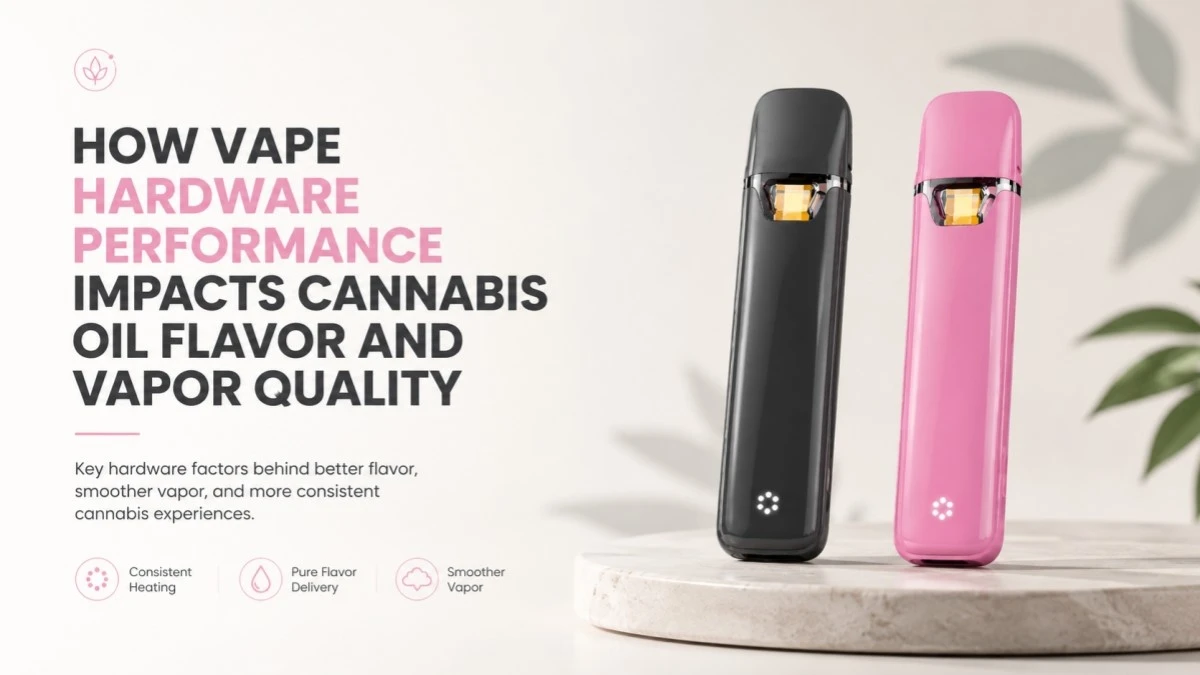
Why Hardware Determines the Final Vape Experience
Vape hardware performance is how well a device controls heat, oil delivery, airflow, power, and material contact during vaporization. In cannabis vape products, this is more complex than simply heating liquid until vapor appears.
Cannabis oil varies widely. Live resin and live rosin are flavor-sensitive. High-viscosity extracts need stable wicking. Thinner oils need better leakage control. Full-spectrum oils need controlled heat to protect terpenes.
A cannabis vape device has to do several things simultaneously:
- Deliver oil to the heating area at the right speed
- Heat the oil evenly without dry burning
- Maintain stable voltage across repeated puffs
- Control airflow without creating harshness or clogging
- Avoid unwanted flavor from poor material contact
If one of these fails, the user does not blame the coil or the voltage curve. They blame the product - and the brand behind it.
Heating Performance: The First Factor in Flavor Preservation
Cannabis oil should be vaporized, not cooked. When the heating area runs too hot, delicate terpenes degrade and flavor turns bitter or flat. When it runs too weak, vapor feels thin and first puffs disappoint. The goal is not maximum heat - it is controlled, repeatable heat.
Low-Voltage Vaping for Live Resin and Live Rosin
Live resin and live rosin are chosen because they retain more of the plant's original aroma. That also makes them less forgiving of high temperatures.
For terpene-rich oils, brands often evaluate flavor-focused hardware around 2.2V–3.0V, depending on coil resistance, viscosity, and target vapor volume. Lower voltage helps preserve flavor - but only when the hardware is designed for it. If the coil area is too small, low voltage produces weak vapor. If battery output is unstable, the first puff and the fifth puff feel different.
Low-voltage vaping works best when coil, ceramic structure, oil inlet, and battery output are engineered as one system.
Hot Spots and Burnt Taste
A hot spot is a localized area of excessive heat on the heating element. In cannabis vape hardware, hot spots are one of the main causes of burnt taste.
This is why ceramic heating elements dominate premium cannabis cartridges. A well-designed ceramic coil distributes heat more evenly than most basic metal coils, reducing direct overheating and protecting flavor-sensitive oils. Metal coils heat fast and can push strong vapor, but they carry a higher risk of uneven heating, metallic aftertaste, or terpene damage when the power curve is not well controlled.
The best heating system is not the one that heats fastest. It is the one that heats evenly, repeatedly, and safely across the full life of the oil.
Coil and Atomizer Design: Where Flavor Is Won or Lost
The atomizer turns cannabis oil into vapor. It includes the heating element, ceramic or wicking structure, oil inlets, and the airflow path around the heating zone. This is where flavor quality is built - or broken.
Ceramic vs. Metal Coils
|
Coil Type |
Main Advantage |
Main Risk |
Best-Fit Use Case |
|
Ceramic coil |
Even heating, cleaner flavor, heat stability |
Poor ceramic slows wicking or weakens output |
Live resin, live rosin, premium distillate, full-spectrum oils |
|
Metal coil |
Fast heating, strong vapor potential |
Higher risk of hot spots, metallic taste, scorching |
Cloud-focused devices, less flavor-sensitive oils |
|
Full ceramic structure |
Reduced metal contact, better flavor purity |
Requires precise ceramic engineering |
Premium cannabis cartridges |
For flavor-focused brands, ceramic is usually the safer direction. But "ceramic" alone is not enough - pore structure, heating path, oil contact area, and density all affect the result. A low-quality ceramic coil can still underperform.
Heating Surface Area and First-Puff Vapor
First-puff vapor is the vapor produced on the first draw after the device has been idle. Users judge product quality from this puff alone, which makes it disproportionately important.
Live rosin and live resin work better at lower voltage, but lower voltage can shrink vapor output if the heating area is too small. The practical fix is increasing the effective oil-contact area inside the atomizer - more oil vaporizes at a controlled temperature.
That does not mean making the heating core arbitrarily larger. A bigger heating area also requires matching oil supply, battery support, airflow balance, and thermal control. Otherwise, it creates condensation, oil waste, or uneven vaporization. The goal is balance: enough surface to produce satisfying vapor at low power, without overheating the oil.
Wicking, Aperture Size, and Oil Viscosity
Wicking is how oil moves from the tank into the heating area. Aperture size refers to the oil inlet openings that feed the atomizer. This is one of the most common reasons good oil performs badly in the wrong cartridge.
|
Oil Type |
Hardware Challenge |
Hardware Requirement |
|
Distillate |
Moderate-to-high viscosity, broad formulation range |
Stable wicking, balanced voltage, leak-resistant tank |
|
Live resin |
Flavor sensitivity, terpene preservation |
Low-temperature heating, ceramic coil, controlled airflow |
|
Live rosin |
High viscosity, flavor sensitivity, cold-start difficulty |
Strong wicking, preheat option, stable low-voltage output |
|
Liquid diamonds / high-viscosity oils |
Slow flow, dry burn risk |
Larger oil inlets, strong ceramic absorption, careful priming |
Thick oils starve the coil if inlets are too small - burnt taste and early failure follow. Thin oils leak if the seal structure is weak. Oil and hardware must be tested together; a cartridge that works for distillate may not work for live rosin.
Voltage, Resistance, and Battery Output Stability
Voltage is the electrical pressure supplied by the battery. Resistance, measured in ohms, controls current flow through the heating element. Together they shape vapor density and flavor intensity. The real question is not "high voltage vs. low voltage" - it is whether voltage, resistance, and oil type match each other.
Voltage Range and Flavor Balance
|
Voltage Direction |
Likely Result |
Main Risk |
|
Lower voltage |
Cleaner flavor, smoother vapor, better terpene preservation |
Weak vapor if coil area or wicking is insufficient |
|
Higher voltage |
Denser vapor, stronger hit, faster vaporization |
Burnt taste, terpene loss, harshness |
|
Adjustable voltage |
Flexibility across different oils |
Requires clear user guidance and stable battery control |
For live resin and live rosin, flavor-focused brands usually avoid aggressive high-voltage settings. For heavier distillate products, slightly higher output may be acceptable if coil and airflow can handle it.
Resistance and Vapor Density
Higher resistance atomizers (around 1.2Ω–2.0Ω in many cannabis applications) often support lower-power, flavor-focused vapor. Lower resistance can push stronger vapor but demands more careful thermal control.
Resistance should not be selected in isolation. A 1.4Ω ceramic coil can perform very differently depending on ceramic structure, voltage curve, oil inlet size, and airflow. This is why serious hardware evaluation tests the complete device - not just the spec sheet.
Why Stable Output Matters
Battery output stability means the device delivers predictable power as battery level drops, ambient temperature changes, or the user takes repeated puffs.
This matters most in cold environments. Cannabis oil thickens, the first puff may produce little vapor, and an unstable battery makes it worse. A well-designed cannabis vape battery should hold stable output, support preheating where needed, and avoid sudden power drops that change flavor from puff to puff.
Airflow Design and Draw Experience
Airflow controls how air moves through the device, across the heating zone, and into the mouthpiece. It affects draw resistance, vapor density, cooling, condensation, and clogging. A device can have an excellent coil and still deliver a poor experience if airflow is wrong.
Restricted vs. Smooth Draw
Restricted airflow creates a tighter draw and denser vapor - some users prefer this concentrated feel. But too much restriction makes vapor hot, harsh, or hard to pull. Open airflow feels smoother but can dilute vapor and weaken flavor intensity.
The right balance depends on product positioning. A premium live resin vape needs smooth, flavor-forward airflow. A high-vapor disposable may need a different balance entirely.
Condensation and Clogging
Clogging happens when vapor cools and condenses inside the mouthpiece or air path. Thick oils, cold storage, narrow channels, and heavy repeated draws all increase the risk.
Poor airflow design typically shows up as:
- Tight draw after storage
- Oil spit-back
- Condensation buildup
- Weak vapor despite adequate battery power
- Inconsistent draw between units
Brands should test airflow beyond a few sample puffs - after storage, after repeated use, and across different temperatures.
Material Compatibility and Oil Purity
Material compatibility refers to how well hardware materials resist interaction with cannabis oil. Contact surfaces include the tank, center post, mouthpiece, seals, and atomizer housing. Cannabis oil - especially terpene-rich formulations - can be chemically active, and poor material selection affects flavor, appearance, and consumer trust.
|
Material |
Strength |
Risk |
|
Glass |
Clean flavor, strong oil compatibility, premium feel |
Breakage risk |
|
Ceramic |
Inert surface, heat stability, no metallic taste |
Requires precise manufacturing quality |
|
PCTG |
Lightweight, impact-resistant, design flexibility |
Must be tested for oil compatibility |
|
Metal |
Structural strength, durability |
Poor alloys may affect taste or raise contamination concerns |
For premium cartridges, ceramic and glass are preferred where flavor purity is the priority. PCTG works well for disposables when sourced and tested properly - impact resistance and design flexibility matter there.
A metallic taste is not just a sensory complaint. It signals that the material experience is not clean enough for a flavor-sensitive cannabis product. Brands should evaluate every oil-contact component - mouthpiece, center post, seals, atomizer structure - not just the tank.
Hardware should preserve oil character, not add its own.
Matching Hardware to Different Oil Types
Treating all oils the same is one of the fastest ways to create product complaints.
Distillate is more forgiving than live extracts but still needs stable wicking, proper voltage, and leak-resistant construction. Brands typically focus on vapor volume, cost control, reliability, and broad formulation compatibility.
Live resin is terpene-forward, and its value depends on aroma expression. Prioritize lower-temperature atomization, ceramic heating, stable voltage, smooth airflow, and minimal material taste. A harsh live resin vape defeats the purpose of the formulation.
Live rosin is thicker and more heat-sensitive. It often requires stronger wicking, preheat functionality, and careful low-voltage output. Cold-start performance is especially important - if the first puff disappoints, users assume the oil is weak or the device is defective.
High-viscosity oils and liquid diamonds need robust oil delivery. Small apertures, slow ceramic absorption, or weak preheating cause dry hits. Test under realistic conditions: after filling, after storage, after temperature changes, and after repeated puff cycles.
Cold-Start Performance and Activation
Cold-start performance is how well a device performs after sitting unused, especially in cooler environments. It affects first-puff vapor, oil flow, and user satisfaction.
|
Activation Type |
Advantage |
Limitation |
|
Draw activated |
Simple, intuitive, no button |
First puff may be weak with thick or cold oil |
|
Button activated |
Enables preheat, more control |
Slightly less simple for casual users |
|
Draw + preheat |
Balanced user experience |
Requires careful product design |
Draw activation feels clean and simple - which is why most disposables use it. Button activation enables preheating, which makes a clear difference for thicker oils. Preheating gently warms the oil before the main draw, restoring flow in cold conditions. But preheat must be controlled: too much wastes oil and damages flavor. Good preheat prepares the oil. It should not cook it.
Common Flavor and Vapor Problems Caused by Poor Hardware
Many product complaints are hardware symptoms. The oil may be fine - the device just fails to deliver it correctly.
- Burnt or harsh taste: excessive voltage, hot spots, poor wicking, dry burning, low-quality heating elements
- Weak first puff or thin vapor: low heating surface area, weak battery output, cold oil, poor preheat design, insufficient oil delivery
- Clogging and tight draw: condensation, narrow airflow paths, thick oil, cold storage, poor mouthpiece design
- Leaking and oil waste: seal structure, viscosity mismatch, filling process issues, temperature change, poor internal pressure control
A good cannabis vape hardware supplier should discuss these problems before mass production - not only after complaints appear.
How Brands Should Evaluate Hardware Before Production
Sample testing has to go beyond confirming the device works. Brands need to verify the device protects flavor and delivers stable vapor across the full product life cycle.
Flavor consistency testing. Compare first-puff flavor to later puff stages. Watch for burnt notes, metallic taste, muted terpene profile, and flavor drift after storage.
First-puff and cold-start testing. Test after devices have rested several hours or overnight. Retest in cooler conditions if the target market includes cold regions. First-puff impressions shape user confidence immediately.
Oil compatibility and leak testing. Fill the actual production oil, not a generic test liquid. Evaluate leakage, bubble movement, dry hits, clogging, and vapor output across multiple units.
Voltage stability and batch consistency. Test battery output at full, mid, and low charge. Then compare results across production batches. For B2B brands, consistency across thousands of units is often more valuable than one impressive prototype.
Advanced Features That Support the Oil Experience
Advanced features should support the oil - not exist for appearance.
Adjustable voltage and screen displays help users match vapor strength to oil type. A display can show battery level, voltage mode, or puff count, which reduces uncertainty and supports more informed consumption.
Dual-chamber designs allow two oils or flavors in one device. Users can switch profiles or blend them depending on the design. Not necessary for every brand - but for premium lines built around flavor variety, it creates a stronger product story.
Why Hardware Performance Is a Brand Decision
Poor vape hardware creates more than technical problems. It creates business problems: customer complaints, retailer friction, returns, negative reviews, and lower repeat purchase. The brand absorbs the damage, not the hardware supplier.
High-performance cannabis vape hardware protects three things brands cannot afford to lose:
- The flavor profile they invested in developing
- The user experience promised on the package
- The trust required for repeat sales
For premium cannabis brands, hardware is not a cost line item. It is part of product quality control.
FAQ
Does a ceramic coil improve cannabis oil flavor?
A well-designed ceramic coil improves flavor by heating more evenly and reducing metallic taste. It is especially useful for terpene-rich oils like live resin and live rosin. But ceramic quality varies widely - not every ceramic coil performs the same.
Why does the same oil taste different in different cartridges?
Each cartridge controls heat, airflow, wicking, and material contact differently. If one cartridge overheats the oil or uses poor contact materials, the same formulation can taste harsh, muted, or contaminated.
What voltage is best for live resin or live rosin?
Many live extracts perform better at lower voltage because lower heat preserves terpenes. A common flavor-focused testing range is 2.2V–3.0V, but the right setting depends on coil resistance, viscosity, and device design.
How does oil viscosity affect vapor quality?
Viscosity controls how quickly oil reaches the heating element. If the oil is too thick for the cartridge structure, the coil runs dry and burns. If too thin for the seal design, leakage risk increases.
How should brands test hardware before mass production?
Test flavor consistency, first-puff vapor, cold-start performance, leakage, clogging, voltage stability, and batch consistency - using the actual production oil. Testing only with generic oil hides problems that surface later.

Conclusion
Vape hardware performance shapes cannabis oil flavor and vapor quality through heating control, atomizer design, wicking, airflow, battery stability, activation method, and material compatibility. When these match the oil, flavor stays clean, vapor stays smooth, and the product performs consistently across batches.
ASM VAPE manufactures cannabis vape hardware for brands in legal markets including the United States and Germany. If your brand is developing or upgrading cartridges, disposables, or custom vape hardware, contact ASM VAPE to discuss samples, oil compatibility, and hardware solutions built around your formulation.
![How to Choose Vape Hardware for Delta 9 Oil [2026 Guide]](/uploads/43868/info/n20260923113103fe52e.jpg)