A 510 thread battery that suddenly stops working can be frustrating, but the battery itself is not always the problem.
A cartridge that does not fire, produces weak vapor, or causes the battery light to blink can be affected by several parts of the system: the battery charge, the 510 connection, the cartridge, airflow, voltage settings, or even the viscosity of the cannabis oil.
That is why effective 510 thread battery troubleshooting should start by identifying the symptom before replacing the battery. If you are working with interchangeable cannabis vape hardware, it also helps to understand how 510 batteries interact with different cartridges.
This guide explains the most common 510 battery problems, how to narrow down the cause, and when it is safer to stop troubleshooting and replace the device.
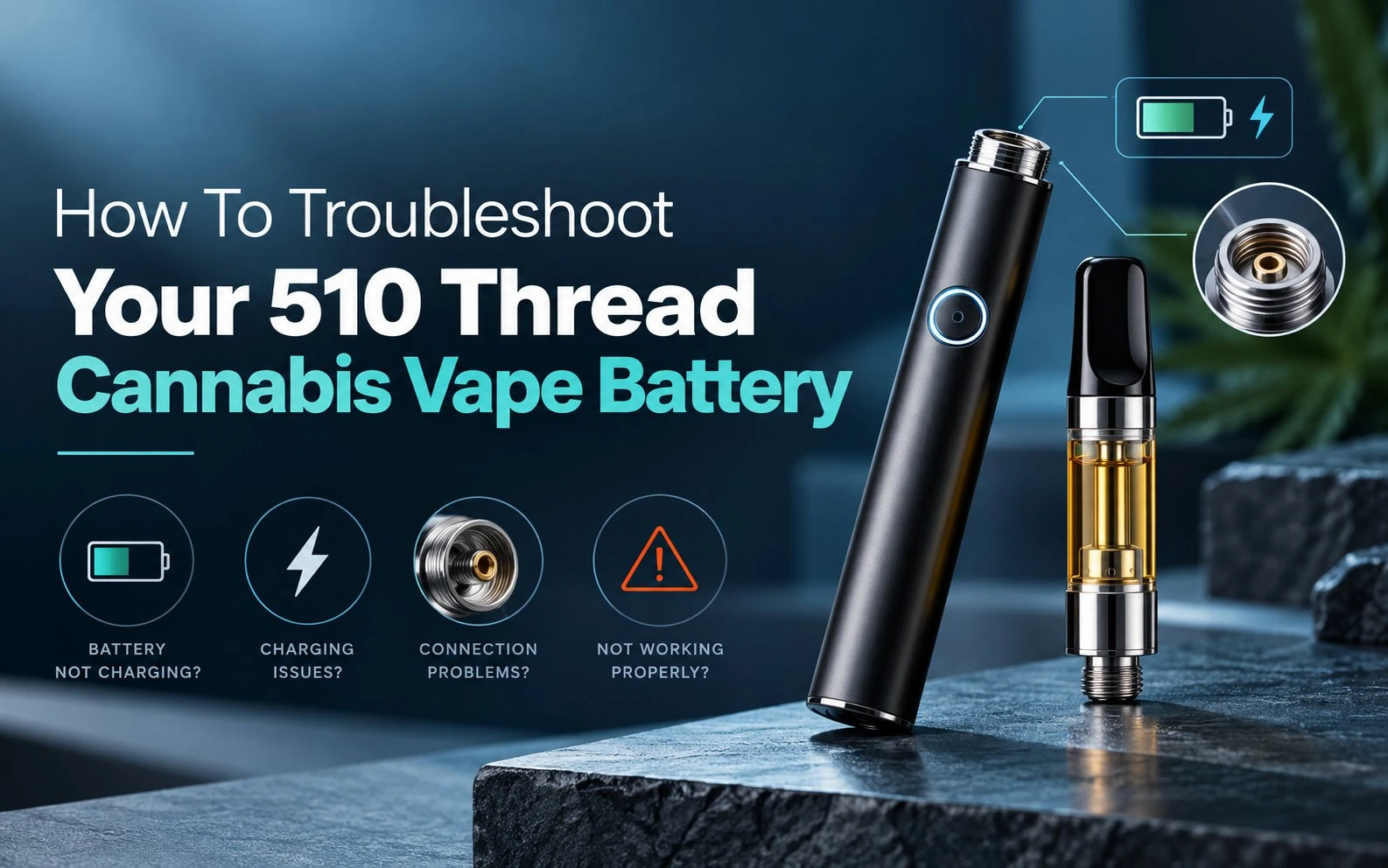
510 Thread Battery Troubleshooting: Quick Answer Guide
Start here if you want the fastest possible diagnosis.
|
Problem |
Possible Cause |
First Thing to Try |
|
510 battery will not turn on |
Low charge, power lock, internal fault |
Charge the battery and check the manufacturer's power-on instructions |
|
Battery blinks when cartridge is connected |
Connection issue, low charge, protection circuit |
Remove the cartridge, inspect the contacts, and reconnect it gently |
|
Battery light turns on but no vapor comes out |
Cartridge, contact, airflow, or atomizer problem |
Clean the connection and test another compatible cartridge |
|
510 battery will not charge |
Cable, port, connector, charger, or battery fault |
Try a known-good compatible charging setup |
|
Vapor is weak |
Low charge, poor contact, clogging, voltage mismatch, oil viscosity |
Recharge, inspect the cartridge, and check voltage settings |
|
Auto-draw battery will not activate |
Restricted airflow, condensation, cartridge issue, sensor problem |
Check airflow openings and test the cartridge on another battery |
|
Cartridge works on another battery |
Battery or connection problem |
Inspect the original battery's connector and contacts |
|
Other cartridges work on the same battery |
Cartridge problem |
Inspect or replace the original cartridge |
The important point is that a "510 battery problem" is often a battery-cartridge connection problem rather than a failed battery cell.
Is the Problem the Battery or the Cartridge?
Before trying more complicated fixes, determine which component is actually causing the problem.
A simple cross-test can save a lot of time.
Suppose:
Battery A + Cartridge A = Not working
Try connecting a known-good compatible cartridge:
Battery A + Cartridge B
If Cartridge B works normally, Battery A is probably functioning and Cartridge A is the more likely problem.
You can also test Cartridge A on another known-good compatible battery:
Battery B + Cartridge A
If Cartridge A still does not work, the problem is likely inside the cartridge rather than the original battery.
This type of cross-testing is especially useful when:
- the battery lights up but produces no vapor;
- the battery blinks only with one cartridge;
- one cartridge produces much weaker vapor than others;
- a cartridge suddenly stops working after previously working normally.
If multiple cartridges fail on the same battery, then the battery, connector, or power system deserves closer inspection.
For brands or operators choosing interchangeable components, our guide to 510 cannabis vape cartridge hardware explains the compatibility factors that should be evaluated before pairing batteries and cartridges.
Problem 1: 510 Battery Won't Turn On
If the battery shows no light and does not activate, start with the simplest possibilities.
Charge the Battery
A deeply discharged battery may not respond immediately when you try to use it.
Connect it using the charging method specified by the manufacturer and allow it time to charge.
If the charging indicator appears normally but the battery still does not activate afterward, continue troubleshooting.
Check the Power Lock
Many button-activated 510 batteries include a multi-click lock or power function.
Five clicks is common on many devices, but it is not a universal 510 standard.
Different manufacturers can use different button sequences, so check the instructions for your specific model before assuming the battery has failed.
Activation style itself can also affect troubleshooting. For a deeper comparison, see our guide to button vs inhale activation.
Inspect the Battery for Damage
Stop using the battery if you notice:
- swelling;
- cracks or deformation;
- unusual heat;
- liquid inside the battery housing;
- a burnt or unusual smell;
- damaged charging components.
A lithium-ion battery with visible physical damage should not be opened or repaired by the user.
Problem 2: Why Is My 510 Battery Blinking?
A blinking battery light usually means the battery has detected a condition that requires attention.
Possible reasons include:
- low battery charge;
- poor cartridge contact;
- short-circuit protection;
- incompatible cartridge resistance;
- draw-time protection;
- charging protection;
- an internal battery fault.
However, there is an important rule:
There is no universal blink-code standard for every 510 battery.
Three flashes on one device may indicate something completely different from three flashes on another device.
For that reason, avoid assuming that a specific number of flashes always means a specific fault.
Instead, troubleshoot in this order:
- Fully charge the battery.
- Remove the cartridge.
- Inspect and clean the connection.
- Reconnect the cartridge without overtightening it.
- Test another compatible cartridge.
- Check the manufacturer's manual for the exact LED indicator pattern.
If the battery continues blinking with several known-good cartridges, the battery itself may require replacement.
For users or brands that prefer clearer battery-status information, a 510 thread battery with digital display can make voltage and operating status easier to monitor.
Problem 3: Battery Light Is On but No Vapor Comes Out
This is one of the most confusing 510 battery problems because the battery appears to be working.
If the LED activates but no vapor is produced, check four areas.
1. Check the Electrical Contact
Oil residue, dust, or condensation can prevent proper electrical contact between the battery and cartridge.
Remove the cartridge and inspect both contact surfaces.
A dirty connection can allow the battery electronics to activate while preventing sufficient power from reaching the cartridge.
2. Try Another Cartridge
Cross-testing is one of the fastest ways to separate a battery problem from a cartridge problem.
If another compatible cartridge works, the original cartridge may have:
- a failed heating element;
- damaged electrical contacts;
- internal clogging;
- airflow restriction;
- another cartridge-specific fault.
3. Check Airflow
A cartridge can receive power but still produce little or no vapor if airflow is heavily restricted.
Inspect the cartridge's airflow openings and mouthpiece for visible blockage.
Airflow can have a major effect on vapor output, pressure balance, and draw resistance. Our guide to cannabis vape hardware airflow problems explains why restricted airflow can sometimes be mistaken for a battery failure.
4. Consider the Oil Condition
High-viscosity cannabis oil can become more difficult to wick and vaporize at lower temperatures.
If the cartridge has been stored in a cool environment, the first draw may sometimes produce less vapor because the oil is not moving toward the heating area efficiently.
This does not automatically mean the battery is defective.
Problem 4: 510 Battery Won't Charge
If your 510 battery will not charge, check the charging system before replacing the battery.
Inspect the Charging Connection
Depending on the battery design, charging may use USB-C, Micro-USB, or another charging system.
Inspect the charging area for:
- lint;
- dust;
- oil residue;
- physical damage;
- loose connections.
Avoid inserting metal objects into a charging port.
Try a Known-Good Compatible Cable or Charger
Charging cables can fail.
If your battery does not respond, test the charging setup using equipment that is known to work and is compatible with the battery manufacturer's specifications.
Do not assume that every USB power adapter or charger is appropriate simply because the connector fits.
Watch the Charging Indicator
Charging indicator behavior varies by manufacturer.
Some batteries change color, some pulse, and some turn the light off when fully charged.
If there is no charging response after you have ruled out the cable and power source, the battery's charging circuit or cell may have failed.
At that point, replacement is usually safer than attempting to open the battery.
Problem 5: 510 Battery Produces Weak Vapor
Weak vapor is not necessarily a battery failure.
Vapor production depends on the entire system:
Battery Output + Cartridge Resistance + Heating Element + Airflow + Oil Viscosity
That means simply increasing voltage is not always the correct solution.
Check the Battery Charge First
A low battery may deliver weaker performance or reach its protection threshold more quickly.
Fully recharge the battery before changing other variables.
Check the Cartridge Connection
Poor electrical contact can reduce the power delivered to the heating element.
Remove the cartridge, inspect the contact surfaces, and reconnect it gently.
Check for Cartridge Clogging
Thick cannabis oil, condensation, or oil inside the airflow path can restrict vapor production.
If airflow feels significantly tighter than usual, the cartridge may need attention.
For a more detailed explanation of the hardware factors involved, see our guide to weak vapor in cannabis vape hardware.
Adjust Voltage Carefully
If you are using a variable-voltage 510 battery, start with a lower setting and increase gradually only when necessary.
Higher voltage does not automatically mean better performance.
Too much power can produce:
- harsh vapor;
- excessive heat;
- burnt taste;
- faster oil degradation around the heating area.
If vapor is weak, voltage may be only one part of the problem.
Voltage, Resistance, and Cannabis Oil Compatibility
This is where 510 troubleshooting becomes more complicated than simply asking whether the battery has power.
A cartridge is an electrical and thermal system.
Its performance depends on the relationship between:
- battery voltage;
- cartridge resistance;
- ceramic heating structure;
- heating surface area;
- airflow;
- oil inlet design;
- oil viscosity;
- cannabis oil formulation.
For example, a setting that performs well with one cartridge may produce weak vapor or excessive heat with another.
The same is true for different oil types.
Distillate, live resin, live rosin, CBD formulations, and other cannabis oils do not necessarily behave the same way inside identical hardware.
This is why there is no single "best voltage" that applies to every 510 cannabis cartridge.
For a deeper explanation of how these electrical parameters interact, read our guide to vape voltage and resistance.
When possible, follow the cartridge manufacturer's recommended operating range.
Problem 6: Auto-Draw Battery Won't Activate
Inhale-activated 510 batteries rely on changes in airflow or pressure to trigger the battery.
If the cartridge works but the battery does not activate when you inhale, check the airflow system.
Common causes include:
|
Possible Cause |
What to Check |
|
Oil or condensation around airflow openings |
Inspect and gently clean accessible openings |
|
Cartridge installed too tightly |
Reinstall without overtightening |
|
Cartridge airflow restriction |
Test another compatible cartridge |
|
Cartridge works on button battery but not auto-draw battery |
Possible auto-draw activation issue |
|
Multiple cartridges fail to activate |
Battery sensor or internal hardware may be faulty |
Do not insert pins, needles, or other metal objects deep inside the battery body.
If the activation sensor itself has failed, the battery is generally not user-serviceable.
Problem 7: Cartridge Won't Connect Properly to the Battery
A 510 cartridge should make secure electrical contact without requiring excessive force.
If the cartridge only works when screwed down very tightly, something may be wrong with the connection.
Possible causes include:
- oil residue on the contacts;
- damaged threads;
- recessed or damaged battery contact;
- cartridge dimensional variation;
- overtightening damage.
Start by cleaning the accessible contact surfaces and reconnecting the cartridge gently.
Do not aggressively pry the battery's center contact upward with a screwdriver, tweezers, or another metal tool.
If several compatible cartridges cannot make reliable contact, replacing the battery is safer than attempting to modify the electrical connector.
For brands evaluating refillable or prefilled cartridge platforms, empty 510 vape cartridges provide a useful reference point for understanding the connection between cartridge structure and battery compatibility.
How to Clean a 510 Battery Connection Safely
A dirty connection is one of the easiest problems to fix.
Step 1: Remove the Cartridge
Disconnect the cartridge before cleaning.
Step 2: Inspect the Connection
Look for:
- cannabis oil residue;
- condensation;
- dust;
- lint;
- visible debris.
Step 3: Clean the Accessible Surface
Use a soft cotton swab or lint-free material.
If necessary, a small amount of isopropyl alcohol can help remove oily residue from accessible external contact surfaces.
Do not pour liquid into the battery.
Step 4: Let the Connection Dry Completely
Never reconnect or activate the battery while cleaning fluid remains present.
Step 5: Reinstall the Cartridge Gently
Tighten only until the cartridge is securely connected.
Overtightening can damage threads or compress the electrical contact.
How to Prevent 510 Battery Problems
A few simple habits can reduce connection and performance problems.
Keep the 510 Connection Clean
Oil inside the connector can interfere with both electrical contact and airflow.
Inspect the connection periodically, especially if you notice leaking from a cartridge.
Avoid Overtightening Cartridges
A cartridge only needs enough pressure to establish a stable connection.
More force does not mean better conductivity.
Protect the Battery From Extreme Heat
Do not leave a lithium-ion vape battery in a hot vehicle or expose it to other extreme-temperature environments.
Use the Charging Method Recommended by the Manufacturer
Different batteries can have different charging requirements.
Use compatible charging equipment rather than assuming all chargers are interchangeable.
Store Cartridges Carefully
Keeping a cartridge upright when practical can help reduce the chance of oil moving into the mouthpiece, airflow path, or battery connection.
Keep Oil Away From the Battery Housing
A leaking cartridge can introduce oil into electrical areas.
If a battery becomes heavily contaminated internally, replacement is safer than opening the device.
When Should You Replace a 510 Battery?
Troubleshooting is useful only when the device remains safe to use.
Stop using the battery if you notice:
|
Symptom |
Recommended Action |
|
Battery is swollen |
Stop using immediately |
|
Battery becomes unusually hot |
Stop using and allow it to cool in a safe location |
|
Housing is cracked or heavily damaged |
Replace |
|
Charging port is physically damaged |
Replace |
|
Burning smell or signs of internal overheating |
Stop using immediately |
|
Several known-good cartridges fail repeatedly |
Battery may need replacement |
|
Battery will no longer charge with a known-good compatible setup |
Replace or contact the manufacturer |
|
Operation becomes unpredictable |
Discontinue use |
Do not open, puncture, crush, or attempt to repair the lithium-ion cell.
Dispose of damaged batteries according to applicable local battery recycling or hazardous-waste requirements.
FAQ
Why is my 510 battery charged but not working?
If the battery appears fully charged but does not fire, check the power lock, cartridge connection, contact surfaces, and cartridge itself.
Testing another known-good cartridge is one of the fastest ways to determine whether the battery or cartridge is responsible.
Why does my 510 battery blink when I screw in the cartridge?
The battery may be detecting a poor connection, incompatible load, short-circuit condition, or another protection event.
Because LED codes vary by model, consult the battery manufacturer's manual for the exact meaning.
Why is my 510 battery light on but no vapor comes out?
The battery may be activating normally while the cartridge is not heating or airflow is blocked.
Clean the contact surfaces, inspect airflow, and test another compatible cartridge.
How do I know if my 510 battery or cartridge is bad?
Cross-test them.
Try the cartridge on another known-good compatible battery and try another known-good cartridge on the original battery.
The results usually show which component is causing the problem.
Can a clogged cartridge make a battery seem broken?
Yes.
A heavily restricted cartridge can produce little or no vapor even when the battery is functioning normally.
Should I increase voltage if vapor is weak?
Not immediately.
Weak vapor can also result from low battery charge, poor contact, airflow restriction, cartridge failure, or oil viscosity.
Check those conditions first, then adjust variable voltage gradually within the cartridge manufacturer's recommended range.
Why won't my auto-draw 510 battery activate?
Possible causes include restricted airflow, condensation, cartridge incompatibility, or a problem with the activation sensor.
Test another compatible cartridge before concluding that the battery has failed.
For Cannabis Brands: Repeated "Battery Problems" May Be a Hardware-Matching Problem
For an individual consumer, troubleshooting one battery is relatively straightforward.
For a cannabis brand receiving repeated complaints about:
- weak vapor;
- inconsistent output;
- burnt taste;
- clogging;
- poor airflow;
- cartridge connection;
- battery compatibility;
the problem may be larger than a single defective battery.
Reliable cannabis vape performance depends on matching the complete hardware system to the oil formulation.
At ASM VAPE, our hardware-development approach considers factors such as:
- cannabis oil type and viscosity;
- ceramic heating platform;
- cartridge structure;
- airflow design;
- oil intake;
- resistance;
- voltage;
- battery performance;
- activation method.
This type of oil-matched hardware development can help cannabis brands identify compatibility problems before full-scale production instead of discovering them through consumer returns.
ASM VAPE provides cannabis vape hardware solutions including 510 thread batteries, cartridges, all-in-one devices, POD systems, OEM/ODM customization, hardware testing, and oil-matching support for THC/CBD brands and partners in legal cannabis markets.
The Bottom Line
Most 510 thread battery problems can be narrowed down by checking five things:
Power → Connection → Cartridge → Airflow → Hardware Compatibility
Start with the simplest checks.
Charge the battery, inspect the contact surfaces, reconnect the cartridge without overtightening it, and cross-test with another compatible cartridge.
If the device shows physical damage, unusual heat, swelling, charging abnormalities, or persistent electrical faults, stop troubleshooting and replace the battery.
And if the same problems repeatedly appear across a cannabis product line, the issue may not be one battery at all.
It may be a sign that the cartridge, battery, oil formulation, heating system, and operating parameters need to be evaluated as one complete hardware system.
![How to Choose Vape Hardware for Delta 9 Oil [2026 Guide]](/uploads/43868/info/n20260923113103fe52e.jpg)