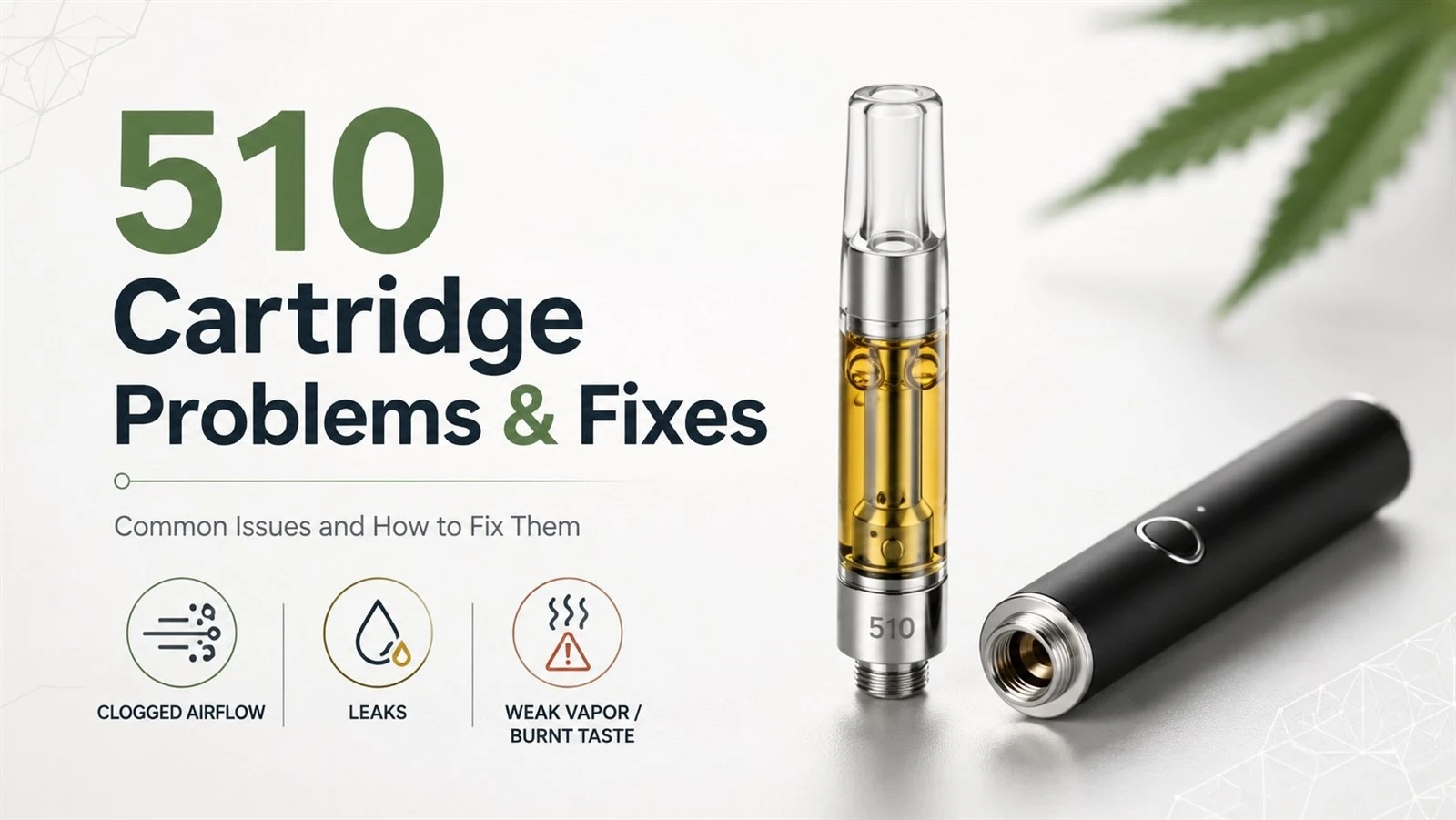
510 cartridges are widely used because they are compact, familiar, and compatible with many vape batteries. Still, a cartridge may clog, leak, produce weak vapor, taste burnt, or stop working altogether.
Most 510 cartridge problems come from four areas: airflow, oil feeding, electrical connection, or oil-hardware compatibility. The correct fix depends on identifying which part of the system is failing.
510 Cartridge Troubleshooting Guide
A 510 cartridge is a prefilled or refillable oil tank that connects to a compatible battery through a standardized threaded fitting. The thread makes connection easier across many devices, but it does not guarantee that every cartridge will perform correctly with every battery. For a broader format comparison, see vape pods vs. 510 thread cartridges.
Use the table below to identify the most likely cause of a problem before attempting more detailed troubleshooting.
| Symptom | Most Likely Causes | First Step |
|---|---|---|
| Cartridge does not produce vapor | Dead battery, dirty contact, clogged airway, damaged coil | Charge the battery and clean the 510 connection |
| Cartridge is hard to draw | Condensation, thick oil, blocked airway | Return the cartridge to room temperature and inspect the mouthpiece |
| Oil leaks from the mouthpiece | Flooded airway, strong draw pressure, heat exposure | Keep the cartridge upright and clean the mouthpiece |
| Oil leaks from the bottom | Seal failure, overfilling, heat, pressure change | Disconnect it from the battery and inspect the base |
| Vapor tastes burnt | High voltage, dry ceramic core, poor oil feeding | Lower the voltage and allow the core to resaturate |
| Vapor output is weak | Low battery, partial clog, low voltage, thick oil | Recharge the battery and test within the recommended voltage range |
| Battery blinks when connected | Low charge, short circuit, resistance issue, poor contact | Check the battery manual and test another cartridge |
Do not continue troubleshooting if the battery overheats, the cartridge is cracked, or the connection produces a burnt electrical smell.
Why Is My 510 Cartridge Not Hitting?
A cartridge that is "not hitting" does not produce normal vapor when the battery is activated. The cause may be electrical, mechanical, or related to airflow and oil delivery.
Start with the simplest checks before assuming the cartridge has failed.
Check the Battery and 510 Connection First
Make sure the battery is charged and turned on. Many button-operated batteries use five rapid clicks to switch on or off, but this is not a universal rule. Automatic-draw batteries may not have a power button at all.
If the battery light blinks, check the product manual. Blinking can indicate low power, a short circuit, overheating, excessive puff duration, poor contact, or an unsupported cartridge resistance. Flash patterns are not standardized across the industry.
Next, remove the cartridge and inspect the 510 thread and center contact. Oil residue, condensation, dust, and oxidation can interfere with electrical contact.
Clean only the external connection surfaces. A dry cotton swab or lint-free cloth is often enough. If oil residue is difficult to remove, use a very small amount of isopropyl alcohol on the swab. Keep liquid out of the battery and allow the connection to dry fully before reassembly.
Reinstall the cartridge until it feels secure.
Do not force it tighter.
Over-tightening can push the center contact down, damage the insulator, wear the threads, or create an intermittent connection.
Check for a Clogged Airway or Damaged Coil
If the battery appears normal, check whether air can move through the cartridge. A blocked mouthpiece or flooded center airway can make a working cartridge feel completely dead.
Bring the cartridge back to a stable room temperature if it has been stored in a cold environment. Thick cannabis oil moves slowly at low temperatures and may not reach the ceramic heating core fast enough.
Inspect the mouthpiece for visible condensation or oil. Draw gently rather than pulling harder. A forceful draw can create excessive negative pressure and pull more oil into the airway.
A simple cross-test can help isolate the problem:
- Test the cartridge on another known working, compatible battery.
- Test the original battery with another known working cartridge.
If the cartridge fails on multiple batteries, the problem is more likely inside the cartridge. A blocked airway, broken electrical path, damaged heating core, or severe oil crystallization may be responsible.
How to Fix a Clogged 510 Cartridge
A clogged cartridge does not always have a single blockage. The restriction may be in the mouthpiece, center airway, intake holes, or porous ceramic core.
The correct fix depends on where the restriction has formed.
Condensation or Oil in the Airway
Vapor cools as it travels through the cartridge. Some of it can condense inside the mouthpiece or center airway. Over time, this residue may create a sticky restriction.
Common signs include:
- A sudden increase in draw resistance
- Gurgling sounds
- Oil near the mouthpiece
- Small amounts of liquid entering the mouth
- Normal battery activation but very little airflow
Keep the cartridge upright and allow it to return to room temperature. Clean only the visible and accessible area around the mouthpiece. Avoid pushing pins, needles, or metal tools deep into the airway because they can damage the heating core, internal seals, or center post.
Use a slow, steady draw. Pulling harder usually makes flooding worse.
If the cartridge repeatedly floods after cleaning, the problem may involve oil viscosity, internal pressure, or the cartridge's airflow design rather than simple condensation.
Thick Oil or Slow Oil Feeding
Oil-feeding problems occur when oil does not move into the ceramic heating core quickly enough. This is common with high-viscosity distillates, cold oil, and some solventless or highly concentrated formulations.
Typical signs include:
- Weak vapor despite open airflow
- Better performance after the cartridge sits
- Dry or harsh flavor during repeated use
- Worse performance in cold conditions
- Oil that barely moves when the cartridge is tilted
Return the cartridge to normal room temperature. If the battery has a manufacturer-approved preheat function, use it briefly and gently. Preheat should reduce viscosity around the core, not cook the entire tank.
Take shorter draws and allow time between puffs. The ceramic core needs time to absorb more oil after each heating cycle.
Do not solve slow oil feeding by repeatedly using the highest voltage setting. Excess power may produce temporary vapor while damaging flavor, darkening the oil, and burning the core.
Crystallization or Coil Contamination
Some cannabinoid-rich formulations can separate or crystallize during storage. THCA-heavy oils are especially likely to form solids under certain conditions. These crystals may restrict intake holes or block pores inside the ceramic core.
Repeated high-temperature use can also create degraded oil residue on the heating surface. This contamination reduces oil absorption and causes uneven heating.
Mild temperature-related thickening may improve after gentle warming. Severe crystallization or carbon buildup usually will not.
If the cartridge remains restricted after returning to room temperature and testing on a compatible battery, replacement is often safer than repeated heating. A cartridge that clogs consistently may also indicate that the oil formulation and hardware were never properly matched.
Why Is My 510 Cartridge Leaking?
A leaking cartridge may release oil through the mouthpiece, center airway, bottom seal, or air-intake openings. The location of the leak helps identify the cause.
Leakage is often treated as a user problem, but repeated leakage across the same production batch usually points to hardware selection, filling, sealing, or material compatibility.
Leaking From the Mouthpiece or Center Airway
Oil at the mouthpiece does not always mean the tank is cracked. It may be condensed vapor or oil pulled into the center airway.
Common causes include:
- Strong, forceful draws
- Repeated use without cooling time
- Incomplete vaporization
- High storage temperatures
- Low-viscosity oil
- Long-term horizontal or upside-down storage
- Internal flooding around the heating core
Keep the cartridge upright and clean the visible mouthpiece area. Avoid high heat, including parked cars and direct sunlight. Take slower draws and allow the cartridge to cool between uses.
If oil continues to collect in the airway, the hardware may be feeding oil faster than the coil can vaporize it. A low-resistance core, excessive intake area, or unsuitable battery setting can contribute to the problem.
Leaking From the Bottom or Air Intake
Bottom leakage is more serious because oil can enter the battery connection.
Possible causes include:
- Damaged or poorly seated seals
- Loose base assembly
- Incorrect dimensional tolerances
- Overfilling
- Delayed or incomplete capping
- Excessively low oil viscosity
- High-temperature storage
- Pressure changes during transport
- Incompatible oil and sealing materials
Disconnect the cartridge from the battery and clean any external oil from the connection. Do not continue firing the device if oil has entered the battery interface.
A cartridge that repeatedly leaks from the bottom should be replaced. Cleaning removes the oil but does not repair a failed seal.
Why Brands See Repeated Leakage Complaints
When many units show the same leakage pattern, the root cause is rarely solved by adding another user warning.
The complete system should be reviewed:
| Area | What to Check |
|---|---|
| Seal design | Seal compression, material, placement, and assembly consistency |
| Filling process | Oil temperature, fill volume, nozzle accuracy, and headspace |
| Capping process | Time between filling and closure, closure force, and alignment |
| Oil properties | Viscosity, terpene content, formulation stability, and temperature sensitivity |
| Cartridge design | Intake size, airflow path, tank pressure, and base construction |
| Testing | High-temperature storage, low-temperature recovery, transport, and pressure changes |
Automated filling can improve consistency, but automation cannot compensate for the wrong cartridge design or poor oil compatibility.
Repeated leakage is a system problem, not a wiping problem.
Why Does My Cartridge Taste Burnt or Produce Weak Vapor?
Burnt flavor and weak vapor often come from opposite power conditions, but both may also involve poor oil feeding.
The goal is not to produce the largest possible cloud. The goal is to vaporize the oil evenly without overheating the formulation or starving the ceramic core.
Burnt Taste and Dry Hits
A dry hit occurs when the heating surface becomes hotter than the available oil can safely support. The core vaporizes oil faster than new oil can enter its pores.
Common causes include:
- Voltage set too high
- Long puffs
- Rapid consecutive puffs
- Thick oil
- Intake holes that are too small
- Inadequate ceramic porosity
- Low oil level
- A newly filled cartridge that was not given enough saturation time
- A heating core that has already been damaged
Lower the voltage and stop using the cartridge for several minutes. Keep it upright so oil can return to the intake area.
If the burnt taste disappears, the core may have been temporarily starved. If the flavor remains harsh or burnt after resting and lowering the voltage, the heating surface may be permanently damaged.
Once the core has been seriously scorched, the cartridge is unlikely to recover.
Weak or Inconsistent Vapor
Weak vapor can result from:
- Low battery charge
- Voltage set too low
- Partial airway blockage
- High-viscosity oil
- Slow ceramic absorption
- Incompatible cartridge resistance
- Aging or contaminated heating material
- Poor contact between the battery and cartridge
Charge the battery first. Confirm that the connection is clean, then test the cartridge within the hardware supplier's recommended voltage range.
Increase power gradually rather than jumping to the maximum setting. Too little power can cause weak vapor and incomplete vaporization. Too much power can damage terpenes, darken the oil, and create burnt flavor.
Stable performance depends on matching the oil, ceramic core, resistance, and battery output.
Is the Problem the Cartridge or the Battery?
A 510 cartridge and battery form one electrical and airflow system. A failure in either component can create the same symptom.
The fastest way to isolate the problem is a controlled cross-test.
| Test Result | Likely Cause |
|---|---|
| The cartridge works on another battery | Original battery, connection, or setting problem |
| Another cartridge also fails on the same battery | Battery problem |
| The cartridge fails on multiple compatible batteries | Cartridge clog, open circuit, short, or damaged coil |
| The battery blinks only with one cartridge | Cartridge resistance, short circuit, or contact issue |
| The device works after the cartridge is slightly loosened | Over-tightening or center-contact mismatch |
| Cleaning the thread restores performance | Oil or residue was blocking electrical contact |
A shared 510 thread does not guarantee complete compatibility. Two products may connect mechanically but still differ in resistance, center-contact height, airflow requirements, or voltage needs.
Do not pry the center contact with a metal tool. Damaging the insulator can create a short circuit.
Stop testing immediately if the battery becomes unusually hot or if the connection smells burnt.
How Oil Type, Temperature, and Hardware Design Affect Performance
Cannabis oils vary in viscosity, composition, terpene level, crystallization tendency, and thermal sensitivity. These differences directly affect how a 510 cartridge feeds and vaporizes the oil.
Distillate, live resin, live rosin, CBD formulations, and cannabinoid-rich blends should not automatically use the same cartridge design.
High-viscosity oils need a ceramic system that can absorb thick material without requiring excessive power. The intake holes must provide enough flow while still controlling leakage.
Low-viscosity or high-terpene oils move more easily. They may require tighter oil control, stronger sealing, or smaller intake geometry.
Crystallization-prone formulations need additional testing. A wide intake hole may help oil access, but it will not solve instability inside the formulation. Crystals can still block the ceramic structure or separate from the liquid phase.
Temperature changes affect every formulation:
- Low temperature increases viscosity and slows oil feeding.
- High temperature lowers viscosity and increases leakage risk.
- Repeated heating and cooling can change pressure inside the tank.
- Excessive heat can accelerate flavor loss and oil degradation.
Ceramic quality also involves more than simply using ceramic. Performance depends on pore size distribution, oil affinity, thermal uniformity, resistance consistency, and the way the core contacts the oil.
Vape hardware should be selected according to the oil's actual viscosity, composition, crystallization tendency, and intended operating temperature-not only its marketing category.
Consumers should not add diluents or alter the formulation themselves. Any formulation change should be completed by a qualified team and validated for inhalation safety, stability, hardware compatibility, and local regulatory requirements.
How to Prevent Problems and Know When to Replace a 510 Cartridge
Good handling can reduce clogging, leaking, and burnt hits, but user habits cannot correct a defective seal or an incompatible hardware design.
Best Practices for Preventing Clogs, Leaks, and Burnt Hits
For normal use:
- Store cartridges upright in a cool, dry place.
- Keep them away from direct sunlight and hot vehicles.
- Let cold cartridges return to room temperature before use.
- Use a stable, compatible 510 battery.
- Start at a lower voltage.
- Avoid long or rapid consecutive puffs.
- Do not pull excessively hard.
- Do not over-tighten the cartridge.
- Keep the external connection clean and dry.
- Allow a newly filled cartridge enough time to saturate before activation.
For commercial production, prevention starts before the cartridge reaches the customer.
Brands should test the actual production oil with the selected hardware. Testing should evaluate intake size, ceramic saturation, resistance, battery output, sealing, filling temperature, capping time, and storage conditions.
Useful validation may include:
- High- and low-temperature exposure
- Leak testing
- Clog recovery testing
- Draw-resistance testing
- Transport simulation
- Pressure-change testing
- Resistance consistency
- Flavor and oil-color stability
- Long-term material compatibility
User instructions should clearly state the recommended voltage range, storage position, and any preheat limitations.
When Should You Stop Using the Cartridge?
Replace the cartridge or stop using the device when:
- The tank is cracked or deformed.
- Oil repeatedly leaks from the bottom.
- The battery or connection overheats.
- The contact is burnt or discolored.
- The cartridge produces a plastic, electrical, or metallic smell.
- Burnt flavor continues after lowering voltage and allowing the core to rest.
- The cartridge fails on multiple compatible batteries.
- The internal oil looks unusually separated, contaminated, or unstable.
- The cartridge comes from an unknown or unverified source.
A damaged cartridge is not worth forcing back into service. Users and retailers can also review how to spot fake or low-quality THC vape cartridges before using an unfamiliar product.
Frequently Asked Questions
Can a Clogged 510 Cartridge Be Fixed?
A mild blockage caused by cold oil or mouthpiece condensation may improve after the cartridge returns to room temperature and the accessible airway is cleaned. Severe crystallization, internal flooding, or ceramic contamination usually requires replacement.
Why Is My Cartridge Leaking From the Bottom?
Bottom leakage may result from seal failure, overfilling, high temperature, pressure change, or incompatibility between the oil and cartridge design. Disconnect it from the battery and replace it if the leakage continues.
Why Does My Cartridge Work on One Battery but Not Another?
The batteries may differ in center-contact height, voltage output, airflow structure, or supported resistance range. A matching 510 thread does not guarantee complete electrical compatibility.
Can Cold Weather Clog a Vape Cartridge?
Yes. Cold temperatures increase oil viscosity and reduce oil movement through the intake holes and ceramic core. Let the cartridge return naturally to room temperature before using it.
Should 510 Cartridges Be Stored Upright?
Yes. Upright storage helps keep oil near the intake area while reducing the chance of flooding the center airway or mouthpiece.
Final Thoughts
The most common 510 cartridge problems-clogging, leaking, weak vapor, burnt taste, and failure to hit-can usually be traced to airflow, oil feeding, electrical contact, or hardware-oil mismatch.
Start with the battery and connection. Then check the airway, oil condition, and heating performance. Persistent problems across the same product line require deeper testing of the cartridge design, oil formulation, filling process, and battery output.
ASM VAPE develops customizable cannabis vape hardware for different oil viscosities and performance requirements. Contact our team to discuss cartridge selection, oil compatibility testing, samples, and custom hardware solutions.
![How to Choose Vape Hardware for Delta 9 Oil [2026 Guide]](/uploads/43868/info/n20260923113103fe52e.jpg)